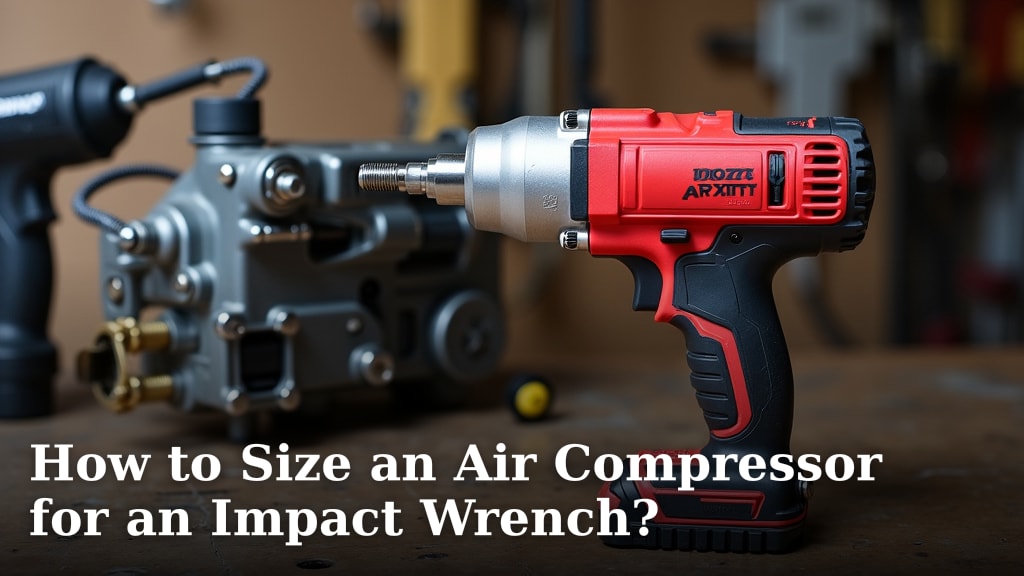
To accurately size an air compressor for an impact wrench, you primarily need to match the wrench’s required CFM (cubic feet per minute) and PSI (pounds per square inch) with the compressor’s output capabilities. The compressor must deliver more CFM than the tool uses to run continuously.
Getting the right air compressor means your impact wrench will work at its best, preventing frustrating power drops. We found that most homeowners often underestimate the CFM needs, leading to tools that lag or stop. You want enough air to keep the job moving smoothly, whether you’re rotating tires or tackling rusty bolts, so understanding these ratings is key.
Match the impact wrench’s CFM and PSI.
Compressor CFM must exceed tool CFM.
Tank size affects continuous run time.
Consider future air tool needs.
Larger jobs need bigger compressors.
Let’s walk through exactly how to calculate these needs and choose the perfect air compressor for your impact wrench, ensuring you have the power you need, right when you need it.
Conclusion
You’ve now got the knowledge to pick the perfect air compressor for your impact wrench. Remember, checking the CFM and PSI requirements of your specific tool is always the first step. Don’t simply guess or assume; a little preparation goes a long way here!
We found that many common issues with air tools come from an undersized compressor. By taking the time to match your compressor’s output to your wrench’s needs, you ensure smooth operations every time. Go ahead, make that confident purchase, and get ready for efficient work.
Frequently Asked Questions
Can I use a small pancake compressor with an impact wrench?
While a small pancake compressor might power an impact wrench for very short, intermittent bursts, it generally won’t provide enough sustained CFM for effective work. You’ll likely experience frequent pauses as the compressor struggles to keep up.
Does a bigger air tank mean more power for my impact wrench?
A bigger air tank doesn’t add more power, but it does allow your impact wrench to run longer before the compressor kicks on again. The power comes from the compressor’s motor and pump, which determine the CFM and PSI output.
What happens if my air compressor’s CFM is too low for my impact wrench?
If your compressor’s CFM is too low, your impact wrench will lack power and may stop working during use. It won’t be able to remove stubborn bolts and will operate inefficiently. This can lead to frustration and wasted time.
Is PSI or CFM more important for an impact wrench?
Both PSI and CFM are crucial, but CFM is often considered more critical for continuous tool operation. PSI determines the force, but CFM ensures a steady supply of air to maintain that force. An impact wrench needs both adequate pressure and volume.
Should I always buy an air compressor with higher CFM than my impact wrench requires?
Yes, it’s a good practice to choose a compressor with a CFM rating slightly higher than your impact wrench’s requirement. This provides a buffer, ensures optimal performance, and leaves room for potential air leaks or future tools.
Top Cool DIY is your trusted guide for practical DIY tools and home improvement solutions, reviewing everything from beginner-friendly power tools and workshop equipment to home repair accessories and outdoor project gear to help DIY enthusiasts, homeowners, and hobbyists tackle projects confidently and efficiently.
A desiccant dryer for an air compressor is a vital piece of equipment designed to remove water vapor from compressed air, delivering exceptionally dry air to your tools and systems….
Refrigeration and air-conditioning compressor heaters are used primarily to prevent liquid refrigerant from accumulating in the compressor’s lubricating oil during idle periods. This protection is crucial for the longevity and…
Yes, you can put two air compressors together to increase your air capacity or pressure for demanding tasks. Connecting air compressors requires careful consideration of tank size, pressure settings, and…
To use a Kobalt Air Compressor, first ensure it is on a stable, level surface and plugged into a proper power source. Then, connect your air hose and desired tool,…
A truck air compressor works by drawing in ambient air, compressing it to a higher pressure, and then storing it in a reservoir tank. This compressed air powers essential systems…
You check PSI on an air compressor using its built-in pressure gauge, located on the tank or regulator. This gauge displays the current pounds per square inch (PSI) of air…