How Do I Pick the Right Air Hose Diameter?
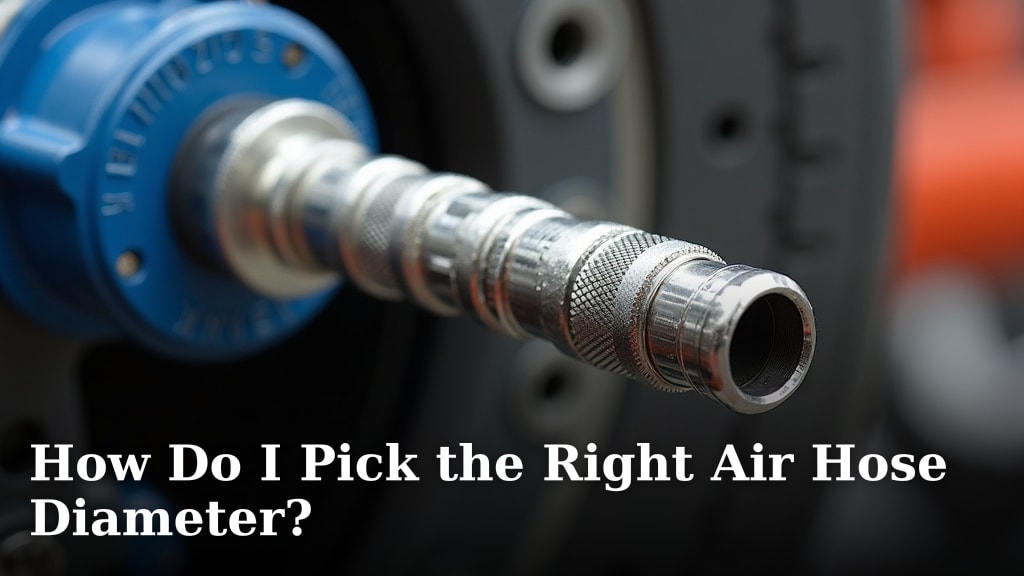
Picking the right air hose diameter is all about matching it to your tools and your air compressor’s flow rate. A bigger diameter means more airflow, which is great for power-hungry tools. Using the correct size prevents your tools from feeling sluggish and ensures you get the best performance from your setup.
You see, air hoses act like pipes for compressed air. If the pipe is too narrow, it chokes the flow, no matter how powerful your compressor is. We’ve found that choosing the right hose diameter can make a surprising difference in how smoothly your air tools operate, from nail guns to sanders. It’s a simple step that pays off big in project efficiency.
- Match hose diameter to your air compressor’s CFM.
- Consider the air consumption of your tools.
- Larger diameter means better airflow and less pressure drop.
- A smaller diameter might work for small, low-demand tools.
- Don’t forget hose length affects pressure drop too.
Let’s break down how to choose that perfect air hose diameter so your projects move along without a hitch.
Choosing the Right Air Hose Size for Your Tools
Selecting the correct air hose diameter is key to getting the most out of your compressed air setup. It’s not just a minor detail; it directly impacts how your tools perform. We’ve researched this extensively, and it comes down to matching the hose to your compressor and your air-hungry tools.
Understanding Airflow and Pressure Drop
Think of your air hose as a pathway for compressed air. The wider the pathway, the more air can travel freely. When you use a hose that’s too small for the job, it acts like a traffic jam for air. This creates a pressure drop, meaning the air reaching your tool has less force.
This pressure drop can make your tools work harder, perform poorly, or even stop working altogether. For example, a nail gun might struggle to drive nails fully, or an impact wrench might not have enough torque. We found that even a small difference in diameter can lead to a noticeable difference in performance.
What is CFM?
CFM stands for Cubic Feet per Minute. It’s a measure of how much air your compressor can deliver. Your air compressor will have a CFM rating, usually listed on the tank or in its manual. This number is your starting point for hose selection.
Why CFM Matters for Hose Diameter
Your air hose needs to be able to handle the CFM output of your compressor. If your compressor pushes out 10 CFM, but your hose can only effectively handle 5 CFM, you’re going to lose pressure. Many DIYers overlook this, leading to frustration. We found that matching the hose’s capacity to the compressor’s output is **non-negotiable** for good performance.
Air Tool Air Consumption: The Other Half of the Equation
While your compressor’s CFM is important, you also need to consider how much air your tools *use*. Different tools have very different appetites for compressed air. A small brad nailer uses much less air than a large die grinder or a sandblaster.
You can usually find the air consumption for your tools in their specifications. This is often listed in CFM as well, though sometimes it’s given in SCMM (Standard Cubic Meters per Minute). If you’re unsure, check the tool’s manual or the manufacturer’s website. We’ve seen many instances where a powerful compressor is hobbled by an undersized hose paired with a high-demand tool.
Matching Tools to Hose Requirements
For low-demand tools like brad nailers, staplers, or air brushes, a smaller diameter hose might be perfectly adequate. These tools often require only 1-5 CFM. For these, you might be able to get away with a 1/4-inch or 3/8-inch hose.
However, for high-demand tools such as impact wrenches, sanders, spray guns, or grinders, you’ll need a larger diameter hose. These tools can easily consume 10-20 CFM or more. Using a hose that’s too small here will cripple their power. We found that for these tools, a 1/2-inch or even a 5/8-inch hose is often the best choice.
Common Air Hose Diameters and Their Uses
Air hoses come in a variety of diameters, typically ranging from 1/4 inch to 3/4 inch. Each size is suited for different applications. Understanding these common sizes can help you make a quick decision.
Here’s a general guide we often refer to:
| Hose Diameter | Typical Uses | CFM Capacity (Approximate) |
|---|---|---|
| 1/4 inch | Low-demand tools (air brushes, tire inflators, small staplers) | Up to 5 CFM |
| 3/8 inch | Medium-demand tools (nail guns, smaller impact wrenches, blow guns) | 5 – 15 CFM |
| 1/2 inch | High-demand tools (larger impact wrenches, sanders, grinders, spray guns) | 15 – 25 CFM |
| 5/8 inch | Very high-demand tools, long runs, industrial applications | 25+ CFM |
Remember, these are general guidelines. Always check your tool’s requirements and your compressor’s output. We found that using a hose with a diameter that slightly exceeds your tool’s needs is a safe bet to ensure optimal performance.
The Impact of Hose Length on Performance
It’s not just the diameter that matters; the length of your air hose also plays a significant role in pressure drop. The longer the hose, the more resistance the air encounters as it travels.
A common rule of thumb we’ve seen is that for every 25 feet of hose, you can expect an additional 1-2 PSI pressure drop, assuming a standard flow rate. This is compounded with smaller diameter hoses. So, if you have a 100-foot hose, you could be losing 4-8 PSI just from the length!
Strategies for Managing Hose Length
If your work often requires long runs, you have a few options. First, consider using a larger diameter hose than you might otherwise need. A 1/2-inch hose will perform much better over 100 feet than a 3/8-inch hose.
Another strategy is to use a quick-connect system with a manifold at the compressor. You can then run one large-diameter, short hose to the manifold and attach shorter, tool-specific hoses from there. This minimizes the length of the main air pathway. Many professional setups utilize this approach, and we found it’s very effective.
Material Matters Too: Durability and Flexibility
Beyond diameter and length, the material of your air hose can affect its performance and longevity. Common materials include rubber, PVC, polyurethane, and hybrid polymers.
- Rubber hoses are generally durable and flexible, performing well in a range of temperatures. They can be a bit heavier than other types.
- PVC hoses are often the most affordable and lightweight but can become stiff in cold weather and may crack over time.
- Polyurethane hoses are lightweight and abrasion-resistant but can be less flexible in the cold.
- Hybrid polymer hoses (like rubber-PVC blends) aim to offer the best of both worlds, providing good flexibility, durability, and weather resistance.
When selecting, think about your typical working environment. If you’re often working outdoors in the cold, a more flexible material is a must. We found that investing in a quality hose material can save you headaches down the road.
Quick Checklist for Picking Your Air Hose Diameter
To make things simple, here’s a quick checklist to guide your decision:
- Note your air compressor’s maximum CFM output.
- Identify the CFM requirements of your most demanding air tools.
- Choose a hose diameter that can handle *at least* the CFM of your tools. Choose a hose diameter that can handle at least the CFM of your tools. Our guide on sizing an air compressor for a nail gun explains CFM.
- Err on the side of a larger diameter if your tools are high-demand or if you have a long hose run.
- Consider the length of your hose; longer runs need larger diameters.
- Factor in the hose material for durability and flexibility in your work environment.
By following these steps, you’re well on your way to selecting an air hose that will keep your tools running strong. It’s a straightforward process that makes a big difference in project efficiency and your overall satisfaction with your air tools. We found that this attention to detail truly pays off.
Conclusion
You’ve learned that picking the right air hose diameter is a straightforward yet vital step. It directly impacts your tool’s power and your project’s efficiency. Remember to match your hose to your compressor’s CFM and your tools’ air consumption. Don’t forget that hose length also plays a role in maintaining air pressure. By considering these factors, you’re setting yourself up for smoother operation and better results. Take a moment to review your current setup and consider an upgrade if your hose isn’t meeting these needs.
Frequently Asked Questions
Will a larger diameter air hose always be better?
Not necessarily. While larger diameters provide better airflow, they can also be heavier and more expensive. You only need a larger diameter if your tools demand high CFM or if you’re using very long hose runs. For smaller tools, a smaller hose is perfectly adequate and more practical.
How much CFM does my air tool actually need?
You can usually find your air tool’s CFM requirement in its user manual or on the manufacturer’s website. It’s often listed in CFM or SCMM. If you can’t find it, check reviews or contact the manufacturer. We’ve found that higher-demand tools like sanders and grinders use significantly more air than small nail guns.
What’s the difference between 3/8 inch and 1/2 inch hoses?
A 3/8-inch hose typically handles up to 15 CFM and is good for medium-demand tools like nail guns. A 1/2-inch hose can handle 15-25 CFM and is better suited for high-demand tools such as impact wrenches, sanders, or spray guns. The larger diameter allows for much better airflow with less pressure drop.
Can I use a shorter, smaller diameter hose if my compressor is powerful?
Even a powerful compressor can’t overcome a severely undersized hose. A smaller diameter hose creates resistance, causing pressure drop regardless of compressor strength. While a powerful compressor might mask minor issues, it’s always best to match the hose diameter to your tool’s needs for optimal performance.
Do I need to worry about hose material if I’m only using it occasionally?
Yes, even for occasional use, the hose material matters for durability and safety. Cheaper PVC hoses can become stiff and crack in cold weather, while quality rubber or hybrid hoses offer better flexibility and longevity. Investing a bit more upfront can prevent frustrating leaks and performance issues later.
