
How Many Watts Does an Air Compressor Use?
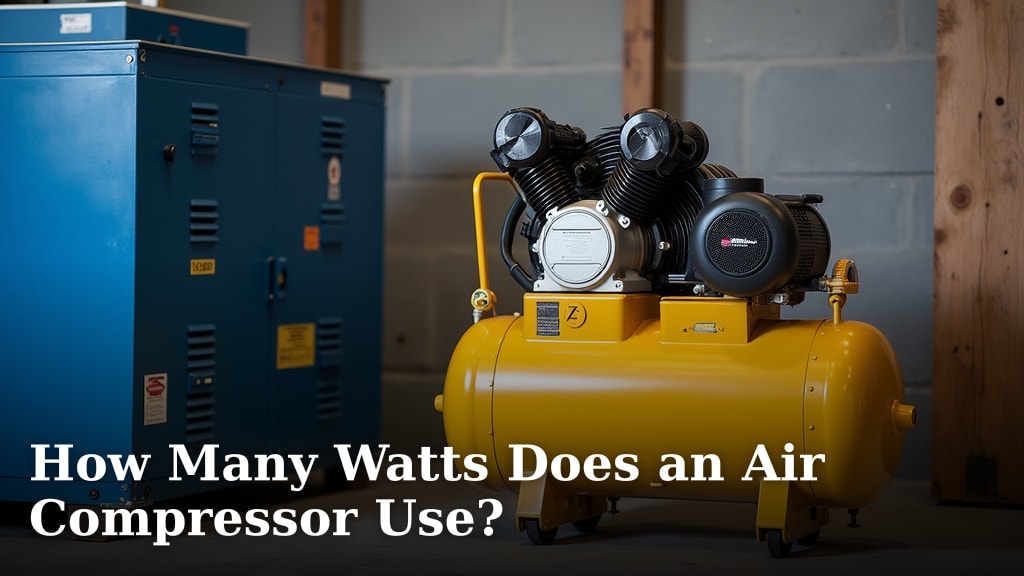
Air compressors use anywhere from 1500 to 7500 watts of electricity, depending on their size and motor. A small pancake compressor might draw around 1500 watts, while a large industrial unit could easily exceed 5000 watts. This power usage is important for understanding your energy bill.
Understanding how many watts your air compressor uses helps you plan for its electrical needs. It also helps you budget for your electricity costs. We found that the wattage can vary greatly, even among similar models, based on factors like motor horsepower and tank size.
- Most air compressors use between 1500 and 7500 watts.
- Smaller compressors are closer to 1500 watts.
- Larger industrial compressors can use over 5000 watts.
- Wattage impacts your electricity bill.
- Motor size and tank capacity influence power draw.
Let’s walk through everything you need to know about air compressor wattage and how it impacts your tools and wallet.
Understanding Your Air Compressor’s Power Consumption
So, you’re curious about how much juice your air compressor really sips, right? It’s a smart question, especially with today’s electricity costs. We found that understanding its power consumption isn’t just about numbers; it’s about making smart choices for your workshop or job site.
Air compressors don’t just magically make compressed air. They use an electric motor that converts electrical energy into mechanical energy. This mechanical energy then powers the compressor pump, which pressurizes the air. It’s a pretty straightforward process, but it demands a good chunk of electricity.
Key Factors Influencing Air Compressor Wattage
Why do some compressors use a lot more power than others? We’ve identified a few key factors. Think of it like cars: a compact car uses less fuel than a heavy-duty truck. Air compressors are similar in their electrical demands.
The size and type of your air compressor play the biggest role. But even within similar sizes, there are differences. Let’s break down what truly drives up that wattage.
Horsepower (HP) of the Motor
The motor’s horsepower is arguably the most significant factor. More horsepower means more power to do work, which translates directly to higher wattage consumption. A 1 HP motor will draw significantly less power than a 5 HP motor, that’s just physics.
We often see smaller, portable compressors with 1-2 HP motors. Larger, stationary units for commercial use might boast 5 HP or even more. The jump in wattage between these can be quite substantial.
Tank Size and Pressure Requirements
While the tank itself doesn’t use electricity, it impacts how long the compressor runs. A bigger tank means the compressor runs for longer to fill it up to your desired PSI (pounds per square inch). More run time equals more electricity used.
Also, if you need higher pressure for your tools, the compressor has to work harder. Pushing air to 150 PSI requires more energy than pushing it to 90 PSI. This increased effort means the motor draws more watts. When considering tasks that involve pushing air to 150 PSI, it’s helpful to know if a 150 PSI air compressor is good for your needs.
Duty Cycle of the Compressor
The “duty cycle” refers to how often your compressor runs. If you’re constantly draining the tank with heavy-use tools, the compressor will kick on frequently. More frequent running means more total electricity consumed over time.
For intermittent tasks, your compressor might only run for a few minutes an hour. For continuous blasting or painting, it could be running almost non-stop. This continuous operation will naturally lead to higher wattage use over the duration of your project.
Typical Wattage Ranges for Different Compressor Types
Let’s get into some specific numbers. We’ve researched and found typical ranges for common air compressor types. Keep in mind these are averages; your specific model might vary a bit.
| Compressor Type | Typical Horsepower (HP) | Approximate Wattage Range | Common Uses |
|---|---|---|---|
| Pancake / Hot Dog (Small Portable) | 0.5 – 1.5 HP | 1000 – 2000 Watts | Nail guns, inflating tires, small spray painting |
| Twin Stack / Wheelbarrow (Medium Portable) | 1.5 – 2.5 HP | 1800 – 3000 Watts | Framing, roofing, automotive work |
| Vertical / Stationary (Garage/Shop) | 2.0 – 5.0 HP | 2500 – 5000 Watts | Impact wrenches, sanders, continuous use tools |
| Industrial / Commercial | 5.0+ HP | 5000 – 10000+ Watts | Heavy manufacturing, large-scale painting, industrial processes |
As you can see, there’s a wide spectrum. A small pancake compressor for occasional home use is a very different beast from a large industrial unit running a busy production line.
Calculating Your Compressor’s Actual Wattage
How can you find out the exact wattage for your specific unit? We found a few ways to figure this out, even if it’s not explicitly stated on the label.
Knowing the actual wattage helps you size your circuits properly and gives you a more accurate picture of your energy consumption. You don’t want to trip a breaker in the middle of a big project!
Checking the Manufacturer’s Specifications
The easiest way is to look at your compressor’s nameplate or user manual. Manufacturers are required to list electrical specifications. You’ll often find the wattage (W) or kilowatts (kW) directly.
If you only see amps (A) and volts (V), don’t worry! You can easily calculate the wattage. For resistive loads, it’s pretty straightforward: Watts = Amps x Volts. Many air compressors are inductive loads, so you might need to factor in a “power factor,” usually around 0.8. So, a more accurate formula is Watts = Amps x Volts x Power Factor (e.g., 0.8).
Using an Energy Monitor (Kill-A-Watt Meter)
For the most accurate real-world measurement, we recommend an energy monitor. These devices plug into your outlet, and then your compressor plugs into the monitor. They can show you live wattage, voltage, amperage, and even calculate total energy consumed over time.
This is great for understanding not just the peak wattage, but also the average wattage during operation. It’s a fantastic tool for any energy-conscious homeowner or shop owner.
Impact of Wattage on Your Electricity Bill
This is where the rubber meets the road, right? Higher wattage means higher electricity bills. But how much higher? Let’s consider an example. We want you to be able to estimate your costs.
Understanding the link between watts and dollars empowers you to make smarter choices. Maybe an older, less efficient compressor is costing you more than you think.
Converting Watts to Kilowatt-Hours (kWh)
Your electricity bill is based on kilowatt-hours (kWh). One kilowatt-hour means using 1000 watts for one hour. So, if your compressor uses 2000 watts, it uses 2 kWh every hour it runs.
To calculate: (Compressor Wattage / 1000) x Hours of Use = Total kWh. For instance, a 2000-watt compressor running for 5 hours uses (2000/1000) x 5 = 10 kWh.
Estimating Your Monthly Compressor Cost
Once you have the total kWh, multiply that by your local electricity rate. You can find this rate on your electricity bill; it’s usually listed in cents per kWh.
If your rate is, say, $0.15 per kWh, and your compressor uses 10 kWh in a month, that’s 10 kWh * $0.15/kWh = $1.50. This might seem small, but for heavy users, it adds up significantly. Imagine an industrial compressor using 5000 watts for 8 hours a day, 20 days a month. That’s a much larger number!
Optimizing Air Compressor Energy Usage
Now that you know how much power your compressor uses, how can you reduce that number? We found several strategies that can help you save energy and money. Even small changes can make a difference.
It’s not just about buying a new compressor. Sometimes, simple maintenance and operational adjustments can yield surprising results.
- Check for Leaks Regularly: Even small air leaks force your compressor to run more often. We recommend checking hoses, fittings, and connections.
- Right-Size Your Compressor: Using a compressor that’s too small means it runs constantly. One that’s too big might be inefficient for your tasks. Match your compressor to your actual needs.
- Maintain Your Compressor: Clean air filters, proper lubrication, and healthy belts improve efficiency. A well-maintained machine doesn’t have to work as hard.
- Use Efficient Air Tools: Some air tools are simply more efficient with compressed air. Upgrading old tools can reduce demand on your compressor.
- Lower Pressure if Possible: If your tools don’t need maximum pressure, lower the output PSI. Your compressor won’t have to work as hard to reach that level.
- Turn it Off When Not in Use: It sounds obvious, but many people leave their compressors on stand-by, where they might still cycle to maintain pressure.
By implementing these tips, you can often significantly reduce your air compressor’s energy footprint. This means more money in your pocket and a longer lifespan for your equipment.
Conclusion
Understanding your air compressor’s wattage is essential for both your budget and your projects. We’ve shown you that power consumption varies widely based on factors like motor horsepower and tank size. By knowing these details, you can predict electricity costs and avoid tripped breakers. Remember, even small changes in usage or maintenance can lead to big savings.
Take the time to evaluate your compressor’s specifications and consider implementing our energy-saving tips. This proactive approach will help you optimize your equipment and keep more money in your pocket.
Frequently Asked Questions
Does a higher PSI setting mean my air compressor uses more watts?
Yes, generally it does. The compressor motor has to work harder and longer to achieve and maintain higher pressure settings. This increased effort directly translates to a higher wattage draw during operation.
Can the age of my air compressor affect its wattage usage?
Absolutely. Older air compressors may become less efficient over time due to worn components, internal leaks, or a less efficient motor. This can cause them to run longer or work harder to maintain pressure, increasing their overall wattage consumption.
What’s the difference between starting watts and running watts for an air compressor?
Starting watts, also known as surge watts, are the higher amount of power an air compressor temporarily draws when its motor first kicks on. Running watts are the continuous, lower power draw once the motor is operating steadily. Starting watts can be 2-3 times higher than running watts.
Will using a longer air hose impact my compressor’s wattage?
A longer or narrower air hose can introduce more friction and pressure drop, making your compressor work harder to deliver air to your tools. This increased effort can cause the compressor to run more frequently or for longer durations, thus increasing its total wattage usage over time.
Is a 240V air compressor more energy-efficient than a 120V one?
Not necessarily in terms of raw energy consumption, but 240V compressors often deliver more power with less amperage, leading to more stable performance for larger units. For the same horsepower, a 240V motor might run cooler and more efficiently, but the total wattage (energy used) for the work done is comparable.
