
How Much Electricity Does an Air Compressor Use?
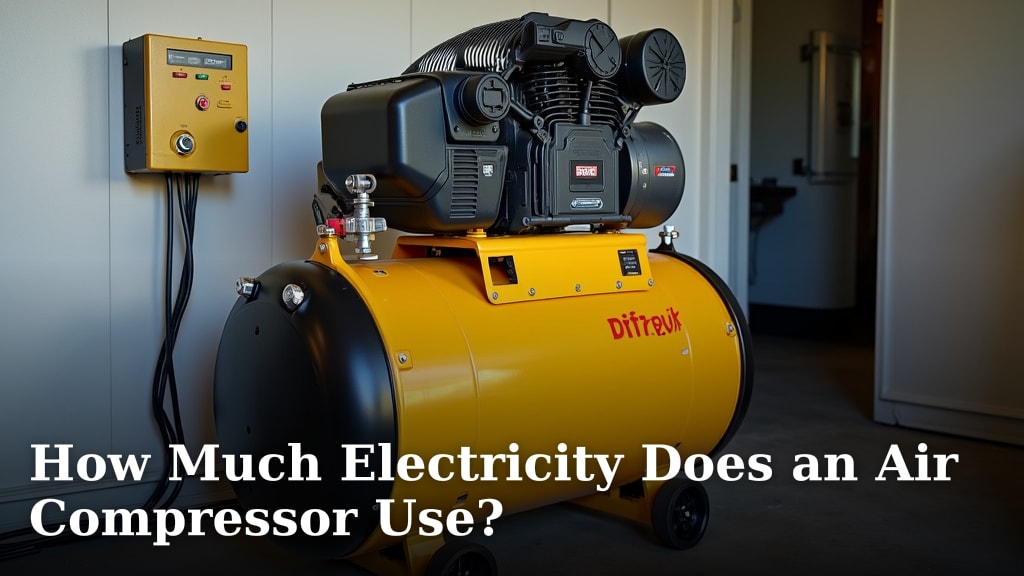
The amount of electricity an air compressor uses varies widely. It depends on the compressor’s size and how often you use it. We found that a small pancake compressor might use only a few hundred watts. A large industrial unit can draw many thousands of watts.
You’re likely wondering about your electricity bill, right? Understanding your air compressor’s energy use helps you plan your projects better. It also helps you save money. We’ll show you how different factors influence power consumption. You’ll soon be able to estimate your costs.
- Air compressor size greatly impacts power use.
- Usage frequency affects your electricity bill.
- Motor horsepower is a key factor in energy draw.
- Volts and Amps determine power consumption.
- Duty cycle influences total energy expended.
Let’s walk through everything you need to know about how much electricity an air compressor uses. We’ll help you make sense of it all.
Understanding Your Air Compressor’s Electrical Consumption
You’re trying to figure out how much electricity your air compressor uses, right? It’s a smart question, especially with today’s energy costs. The simple answer is: it depends on several key factors. We’ll break down these factors so you can better predict your electricity usage and potential costs.
What Makes Air Compressors Use So Much Power?
Air compressors don’t just magically create compressed air. They use a motor, and motors need electricity. Think of it like this: the harder the motor works, the more power it pulls from your electrical outlet. Compressing air takes a lot of energy, especially when you need high pressure or a lot of air volume.
We found that the main reasons for high power consumption come down to the motor’s size and how long it runs. A small, portable unit might sip power, while a large industrial compressor can gulp it down. It’s all about the work being done.
Key Factors Influencing Electrical Draw
Several elements come together to determine how much electricity your air compressor consumes. Understanding these will give you a clearer picture of your energy footprint. It’s not just about turning it on; it’s about what happens while it’s running.
Motor Horsepower (HP)
Horsepower is often the first thing people look at. It’s a good indicator of how much work the motor can do. Higher horsepower generally means higher electricity use. A 1 HP motor will use less power than a 5 HP motor, assuming they run for the same amount of time.
We found that residential and small workshop compressors typically range from 1 HP to 5 HP. Industrial units can easily go into double digits. More power means more air, but it also means more electricity required.
Volts and Amps: The Electrical Foundation
Electricity is measured in volts (V) and amps (A). These two values help us calculate watts (W), which is the actual power consumption. You’ll often see these listed on your compressor’s specifications. Volts tell you the pressure of the electricity, and amps tell you the flow.
For most compressors, you’ll find they operate on 120V or 240V. Larger compressors almost always require 240V. To get the approximate wattage, you can multiply volts by amps. For example, a 120V compressor drawing 15 amps uses about 1800 watts (120V x 15A = 1800W).
Duty Cycle: How Long It Actually Runs
Your air compressor doesn’t run all the time, does it? It kicks on, fills the tank, and then shuts off. This on-and-off pattern is its duty cycle. The duty cycle is the percentage of time the compressor motor is actually running during a given period.
A compressor used for occasional tire inflation will have a very low duty cycle. A unit powering a busy auto shop’s air tools will have a much higher one. The longer the motor runs, the more electricity it consumes. It’s pretty straightforward when you think about it.
Tank Size: A Hidden Factor
While the tank itself doesn’t use electricity, its size influences how often the compressor motor needs to run. A larger tank holds more compressed air. This means the motor won’t need to kick on as frequently to maintain pressure. A bigger tank can lead to fewer motor cycles.
On the flip side, a larger tank takes longer to fill initially. So, the motor will run for a longer continuous period during that first fill. Over time, for intermittent use, a larger tank can actually lead to slightly lower overall energy use because of fewer start-stop cycles.
Calculating Your Air Compressor’s Energy Costs
Ready to crunch some numbers? We’ll show you how to estimate your costs. It’s not as scary as it sounds. You just need a few pieces of information.
Step-by-Step Energy Cost Estimation
Here’s a simple way to get a rough idea of what your air compressor might be costing you. You’ll need to look at your compressor’s label and your electricity bill.
- Find the Amps and Volts: Look for a sticker on your compressor. It should state something like “120V, 15A” or “240V, 20A.”
- Calculate Watts: Multiply Volts x Amps = Watts. For example, 120V x 15A = 1800 Watts.
- Convert to Kilowatts (kW): Divide Watts by 1000. So, 1800 Watts / 1000 = 1.8 kW.
- Estimate Run Time: How many hours per day or week do you actually hear the motor running? Be realistic. Let’s say 2 hours per day.
- Calculate Kilowatt-hours (kWh) per day: kW x Hours run = kWh. So, 1.8 kW x 2 hours = 3.6 kWh per day.
- Find Your Electricity Rate: Look at your electricity bill for the “per kWh” charge. It might be around $0.15 to $0.25, depending on where you live.
- Calculate Daily Cost: kWh per day x Rate per kWh. So, 3.6 kWh x $0.20 = $0.72 per day.
- Calculate Monthly Cost: Daily Cost x 30 days. So, $0.72 x 30 = $21.60 per month.
Remember, this is an estimate. Your actual usage might vary. But it gives you a solid starting point for understanding your costs. It can be surprising how those daily cents add up over a month.
Comparing Air Compressor Types and Their Power Needs
Not all air compressors are created equal when it comes to power consumption. Different designs have different efficiencies and typical usage patterns. We found some general trends.
Small pancake compressors, often 1 HP or less, are usually quite efficient for light tasks. They cycle frequently but for short bursts. On the other hand, larger twin-stack or vertical tank compressors, typically 2-5 HP, can handle more demanding work. They’ll draw more power when running, but their larger tanks might mean less frequent cycling for certain tasks.
Here’s a simplified look at how power consumption might differ by compressor type:
| Compressor Type | Typical HP Range | Approximate Running Watts (Estimated) | Common Usage |
|---|---|---|---|
| Small Pancake/Hot Dog | 0.5 – 1.5 HP | 800 – 1800 Watts | Nail guns, tire inflation, airbrushing |
| Portable/Twin-Stack | 1.5 – 3 HP | 1800 – 3600 Watts | Framing nailers, impact wrenches, general workshop |
| Vertical Tank/Stationary | 3 – 7.5 HP | 3600 – 9000 Watts | Heavy-duty air tools, sandblasting, small auto shops |
| Industrial (Screw/Piston) | 7.5 HP and up | 9000 Watts+ | Manufacturing, large auto shops, continuous use |
Keep in mind these are just averages. Actual wattage can vary based on motor efficiency, pump design, and how much pressure it’s trying to maintain. Always check your specific unit’s rating.
Tips for Reducing Your Air Compressor’s Electricity Use
Now that you know how much power your compressor might be using, you’re probably thinking, “How can I cut those costs?” Good question! There are definitely ways to be more energy-efficient.
- Fix Leaks Immediately: Even small air leaks can make your compressor run more often. Check hoses, fittings, and connections regularly. We found that a single small leak can cost you significant energy over time (Department of Energy).
- Use the Right PSI: Don’t set your compressor to a higher pressure than you need for the task. Every extra PSI requires more energy.
- Regular Maintenance: Keep your compressor in good shape. Clean air filters and proper lubrication ensure the motor runs efficiently.
- Size It Correctly: For continuous work, make sure your compressor’s CFM (cubic feet per minute) output matches your tool’s needs. An undersized compressor will run constantly, wasting energy.
- Consider a Larger Tank: For intermittent use, a larger tank means fewer motor start-ups, which can be less energy-intensive than many short cycles.
- Turn It Off: When you’re done for the day or know you won’t use it for a while, turn the compressor off. It won’t keep cycling to maintain pressure in an empty workshop.
By following these tips, you can often make a noticeable difference in your electricity bill. Every little bit helps, right?
Conclusion
Understanding your air compressor’s electricity use is more than just a technical exercise. It helps you manage your budget better. We walked through how horsepower, volts, amps, and even tank size play a role. You now know how to estimate your costs. We also shared practical tips to reduce energy consumption.
By applying these insights, you can make smarter choices. You can save money and extend the life of your equipment. Start by fixing those leaks and using the right PSI. Your wallet will thank you.
Frequently Asked Questions
Does a higher PSI setting use more electricity?
Yes, absolutely. To reach and maintain a higher Pounds per Square Inch (PSI), your compressor’s motor must work harder. This extra effort translates directly into greater electricity consumption. Try to use only the PSI necessary for your task.
Is it better to have a larger or smaller air compressor tank for energy efficiency?
For intermittent use, a larger tank can be more efficient. It stores more air, meaning the motor cycles less often. However, a larger tank takes longer to fill initially, running the motor continuously for that period. Consider your typical usage patterns.
How accurate are the wattage ratings on an air compressor?
The wattage ratings on your compressor’s label are generally accurate for its peak operating load. However, actual consumption can vary. Factors like motor efficiency, ambient temperature, and system leaks can influence real-world numbers. Our calculation method provides a strong estimate.
Can old air compressors be less energy-efficient than new ones?
Yes, older air compressors can indeed be less efficient. Over time, components wear out, leading to air leaks, decreased motor efficiency, and reduced performance. Regular maintenance helps, but sometimes an upgrade is the most energy-saving solution.
Does the type of air tool I use affect how much electricity my compressor uses?
Indirectly, yes. Different air tools require varying amounts of Cubic Feet per Minute (CFM). If your tool demands a high CFM, your compressor will have to run more frequently or for longer periods. This increases its overall electricity usage. Match your compressor’s output to your tools.
