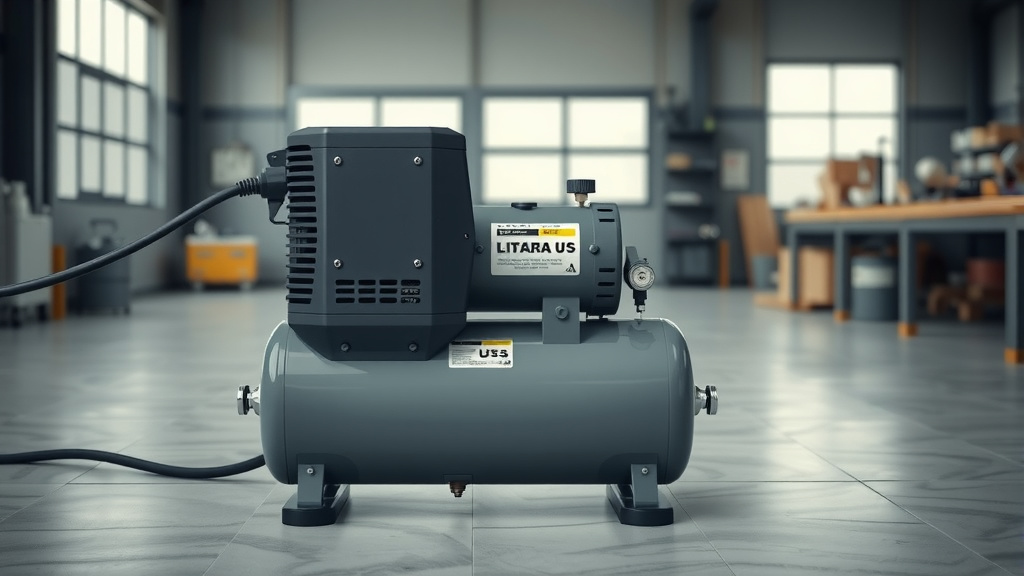
How Many Amps Does a 5.5 HP Air Compressor Draw?
A 5.5 HP air compressor often draws about 23 amps at 230 volts while running. The exact current depends on voltage, phase, motor efficiency, power factor, and the compressor's nameplate.
On this page (9 sections)
- How many amps does a 5.5 HP air compressor draw?
- Why does voltage change the current draw?
- How much starting current does a 5.5 HP compressor need?
- How should you size the electrical circuit?
- Can a 12-volt compressor replace a 5.5 HP shop compressor?
- Is an air compressor motor the same as an A/C compressor?
- What should you check on the motor nameplate?
- How can you reduce startup problems?
- What is the final answer for a 5.5 HP compressor?
A 5.5 HP air compressor often draws about 23 amps at 230 volts while running, but the exact current depends on the motor, voltage, phase, efficiency, and power factor. Starting current can be several times higher, so the nameplate matters more than the horsepower label.
Horsepower is a motor output rating, not a direct amp rating. A compressor labeled 5.5 HP may also use different motor designs, and some advertised horsepower labels do not match the motor's continuous output.
How many amps does a 5.5 HP air compressor draw?
A 5.5 HP motor produces about 4,100 watts of mechanical output before accounting for electrical losses. At 230 volts, a basic watts-to-amps estimate is about 18 amps, but a real motor needs more current after efficiency and power factor are included.
For planning, a 230-volt single-phase compressor may draw roughly 22 to 28 amps while running. A comparable 115-volt model could need about 45 to 55 amps, while a 230-volt three-phase motor may draw less current than a single-phase motor.
These are estimates, not circuit instructions. The motor nameplate should show full-load amps, voltage, phase, and sometimes service-factor information.
For a broader comparison, see How Many Amps Does Air Compressor Draw?. That guide explains why the same horsepower can produce different current readings.
Why does voltage change the current draw?
Higher voltage usually means lower current for the same motor power. A motor running at 230 volts can deliver the needed power with about half the current of a similar motor operating at 115 volts.
This is why larger stationary compressors commonly use 230-volt service. Lower current can reduce voltage drop and make it easier to use appropriately sized conductors, disconnects, and motor protection.
The motor must be connected to the voltage shown on its nameplate. Never assume that a 5.5 HP compressor can use either 115 volts or 230 volts simply because both voltages are common in workshops.
What is the basic current formula?
For a single-phase motor, a rough estimate uses:
Current = watts ÷ volts
A more realistic estimate accounts for efficiency and power factor:
Current = watts ÷ (volts × efficiency × power factor)
For a three-phase motor, the calculation also includes the square root of 3. This is useful for understanding the result, but it doesn't replace the motor nameplate or electrical code.
If you want to compare energy demand from smaller machines, read How Many Watts Does A 1 HP Air Compressor Use? and How Many Watts Does A 2 HP Air Compressor Use?.
How much starting current does a 5.5 HP compressor need?
A 5.5 HP compressor can draw several times its running current during startup. The motor needs extra current to overcome inertia, compressive load, and the pressure that may remain in the pump or discharge line.
A 230-volt motor that runs near 23 amps might briefly demand much more when it starts. The exact inrush depends on motor construction, tank pressure, unloader operation, temperature, wiring, and whether the motor starts across the line or through a reduced-current starter.
A weak circuit may show a voltage drop, dim lights, nuisance breaker trips, slow motor acceleration, or a humming motor. Repeated hard starts can create excess heat and shorten motor life.
For a smaller comparison, see 1hp 220v compressor initial current draw. The same startup principle applies, but the actual current changes with the motor and compressor design.
How should you size the electrical circuit?
Size the circuit from the compressor's nameplate and installation instructions, not from 5.5 HP alone. Confirm the rated voltage, phase, full-load amps, conductor requirements, disconnect instructions, and overcurrent protection before installation.
A compressor may need a dedicated circuit because its motor can create a large startup load. Sharing the circuit with heaters, welders, dust collectors, or other high-draw tools can increase voltage drop and nuisance trips.
Use the correct wire size for the circuit length and local code. A long run can need larger conductors than a short run, especially when startup voltage drop is a concern.
Don't solve repeated tripping by installing a larger breaker without checking the conductors and motor requirements. The breaker, wire, disconnect, overload protection, and motor must work together.
Does a smaller compressor avoid these electrical demands?
A smaller compressor generally needs less current, but its airflow and duty limits may also be lower. The DEWALT D55154 has a 1.1 HP continuous motor, a 4-gallon tank, 4 CFM at 90 PSI, and a 125 PSI maximum.
Its wheeled dolly-style design weighs 44 lb and measures 24 x 19.75 x 22.6 inches. The electric unit includes a 0.5-inch compatible hose diameter, dual universal quick couplers, and a 65 dB noise rating.
Choose a smaller compressor only after checking the airflow required by your tool. A nailer may work well with modest airflow, while continuous spray work or high-demand impact tools can require more recovery than a small tank and motor can provide.
Can a 12-volt compressor replace a 5.5 HP shop compressor?
A 12-volt tire compressor is not a replacement for a 5.5 HP shop compressor. For other sources, read how to get compressed air.
It is designed for portable inflation, while a shop compressor is intended to supply compressed air to tools and equipment.
The VIAIR 400P/40043 uses 12 volts, draws up to 30 amps, and has a maximum power rating of 414 watts. It delivers 2.3 CFM, reaches 150 PSI, and has a 33% duty cycle at 100 PSI.
The unit includes a 25 ft 5-in-1 inflator and deflator hose, an inline 100 PSI gauge, an 8 ft power cord, a carry bag, 3 inflation tips, a Presta valve adapter, and a press-on tire chuck. Its maximum recommended tire size is 35 inches.
Use the vehicle's battery clamps and start the engine as instructed. For a fixed setup, see how to hardwire a 12V compressor.
Its 30-amp maximum current is a useful reminder that low-voltage equipment can still draw substantial current, even when its wattage is much lower than a shop compressor.
Is an air compressor motor the same as an A/C compressor?
No. An air compressor motor drives a pump that compresses air, while an automotive A/C compressor circulates refrigerant.
Their electrical, mechanical, and mounting requirements are different.
The Dorman 34152 A/C Compressor Bypass Pulley is an automotive repair part, not a shop air compressor or an electrical replacement motor. It lets the original equipment drive belt continue operating when an inoperable vehicle A/C compressor is bypassed.
The part includes a pulley and bracket, uses screw mounting, and fits select Chevrolet, GMC, and Oldsmobile models. Confirm the exact vehicle make, model, and trim before considering it.
This product belongs in a vehicle repair situation, not in a 5.5 HP air compressor installation. Keeping those systems separate prevents a common mistake when searching for compressor parts.
What should you check on the motor nameplate?
Check these details before connecting power:
- Rated voltage, such as 115 or 230 volts.
- Single-phase or three-phase operation.
- Full-load amps.
- Motor frequency.
- Service-factor information.
- Wiring diagram and terminal arrangement.
- Required overload and disconnect protection.
The nameplate may show more than one amp value when the motor supports multiple voltages. Use the value that matches the actual supply voltage and connection.
If the compressor has a separate starter, pressure switch, or thermal overload, check those components too. A motor can have the correct running current and still fail to start if the control equipment is mismatched.
For a much larger motor comparison, read How Many Amps Does a 20 HP Air Compressor Motor Draw?. Larger systems make the difference between voltage, phase, and starting current even more important.
How can you reduce startup problems?
Reduce startup problems by using the correct voltage, keeping the circuit run short when possible, and confirming that the unloader releases pressure when the motor stops. The compressor should start without fighting a pressurized pump.
Keep electrical connections tight and protected from moisture. Inspect the cord, disconnect, pressure switch, and motor terminals for heat damage or loose connections.
Don't use an undersized extension cord for a high-current compressor. If a temporary connection is unavoidable, follow the compressor instructions and have an electrician confirm that the cord and circuit can handle the load.
Stop using the unit if the breaker trips repeatedly, the motor hums without turning, or wiring becomes hot. Those symptoms need diagnosis before another start.
What is the final answer for a 5.5 HP compressor?
A 5.5 HP air compressor commonly draws about 22 to 28 amps at 230 volts while running, with a rough midpoint near 23 amps. At 115 volts, the current may be around 45 to 55 amps, and startup demand can be several times higher.
Use the nameplate full-load amps and installation instructions for the exact machine. Choose the DEWALT if a smaller electric compressor meets your airflow needs, the VIAIR for portable tire inflation, and the Dorman part only for its specific automotive A/C bypass use.
Frequently asked questions
How many amps does a 5.5 HP air compressor draw at 230 volts?
A 5.5 HP compressor may draw about 23 amps at 230 volts while running, but that is only a planning estimate. Motor efficiency, power factor, phase, service voltage, and the nameplate full-load amperage can move the actual number higher or lower.
How many amps does a 5.5 HP air compressor draw at 115 volts?
At 115 volts, a 5.5 HP compressor would need roughly twice the current of a similar motor at 230 volts. A rough estimate may be around 45 to 50 running amps, but many compressors of this size are not designed for ordinary 115-volt circuits.
Does a 5.5 HP air compressor need more amps when starting?
Yes. A motor can draw several times its running current during startup, especially while the tank is pressurized or the motor starts under load.
Use the compressor nameplate, manufacturer instructions, and a properly sized circuit rather than sizing from running amps alone.
What breaker size does a 5.5 HP air compressor need?
There is no single breaker size for every 5.5 HP compressor. The correct circuit depends on the motor nameplate, voltage, phase, conductor size, disconnect rules, starting method, and local electrical code.
Have a qualified electrician size the circuit for the exact model.