Can You Use an Air Compressor for a Die Grinder?
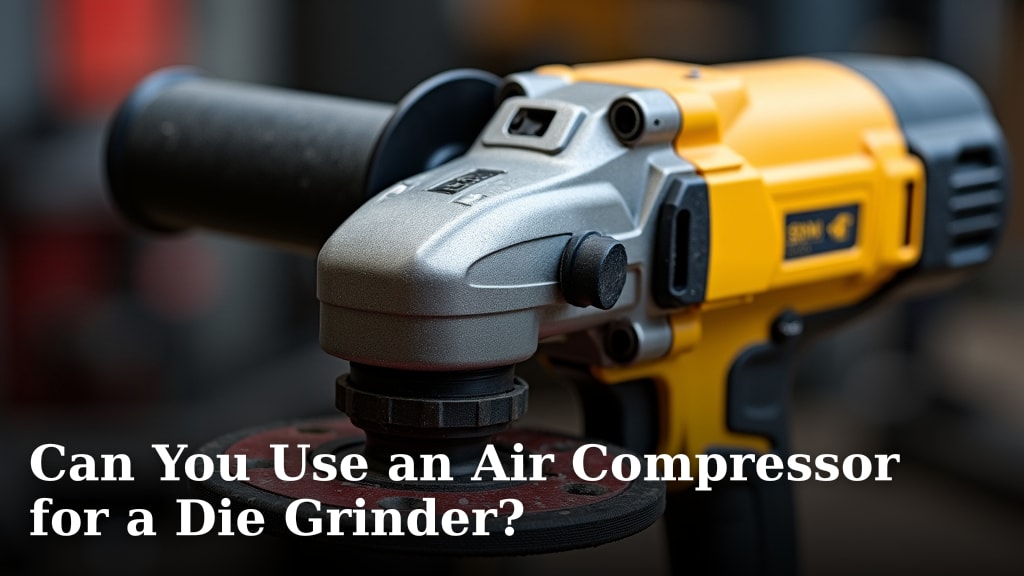
Yes, you can definitely use an air compressor for a die grinder. In fact, an air compressor is the most common power source for these handy tools. You’ll need to make sure your compressor can provide the right amount of air for your specific die grinder to work its best.
Many DIYers and mechanics wonder if their existing compressor is up to the task. We found that using an air compressor is essential for getting the full power and performance out of a die grinder. Without enough air, your die grinder might just sputter along.
- Die grinders absolutely need an air compressor to run.
- Check your die grinder’s CFM and PSI requirements.
- Ensure your air compressor meets or exceeds those needs.
- A proper setup means better results and less frustration.
Below, we’ll walk you through what you need to know to connect your air compressor to a die grinder, and how to pick the right compressor if you don’t have one yet. Below, we’ll walk you through how to pick the right compressor if you don’t have one yet.
Powering Your Die Grinder: The Air Compressor Connection
Can you use an air compressor for a die grinder? Absolutely! Your air compressor is the heartbeat of your die grinder. Without it, that high-speed rotary tool is just a pretty paperweight. We found that pairing the right compressor with your die grinder makes all the difference in performance.
Think of it like a coffee maker. You need electricity to power it, right? A die grinder needs compressed air. Your air compressor is that power source, ready to deliver the air when you pull the trigger. It’s not just about getting it to spin; it’s about getting it to spin effectively.
Understanding Your Die Grinder’s Air Needs
Before you connect anything, you need to know what your die grinder is asking for. This isn’t a one-size-fits-all situation. Different die grinders have different appetites for air. You’ll typically find this information right on the tool itself or in its manual.
CFM: The Volume of Air
The first key spec is CFM, which stands for Cubic Feet per Minute. This tells you how much air your die grinder needs to run at its best. It’s essentially the volume of air the tool consumes.
For die grinders, CFM requirements can vary. Smaller, lighter-duty grinders might need as little as 3 CFM. More powerful, heavy-duty models can easily ask for 10 CFM or even more. If your compressor doesn’t deliver enough CFM, your grinder will feel sluggish. It might struggle to maintain its speed, especially under load. We found that a shortage in CFM is a common reason for die grinder disappointment.
PSI: The Force Behind the Air
Next up is PSI, which means Pounds per Square Inch. This refers to the pressure of the air. Most die grinders operate within a specific PSI range, usually between 90 and 100 PSI. Many standard compressors can easily provide this pressure.
It’s important to match the PSI. Too little pressure, and the grinder won’t have enough oomph. Too much, and you risk damaging the tool’s internal components. Thankfully, most compressors have regulators that let you dial in the exact PSI you need. This makes managing air pressure quite simple, research suggests.
Matching Your Air Compressor to Your Die Grinder
Now, let’s talk about your air compressor. The goal is to ensure your compressor can meet or exceed your die grinder’s demands. You don’t want your compressor to be the bottleneck.
Checking Your Compressor’s Specifications
Your air compressor will also have its own CFM and PSI ratings. These are usually found on a label on the tank or motor. The most important number here is the compressor’s output CFM at the required PSI (often 90 PSI).
Many DIYers have compressors that are great for inflating tires or running brad nailers. However, these might not have the CFM needed for a die grinder, especially if you plan on using it for extended periods or for tougher jobs. We found that a compressor rated for 5 to 6 CFM at 90 PSI is a good starting point for many common die grinders.
The CFM Conversation: What You Need to Know
This is where most people run into trouble. Die grinders are air-hungry tools. If your compressor’s CFM output is lower than what your die grinder needs, you’ll experience problems. The grinder will likely start strong but then slow down as the compressor struggles to keep up.
Consider a scenario where your die grinder needs 7 CFM, but your compressor only delivers 4 CFM. You’re essentially trying to fill a bathtub with a leaky faucet. The tub (die grinder) will never fill up properly. It’s always better to have a compressor with a It’s always better to have a compressor with a higher CFM rating than you strictly need.higher CFM rating than you strictly need. This ensures a consistent supply of air and prevents frustration.
PSI Output and Regulation
Most stationary or larger portable air compressors will easily produce the 90-100 PSI needed. The key is the regulator. Your compressor’s regulator allows you to set the output pressure. This is vital for protecting your die grinder.
We found that a good quality regulator is a must-have. It lets you precisely control the air sent to the die grinder. Always set the regulator to the manufacturer’s recommended PSI for your specific die grinder model. This ensures optimal performance and tool longevity.
Hose and Fittings: The Air Delivery System
It’s not just about the compressor and grinder; the air hose and fittings play a role too. These components affect how efficiently air travels from the compressor to your tool.
Hose Diameter Matters
Air hoses come in various diameters. A larger diameter hose (like 3/8 inch or 1/2 inch) allows more air to flow with less resistance. A smaller hose (like 1/4 inch) can restrict airflow, essentially acting like a thinner straw.
If you have a powerful compressor and a demanding die grinder, using a small, long hose can negate some of your compressor’s capability. We found that matching your hose diameter to your compressor’s output and tool’s needs is important for maintaining good airflow. Many experts recommend a 3/8-inch hose for most die grinder applications.
Quick Connects and Couplers
Quick connect fittings make it easy to swap tools. However, some types can restrict airflow more than others. Industrial-style “high-flow” or “automotive” couplers are generally better for die grinders because they allow more air to pass through. Research indicates that using the right type of coupler can make a noticeable difference in tool performance.
Make sure all your fittings are snug and leak-free. Even small leaks can waste a significant amount of compressed air over time, reducing the air available to your die grinder. This is an easy win for better performance.
Troubleshooting Common Issues
Sometimes, things don’t work perfectly right away. Don’t worry, we’ve all been there! Most problems with die grinders and air compressors are solvable.
Die Grinder Lacks Power
If your die grinder feels weak or stalls easily, it’s most likely an air supply issue. First, check your compressor’s tank pressure. Is it high enough? Then, check the regulator setting. Is it set to the correct PSI for the die grinder?
The most common culprit is insufficient CFM. Is your compressor powerful enough? You might need to let the compressor run longer to build up sufficient air volume. Or, you might need a larger compressor. We found that checking the CFM output of your compressor against the die grinder’s needs is the first step to solving this.
Die Grinder Runs Intermittently
This often happens when the compressor can’t keep up with the die grinder’s demand. The grinder works for a bit, then stops as the air runs out. The compressor tries to catch up, but it’s a losing battle. This points back to a CFM mismatch.
You might also have a leak somewhere in the system. Inspect your hoses, fittings, and the die grinder’s air inlet for any signs of air escaping. Even a small leak can cause this frustrating cycle. Regular maintenance can prevent these issues.
Choosing the Right Air Compressor for Your Needs
If you don’t have an air compressor yet, or your current one isn’t cutting it, you’ll need to select a new one. This is an investment, so let’s get it right.
Consider Your Usage
How often will you use the die grinder? Will it be for quick touch-ups or long, demanding projects? For occasional, light-duty use, a smaller compressor might suffice. But for more frequent or heavy-duty work, you’ll want a more robust compressor.
Many experts suggest looking for a compressor with a tank size of at least 20 gallons for die grinder use. A larger tank acts as an air reservoir, helping to smooth out airflow and reduce how often the compressor motor has to cycle on. This is a definite plus for maintaining consistent power.
CFM at 90 PSI is Key
When shopping, always look for the compressor’s CFM rating *at 90 PSI*. This is the standard measurement. Aim for a compressor that offers at least 1-2 CFM more than your die grinder’s maximum requirement. This provides a safety buffer.
For example, if your die grinder needs 6 CFM at 90 PSI, look for a compressor that provides at least 7-8 CFM at 90 PSI. This simple rule can save you a lot of headaches. Many consumer-grade compressors might only offer 3-5 CFM at 90 PSI, which is why they struggle with air-hungry tools like die grinders.
Checklist for a Smooth Die Grinding Experience
Want to make sure you’re set up for success? Run through this quick checklist:
- Verify your die grinder’s required CFM and PSI.
- Confirm your air compressor’s CFM output at 90 PSI.
- Ensure your compressor’s CFM output meets or exceeds the grinder’s needs.
- Use a quality air hose with an adequate diameter (3/8″ recommended).
- Set your air regulator to the correct PSI for your die grinder.
- Check all connections for air leaks.
Conclusion
So, can you use an air compressor for a die grinder? Absolutely! Your air compressor is the essential power source that makes your die grinder hum. We found that the key is matching your compressor’s CFM output and PSI capability to your die grinder’s specific needs. Getting this right means your tool will perform at its peak, making your projects smoother and more enjoyable. Don’t let a weak compressor hold you back; take a moment to check your tool’s requirements and your compressor’s specs, and you’ll be ready for any grinding task.
Frequently Asked Questions
What happens if my air compressor’s CFM is too low for my die grinder?
If your compressor’s CFM output is lower than your die grinder requires, the tool will likely feel weak and may stall frequently, especially when you apply pressure. Research shows this is the most common cause of poor die grinder performance.
Do I need a special type of air hose for a die grinder?
You don’t necessarily need a special type, but a larger diameter hose (like 3/8 inch or 1/2 inch) is highly recommended. This allows for better airflow, preventing the hose from restricting the air supply your die grinder needs.
Can I use a smaller air compressor if I only use my die grinder occasionally?
For very light, occasional use, a smaller compressor might technically work, but we found it’s often not ideal. Even brief use can be frustrating if the compressor can’t keep up, so it’s usually better to aim for a compressor with adequate CFM.
How important is the regulator on my air compressor for a die grinder?
The regulator is very important. It allows you to set and maintain the precise air pressure (PSI) your die grinder needs to operate safely and effectively. Running too much pressure can damage the tool, while too little will make it perform poorly.
What if my die grinder is running intermittently, even with an air compressor?
An intermittently running die grinder often points to the compressor struggling to keep up with the air demand (a CFM issue). It can also indicate an air leak somewhere in your hose, fittings, or the tool itself, so checking for leaks is a good first step.
