
What Size Air Compressor Do I Need for a Garage?
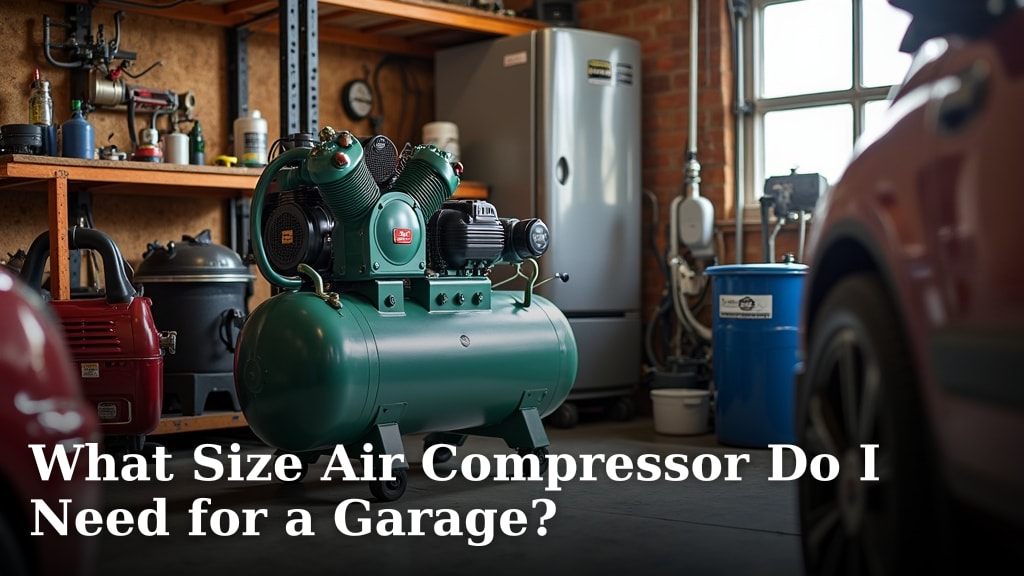
To choose the right air compressor for your garage, you generally need to match its CFM (Cubic Feet per Minute) and PSI (Pounds per Square Inch) to the demands of your tools. For typical DIY automotive tasks and woodworking, a compressor with at least 4-6 CFM at 90 PSI is a good starting point.
Picking the correct size prevents frustration and ensures your projects run smoothly. Too small, and your tools won’t work right; too big, and you’ve wasted money and space. What kind of projects are you planning to tackle?
- Compressor size depends on your tools’ CFM and PSI needs.
- Most garage tasks require at least 4-6 CFM at 90 PSI.
- Consider tank size for sustained use.
- Portability and noise levels are also factors.
- Air compressors are an investment for your workshop.
You’re probably wondering exactly how to figure out those CFM and PSI numbers and what other features really matter. Let’s dig into everything you need to know to pick the perfect air compressor for your garage.
Choosing the Right Air Compressor for Your Garage
Finding the perfect air compressor starts with understanding your needs. It’s not just about getting the biggest one you can afford. It’s about matching the compressor’s capabilities to your tools and projects. Think about what you’ll actually be doing most often in your garage.
Understanding CFM and PSI: Your Compressor’s Power Metrics
These two terms are the most important numbers you’ll encounter when buying an air compressor. They tell you how much air the compressor can deliver and at what pressure. Getting these wrong means your tools won’t work correctly, or they might run out of air too quickly.
CFM (Cubic Feet per Minute) Explained
CFM measures the volume of air your compressor can produce. Imagine it like the flow of water from a faucet. Tools that run constantly, like sanders or grinders, need a higher CFM. If your tool needs 5 CFM, your compressor should provide at least that much, and ideally a little more.
You’ll often see CFM listed at a certain PSI, for example, “6 CFM at 90 PSI.” This indicates the compressor’s output when the pressure is at 90 pounds per square inch. Always look for the CFM rating at 90 PSI, as this is a common operating pressure for many tools (Compressed Air & Gas Institute).
PSI (Pounds per Square Inch) Explained
PSI measures the air pressure the compressor can generate. Most pneumatic tools specify a required PSI. For many common garage tasks, 90 PSI is the standard operating pressure. Nail guns might need less, while an impact wrench could demand a higher burst of pressure.
Your compressor’s maximum PSI rating tells you the highest pressure it can achieve. However, you’ll rarely use this maximum pressure. The critical number is the PSI required by your tools, usually around 90 PSI for continuous operation.
Matching Your Tools to Your Compressor
What tools do you plan to use? This is the core question. Every air tool has specific CFM and PSI requirements. You can usually find these listed in the tool’s manual or on the tool itself. Make a list of all your air tools and their requirements.
If you plan to use multiple tools simultaneously, you’ll need to add up their CFM requirements. Or, more realistically, identify the tool that demands the highest CFM and use that as your baseline. Even if you use three tools, you’ll rarely be running them all at full blast at the exact same moment. One highly demanding tool can usually tell you what you need.
| Common Garage Air Tool | Typical CFM at 90 PSI | Typical PSI Range | Best Use Case |
|---|---|---|---|
| Tire Inflator | 1-2 CFM | 20-100 PSI | Occasional use, low demand |
| Brad Nailer / Stapler | 0.3-0.5 CFM | 60-90 PSI | Small, intermittent tasks |
| Blow Gun | 1-5 CFM | 30-90 PSI | Cleaning, drying |
| Impact Wrench (1/2″) | 4-6 CFM | 90-100 PSI | Lug nuts, heavy fastening |
| Air Ratchet | 3-5 CFM | 90 PSI | Easier fastening, tight spaces |
| Die Grinder | 4-8 CFM | 90 PSI | Metal shaping, deburring |
| Random Orbital Sander | 6-10 CFM | 90 PSI | Surface prep, woodworking |
| Paint Sprayer (HVLP) | 10-15 CFM | 20-40 PSI (at gun) | Automotive paint, large surfaces |
| Air Chisel / Hammer | 3-5 CFM | 90 PSI | Light demolition, cutting |
Tank Size: Not for Power, but for Endurance
The tank size, measured in gallons, doesn’t affect how powerful your compressor is. Instead, it determines how long your tools can run before the compressor motor kicks in again. Think of it as a reserve tank of air.
For tools that use air intermittently, like a nail gun, a smaller tank (2-6 gallons) might be fine. You’ll hear the compressor cycle more often, but the pauses between shots are usually enough for it to catch up. However, for continuous-use tools, like an air sander, a larger tank (20-60 gallons) makes a big difference. It allows for longer run times without constant motor noise and compressor cycling.
Small Tanks (2-6 Gallons)
These are great for portability and light tasks. Perfect for inflating tires, using blow guns, or small brad nailing jobs. They are often less expensive and take up less space. The downside? The motor will run very frequently if you use high-CFM tools.
Medium Tanks (10-30 Gallons)
A good middle-ground for many DIYers. These can handle impact wrenches, small spray paint jobs, and air ratchets without constantly cycling. You get a decent balance of power, tank capacity, and still reasonable portability for occasional moving around the garage.
Large Tanks (40-80+ Gallons)
If you’re serious about automotive work, woodworking, or want to spray paint cars, a large tank is your friend. It provides sustained airflow for demanding tools like sanders and paint guns. You’ll experience longer run times before the compressor needs to refill the tank, leading to a much smoother workflow.
Considering Your Power Source and Compressor Type
Air compressors come in different configurations, mainly defined by their power source and how they operate. These choices affect noise, maintenance, and where you can use them.
Electric vs. Gas-Powered Compressors
Electric compressors are common for garages. They plug into standard outlets (120V) or require a dedicated 240V circuit for larger models. They are generally quieter and emit no fumes, making them ideal for indoor use. Most home garage users will choose electric.
Gas-powered compressors offer portability and high power for jobs where electricity isn’t available, like construction sites or remote workshops. But they produce exhaust fumes and are much louder. They are not suitable for indoor garage use without excellent ventilation.
Oil-Lubricated vs. Oil-Free Compressors
Oil-lubricated compressors tend to be more durable and quieter over time. They require oil changes, much like a car engine. This type is generally preferred for heavier, consistent use because the oil helps keep components cool and reduces wear. Many experts we spoke with recommended oil-lube for longevity.
Oil-free compressors are typically lighter, require less maintenance (no oil changes!), and are often more affordable. The trade-off is they can be louder and may not last as long under heavy, continuous use. They are usually fine for the casual DIYer.
Noise Levels: Keep Your Ears (and Neighbors) Happy
Air compressors can be LOUD. Many traditional models operate at 80-90 decibels, which is equivalent to a garbage disposal or a power lawnmower. If your garage is attached to your home, or you have close neighbors, this can be a real issue.
Look for models advertised as “quiet” or “low noise.” These often use different motor designs or have sound-dampening enclosures. They typically operate in the 60-70 decibel range, much closer to a normal conversation. While they might cost a bit more, your ears (and your family) will thank you. For a home garage, considering noise is a wise decision.
Portability: Do You Need to Move It Around?
Are you going to keep your compressor in one spot, or do you need to move it around your garage, or even take it to other locations? Small “pancake” or “hot dog” style compressors are highly portable. They’re light and easy to carry. Larger tank compressors often come with wheels and handles but are still heavy and bulky.
If your projects take you to different corners of the garage or driveway, a lighter, wheeled unit might be better. If it’s staying put in a dedicated corner, portability is less of a concern.
Your Air Compressor Checklist
Before you buy, run through this quick checklist to make sure you’re getting the right compressor for your garage:
- Identify the highest CFM requirement among all your anticipated air tools. Multiply this by 1.5 for a safety margin.
- Confirm the PSI needed for your tools, usually 90 PSI for continuous operation.
- Decide on an appropriate tank size based on how continuously you’ll use your tools (small for intermittent, large for constant).
- Choose between oil-lubricated for durability or oil-free for less maintenance.
- Consider the noise level, especially if you have sensitive ears or neighbors.
- Think about portability – will it stay in one place or needs to be moved?
Conclusion
Choosing the right air compressor for your garage doesn’t have to be overwhelming. By focusing on your tools’ specific CFM and PSI needs, you can easily determine the performance necessary for your projects. Remember that tank size dictates endurance, not power, and consider features like noise level and portability for a comfortable workflow.
Taking a few moments to assess these factors ensures you invest in a compressor that truly supports your DIY spirit. You’ll avoid frustration and enjoy a more efficient, productive garage. Now that you know the key elements, go ahead and confidently select the perfect compressor for your workshop.
Frequently Asked Questions
Is a larger tank air compressor always better?
No, a larger tank isn’t always better. While it provides longer continuous airflow, it also takes up more space and can be heavier. Match your tank size to how consistently you’ll use high-CFM tools to avoid overspending or oversized equipment.
Can I use a 120V air compressor for all my garage tools?
Most smaller and medium-sized air compressors designed for home garages run on 120V. They can power a wide range of tools like nail guns, impact wrenches, and blow guns. However, very large, high-CFM compressors, especially industrial types, often require a 240V dedicated circuit.
How can I make my air compressor quieter?
If you don’t have a “quiet” model, you can try a few things. Placing rubber mats underneath can reduce vibration noise. Some people build simple sound-dampening enclosures around stationary compressors, ensuring they still have proper ventilation to prevent overheating. Wearing hearing protection is always recommended.
Do I need an oil-lubricated compressor for occasional use?
For occasional or light DIY use, an oil-free compressor is usually perfectly fine. They require less maintenance since there are no oil changes. Oil-lubricated models are typically favored for heavier, more consistent use due to their enhanced durability and quieter operation over time.
What maintenance does an air compressor need?
Regular maintenance for oil-lubricated models includes checking and changing the oil, similar to a car. For all compressors, you should regularly drain condensation from the tank to prevent rust. Also, check air filters and replace them when dirty to ensure efficient operation.
