
How Big of an Air Compressor Do I Need for My Garage?
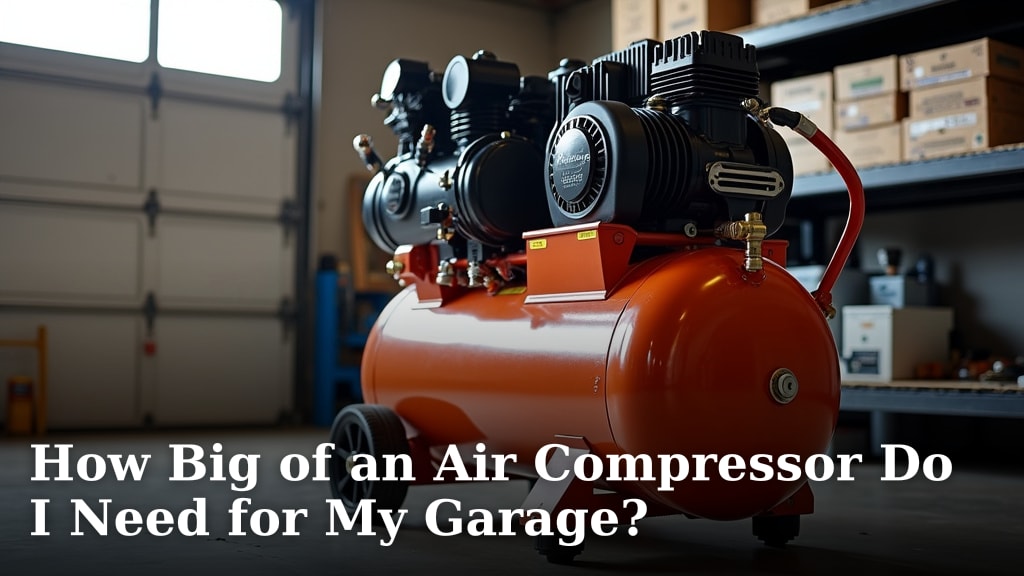
How to Pick the Right Air Compressor Size for Your Garage
To pick the perfect air compressor, you need to match its power and capacity to the tools you plan to use in your garage. Think of it like choosing a vehicle for your family. You wouldn’t buy a tiny car if you need to haul lumber. Similarly, your compressor must handle your tool’s demands. We found that many homeowners skip this step and end up with a unit that’s too weak or too big. Let’s break it down so you get it right the first time.
Understanding the Basics of Air Compressors
Before you shop, you need to know two key terms: PSI and CFM. PSI stands for pounds per square inch, which is the air pressure. CFM means cubic feet per minute, which is the air volume. These numbers tell you if the compressor can power your tools. For example, a nail gun needs less PSI than a paint sprayer. You can’t just guess here. Research from the U.S. Department of Energy shows that matching PSI and CFM to your tools prevents damage and saves energy.
Why PSI and CFM Matter for Your Garage
PSI is like the strength of the air stream. CFM is how much air flows. If your tool requires 90 PSI but your compressor only provides 70 PSI, it won’t work well. We found that 90 PSI is common for most garage tools. But for heavy-duty tasks, you might need 125 PSI or more. CFM is just as important. A tool that needs 5 CFM at 90 PSI won’t run on a compressor that only delivers 2 CFM. Always check your tool’s manual for these specs.
Key Factors That Determine Your Compressor Size
Now that you know the basics, let’s look at what really affects your choice. Your garage size, tool collection, and how often you work all play a role. We’ll cover these factors in detail. Remember, a good compressor is an investment. You don’t want to buy too small and then have to replace it soon.
Air Pressure (PSI) Requirements
Your tools need a specific PSI to operate. For instance, a tire inflator might need 100 PSI, while a brad nailer needs only 70 PSI. According to guidelines from the Occupational Safety and Health Administration (OSHA), you should always use the recommended PSI for safety and efficiency. We suggest making a list of all your tools and their PSI needs. Then, pick a compressor that exceeds the highest PSI on your list. This gives you room to grow.
A common mistake is buying a compressor with just enough PSI. But tools can wear out faster if they don’t get enough pressure. So, aim for a buffer of 10-20 PSI above your tool’s needs. This ensures smooth operation and extends tool life.
Air Volume (CFM) Needs
CF
Conclusion
You now know the key to picking an air compressor for your garage: it all comes down to PSI and CFM. Match these specs to your tools, and don’t forget to consider your workspace and future needs. A well-chosen compressor saves you time, money, and frustration.
Your next move is clear. Grab a pen and list every air tool you own or plan to buy. Check each tool’s PSI and CFM requirements in the manual. Then, shop for a compressor that beats those numbers by a safe margin. This one step ensures you get a unit that powers your projects smoothly for years.
Frequently Asked Questions
What size air compressor do I need for a car tire inflation gun?
Most car tire inflators require about 100 PSI and 2-3 CFM. A small, portable compressor with a 2-3 gallon tank often handles this job well. We recommend checking your inflator’s specs to be sure.
Can I use a 6-gallon compressor for painting my car?
Probably not. Automotive paint sprayers typically need high CFM, often 10+ at 40 PSI. A small 6-gallon tank will run out of air quickly, causing uneven coats. For painting, look for a larger compressor with a 30+ gallon tank and higher CFM.
How do I know if my garage circuit can handle the compressor?
Check the compressor’s amperage or wattage in the manual. Most garage circuits are 15-20 amps. We found that compressors over 15 amps may need a dedicated 20-amp circuit to avoid tripping breakers.
Is a louder compressor more powerful?
Not necessarily. Noise level is often about design, like oil-free versus oil-lubricated models. Oil-lubricated compressors run quieter but can be just as powerful. Focus on PSI and CFM ratings, not sound, for performance.
Should I get a vertical or horizontal air compressor for my garage?
It depends on your space. Vertical compressors save floor space, while horizontal ones are often easier to move. Consider your garage layout and storage needs when deciding.
