
How To Calculate Free Air Delivery Of Compressor?
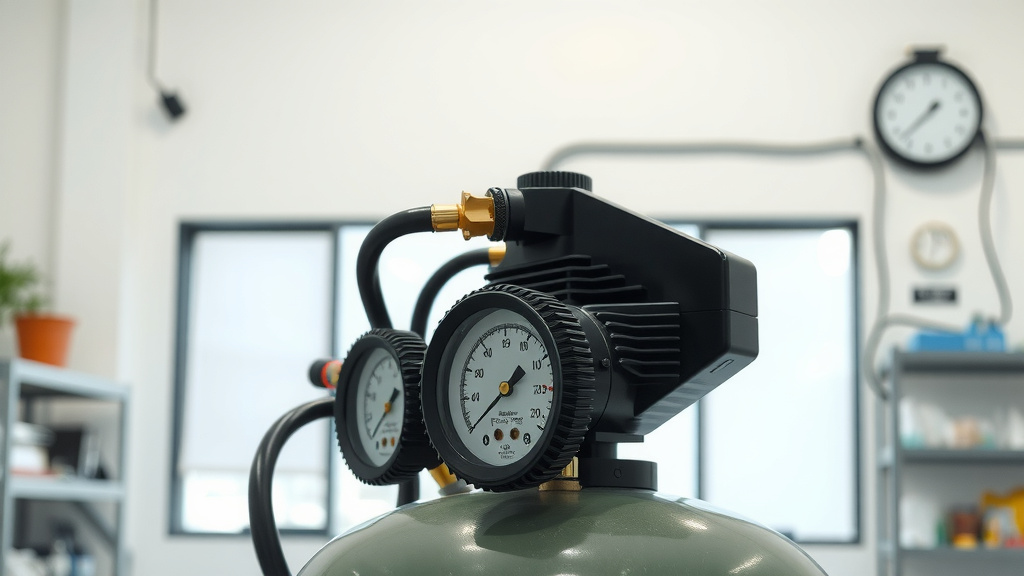
To calculate the Free Air Delivery (FAD) of a compressor, you measure the actual volume of air it delivers at standard conditions over a specific time period. This isn’t just the tank size; it’s about the compressor’s real-world output.
You determine Free Air Delivery by using specialized flow meters, or more commonly for practical purposes, through a receiver tank pump-up test, which measures how quickly the tank fills from one pressure to another.
- The Free Air Delivery (FAD) of a compressor tells you its actual air output, not just its theoretical capacity.
- You can find FAD by performing a simple pump-up test on your compressor’s receiver tank.
- It involves timing how long it takes to increase pressure within a known tank volume.
- Understanding FAD helps you choose the right compressor for your tools and applications.
- Always factor in altitude and temperature for precise FAD measurements.
Ever wondered if your air compressor is truly delivering what it promises? It’s a common question, and understanding Free Air Delivery, or FAD, is your key to the answer. You see, while a compressor’s horsepower or tank size tells part of the story, FAD reveals its actual working capacity. It’s like knowing the gas mileage of a car versus just its engine size.
Many people confuse FAD with displacement. Displacement is theoretical, based on the pump’s size. FAD, however, accounts for efficiencies, leaks, and heat, giving you a realistic performance metric (Compressed Air & Gas Institute – CAGI).
How To Calculate Free Air Delivery Of Compressor?
Calculating the Free Air Delivery of a compressor involves measuring the actual volume of air it delivers under specific conditions, often using a pump-up test method on its receiver tank.
Why FAD Matters More Than You Think
You might look at a compressor and see a big number in Cubic Feet per Minute (CFM). But is that its true output? Not always. FAD considers the actual volume of air at standard conditions, which means it accounts for real-world losses. Imagine trying to fill balloons; FAD tells you how many balloons you can actually fill, not just the potential.
If your pneumatic tools aren’t performing well, a common culprit is insufficient FAD. Using a compressor with a lower FAD than your tools require leads to sluggish operation, decreased efficiency, and potentially even premature tool wear. It’s like trying to run a marathon on a very low calorie diet.
The Tools You’ll Need For a Pump-Up Test
Ready to get started? You don’t need fancy lab equipment. For a practical FAD calculation, you’ll need just a few items. A stopwatch is essential, as timing is everything here. You also need a reliable pressure gauge on your compressor’s receiver tank.
Make sure your compressor tank’s actual volume is known. This is usually stamped on the tank or available in the manual. If not, you might need to find its dimensions to calculate its volume accurately. Don’t forget a pen and paper or a phone to jot down your readings.
Safety First: A Quick Reminder
Working with air compressors involves pressure, so safety is paramount. Always ensure your compressor is in good working condition. Check for any obvious leaks before starting. You should never exceed the maximum rated pressure of your tank or compressor.
Wear appropriate personal protective equipment (PPE), especially eye protection. It’s simple precautions that keep you safe while you are gathering important data about your machine.
Step-by-Step FAD Calculation: The Pump-Up Method
This method is widely used because it’s relatively simple and effective for many applications. You’ll be measuring how fast your tank pressurizes. We’ve found this gives a very good practical estimate of your compressor’s FAD.
- Ensure your compressor tank is completely empty of air. Verify the gauge reads zero PSI.
- Close all outlet valves so no air escapes during the test.
- Start the compressor and immediately begin timing with your stopwatch.
- Note the time it takes for the compressor to pump the tank from 0 PSI to a specified pressure, for example, 100 PSI.
- Record the exact time. This is your “T” (time).
Understanding Your Tank’s Volume
Before calculation, you need the actual volume of your air receiver. This is typically in gallons or liters. For our calculations, we convert this to cubic feet. Remember, 1 cubic foot equals roughly 7.48 gallons. If your tank is 60 gallons, it’s about 8.02 cubic feet.
The tank’s volume is often listed as “receiver volume” or “tank capacity” in your manual. It’s a critical piece of the puzzle, so make sure you have the correct number ready.
Factor in Atmospheric Pressure
Why atmospheric pressure? Because air compressors draw in ambient air. The pressure at sea level is about 14.7 PSI (or 1 bar). If you live at a higher altitude, the atmospheric pressure will be lower. This affects how much air your compressor can actually “free deliver.”
Many experts say that adjusting for atmospheric pressure gives you a more accurate FAD. You can find your local atmospheric pressure online if you want maximum precision for your calculations. For most basic calculations, 14.7 PSI is a good starting point.
The FAD Formula Revealed
Here’s the formula to put all your measurements to good use:
FAD (CFM) = [Tank Volume (Cubic Feet) x (Final Pressure – Initial Pressure) / 14.7 psi ] / Time (Minutes)
Let’s break it down. You’re essentially calculating the number of atmospheric pressure tanks your compressor can fill in one minute. It simplifies what might seem complex into a manageable equation. This formula gives you a good estimate of the real-world performance.
Example Calculation: Let’s Do It Together
Suppose you have a 60-gallon air tank. You timed it taking 2 minutes to go from 0 PSI to 100 PSI. Let’s plug in the numbers:
Tank Volume: 60 gallons / 7.48 gallons/cubic foot = 8.02 cubic feet
Final Pressure: 100 PSI
Initial Pressure: 0 PSI
Atmospheric Pressure: 14.7 PSI (standard)
Time: 2 minutes
FAD = [8.02 cu ft x (100 – 0) / 14.7] / 2 min
FAD = [8.02 x 100 / 14.7] / 2
FAD = [802 / 14.7] / 2
FAD = 54.56 / 2
FAD = 27.28 CFM
So, this compressor has an estimated FAD of about 27.3 CFM. This number is what you should compare against your tools’ air requirements.
Table: FAD vs. Stated CFM – A Quick Comparison
It’s common for stated CFM to differ from FAD. Here’s why:
| Metric | What it Means | Calculation Basis | Why it Matters to You |
|---|---|---|---|
| Stated CFM | Theoretical displacement of the pump at a certain RPM. | Piston diameter, stroke length, RPM. | Often an optimistic number, good for initial comparison. |
| FAD (Free Air Delivery) | Actual volume of air delivered at standard conditions (temperature, pressure, humidity). | Actual measured output, accounting for losses. | The most accurate indicator of usable air for tools. |
Adjusting for Temperature and Altitude
While the pump-up test gives a good practical FAD, for even greater accuracy, you might want to adjust for ambient conditions. Air density changes with temperature and altitude. A compressor performs differently in a cold workshop at sea level than in a hot workshop high in the mountains. We found that higher temperatures reduce air density, thus reducing the FAD slightly.
Similarly, at higher altitudes, the atmospheric pressure is lower, meaning there’s less air to compress in the first place (National Weather Service). This is a factor for very precise industrial applications. For most home or small shop uses, the basic pump-up method is sufficient.
Why Your FAD Might Change Over Time
Compressors, like any machinery, can lose efficiency over time. Worn piston rings, dirty air filters, or leaks in your air lines can all reduce FAD. If your tools suddenly seem underpowered, it might be time to re-check your compressor’s FAD. Many experts agree that regular maintenance is crucial to maintaining optimal FAD.
A simple check of your air filter is a good start. A clogged filter restricts airflow, forcing your compressor to work harder for less output. Keep an eye out for any audible leaks around fittings and hoses; even small leaks can contribute to a significant loss of FAD.
Checklist for Maintaining FAD
- Regularly inspect and change your air filter.
- Check all air lines and fittings for leaks using soapy water.
- Drain your receiver tank daily to prevent rust and maintain volume.
- Ensure your compressor motor and pump are well-maintained.
- Monitor for unusual noises or vibrations, which could indicate wear.
Conclusion
Calculating your compressor’s Free Air Delivery (FAD) is more than just a technical exercise; it’s about empowering you to make informed decisions. Knowing the true output ensures your tools perform optimally, prevents wasted energy, and helps you select the right equipment for your specific needs. By understanding FAD, you move beyond theoretical numbers to the practical reality of your compressed air system. It’s a simple test that provides a lot of clarity and ultimately, helps you get the most out of your valuable equipment.
FAQs
What is the difference between CFM and FAD?
CFM (Cubic Feet per Minute) often refers to the theoretical displacement of a compressor pump, meaning the maximum air it *could* move. FAD (Free Air Delivery), however, measures the actual volume of air delivered at standard atmospheric conditions, accounting for all inefficiencies and losses, making it a more realistic and useful number for tool requirements.
How often should I calculate my compressor’s FAD?
It’s a good practice to calculate your compressor’s FAD when you first get it to establish a baseline. After that, recalculating it annually, or whenever you notice a significant drop in tool performance, can help you identify maintenance needs or potential issues before they become major problems.
Can FAD be higher than the stated CFM?
No, FAD will generally always be lower than the stated displacement CFM. The displacement CFM is a theoretical maximum, while FAD represents the actual, real-world output after accounting for factors like heat, leaks, and mechanical efficiencies that reduce the usable air volume.
Does the size of my air tank affect FAD?
The size of your air tank does not affect the compressor’s FAD, which is a measure of the compressor’s output rate. However, a larger tank provides a greater reserve of compressed air, allowing your tools to run longer before the compressor needs to cycle on again. It’s about storage, not delivery rate.
Is there a simpler way to find my compressor’s FAD without calculation?
Some manufacturers list the FAD directly in the compressor’s specifications, often alongside or instead of the displacement CFM. Always check your compressor’s manual or product page for this information. If it’s not listed, the pump-up test remains the most practical method for a direct measurement.
