Pneumatic Workshop Tools: The Complete Buying Guide
Air tools work best when your compressor matches their CFM and PSI needs, not the other way around. Pick the tool first, check its air demand at 90 PSI, then size the tank and pump to keep up with it.
On this page (9 sections)
- What are the main types of air tools?
- How do fastening and driving air tools differ?
- Which cutting, grinding and sanding air tools should you buy first?
- What size compressor for air tools do you actually need?
- What size compressor for sandblasting and what size air compressor for sandblasting?
- How do air hammers, rivet guns and blow guns fit the shop?
- How do pneumatic jacks and lifting tools work with air tools?
- How should you set up, maintain and store air tools?
- Which air tools should you buy if you buy only a few?
Air tools are only as good as the air that feeds them. A tool rated at 4 CFM at 90 PSI will stall or run weak on a compressor that cannot supply that flow.
Match the tool, the hose, the fittings and the tank before you buy.
This guide covers the main types of air tools, how to size a compressor and where lifting tools fit. It links to deeper guides for each specialty, so you can plan a whole workshop.
You will find product examples for the lifting side of pneumatic work. Those examples show how capacity, lift range and power source change day to day use.
A pneumatic shop is a system, not a pile of tools. The compressor, tank, regulator, filter, hose, couplers and tool all set the limit for the work you can do.
If one part is too small, the whole line feels weak, slow or unreliable. Planning from the job outward pays off, starting with the work you do most.
List the work you do most, note the tool for each job, then size the air supply to run that tool for as long as the job takes. The sections below walk through types, sizing and setup in that order.
What are the main types of air tools?
The main types of air tools fall into fastening, material removal, finishing and lifting. Fastening tools include impact wrenches, ratchets and drills.
Material removal tools include die grinders, belt sanders, needle scalers and hammers.
Finishing tools include sanders, rivet guns and spray equipment. Lifting tools include air jacks and air hydraulic bottle jacks, which use shop air to raise vehicles instead of pumping by hand.
Start with the jobs you do every week. A mechanic needs fastening and lifting first.
A fabricator needs grinding, cutting and hammer work first.
Our best air tools for automotive guide narrows the automotive list by task. It helps you avoid buying speed tools before you have lifting and support gear.
Small accessories matter as much as the power tools. A best air tool holder keeps hoses and couplers off the floor and makes a tool change faster.
Think of each group by how it uses air over time. Fastening tools often work in short bursts.
Grinding and sanding tools run for long stretches.
Spray and blasting tools run without a break and need steady flow. That pattern should shape your first buys, with burst tools on a smaller tank and continuous tools on a compressor that can keep up.
Lifting tools set the pace for a repair, since the vehicle cannot be worked on until it is up and supported.
How do you group tools by air demand?
Group tools by burst use, steady use and continuous use. Burst tools include impact wrenches and hammers.
Steady tools include ratchets, drills and die grinders. Continuous tools include sanders, spray guns and sandblasting guns.
The group tells you what to check first. Burst tools need peak flow and a tank that can refill between bursts.
Steady tools need honest CFM at pressure. Continuous tools need both CFM and tank volume.
A painter should not judge a setup by how an impact wrench feels. The spray gun will show the limits faster.
A mechanic should not judge a setup only by a grinder, since the wrench may still burst while the tank is drained.
Matching the group to the compressor keeps a small shop from buying a large tank it does not need. It also keeps a busy shop from buying a small tank that will cycle all day.
How do fastening and driving air tools differ?
Fastening air tools are rated by torque, speed and air use, and those three numbers pull in different directions. Impact wrenches deliver high torque in short bursts and use more air per minute.
Ratchets deliver lower torque but turn continuously for bolts and fittings.
Drills run at high speed for a steady cut, so they need consistent flow. A drill that slows under load will burn bits and leave rough holes.
Check the tool's CFM at 90 PSI before you compare torque claims. Two wrenches with similar torque can have very different air demands.
If you run a wrench all day, tank size matters more than peak pressure. A larger tank gives the pump time to recover between bursts.
Hose diameter and fittings also affect flow at the tool. Long, narrow hoses can drop pressure enough that a strong tool feels weak.
Torque is only useful if the tool can reach it at the pressure you set. A wrench that needs more CFM than your compressor can give will slow down and lose its bite.
Speed matters in the same way. A ratchet that turns under load will save time on long bolt runs.
A ratchet that stalls will make you reach for a hand tool.
Drills show the problem differently. A drill that starts strong and then fades has run out of air, not cutting power.
Test tools in the order you will use them. Run the wrench, then the ratchet, then the drill, and watch the tank gauge and listen for the pump.
If the pump runs almost nonstop, the tank is too small for that tool. If the tool feels weak even with a full tank, look at hose size, fittings and regulator settings.
Which cutting, grinding and sanding air tools should you buy first?
Cutting and grinding tools are the workhorses of many shops. If you prefer a corded option, see electric right angle die grinders.
A die grinder handles deburring, cutting discs and small port work in tight spots.
One body takes many accessories, so it is often the first removal tool to buy.
Needle scalers remove rust and loose paint by rapid impact, which makes them useful before you coat or weld a joint. Our best needle scaler for rust removal guide explains how to choose by needle count and stroke.
Air hammers drive chisels, punches and scalpels for exhaust, body and general shop work. See the best air hammer kit picks when you need chisels included, and the best air hammer for automotive picks for underbody jobs.
An air belt sander suits flat welds and edge work that a disc sander makes wavy. The best air belt sander guide covers belt width and arm reach for different panels.
Buy in the order of your jobs, not in the order of a catalog. If you prep welds daily, start with grinding and scaling.
If you finish panels daily, start with sanding and a grinder for edges.
Air demand rises as you move from fastening to removal to finishing. Grinders and sanders run longer, so they need more CFM and a larger tank than a wrench used in bursts.
The best air die grinder roundup compares collet size, speed and air use.
What size compressor for air tools do you actually need?
What size compressor for air tools do you need starts with a simple list. Write down each tool, its CFM at 90 PSI, and how long you run it without a break.
Add the highest continuous demand, not every tool at once, unless you plan to run two tools together.
Tank size sets how long you can run before the pump must catch up. A 20 gallon tank suits short bursts.
A 60 gallon tank suits longer grinding, sanding and blasting sessions.
Pressure at the tool matters more than the tank gauge. Long hoses, small fittings and water in the line all lower pressure at the coupler.
For a general shop, our best air compressor for pneumatic tools guide matches compressor types to tool groups. It also explains why a pancake compressor fine for a nailer can struggle with a grinder.
If you plan to run one tool at a time, size for that tool plus a margin. If you plan to run two, add their demands and expect a larger tank.
Start with the tool that runs the longest. That tool sets the floor for CFM at pressure.
The tank then sets how long you can run before the pump must take over.
Look at CFM at 90 PSI, not at 40 PSI. Also check duty cycle and recovery time, since a compressor that needs long cool downs will struggle even if its tank looks large.
Use the shortest hose that lets you reach the work, with fittings that match the tool and the hose. Then set pressure with the tool running, not while it sits idle.
What size compressor for sandblasting and what size air compressor for sandblasting?
What size compressor for sandblasting is larger than what sanding needs. Sandblasting uses air continuously for minutes, so CFM at pressure decides if the blast stays strong.
A blaster that fades after 30 seconds will leave an uneven finish.
A benchtop cabinet uses less air than a full cabinet or a suction blaster. The gun nozzle size also changes demand, and larger nozzles use much more air.
What size air compressor for sandblasting should therefore be chosen by the gun first. Pick the gun and nozzle you will use, then find a compressor that meets its CFM rating at your blast pressure.
Our best benchtop sandblasting cabinet guide ties cabinet size to compressor size. It helps you avoid pairing a large cabinet with a small tank.
Moisture control matters more in blasting than in many other jobs. Wet air can clog media and cause flash rust on clean metal.
Tank size decides how long a blast can run before a pause. A large tank lets you finish a panel in one pass.
A small tank forces stops that can leave a visible line.
A filter, a dryer where needed and a clean, drained tank help more in blasting than in fastening work. The same air that feels fine in a wrench can ruin a finish.
Plan for recovery time as well as flow. After a long blast, the pump needs time to refill the tank before the next pass.
How do air hammers, rivet guns and blow guns fit the shop?
Hammers and specialty impact tools fill the gap between fastening and grinding. Air hammers use chisel energy for cutting, scaling and shaping, while rivet guns set rivets with repeated blows.
The two look similar but use different retainers and accessories.
A rivet gun is a focused tool for aircraft style and body rivets. The best air rivet gun guide covers gun weight, rivet set size and air use for long sessions.
A blow gun is simple, but it is used constantly. A best high pressure air blow gun should have a regulated tip, a comfortable grip and a safety nozzle.
Grease guns are a maintenance tool that many buyers overlook. The best pneumatic grease gun air powered options help you service bearings and joints without hand pumping.
Pneumatic drills fill holes where electric drills are awkward. The best pneumatic air drill guide explains chuck size and speed for metal work.
An air hammer suits exhaust work, body panels and general shop jobs where a grinder would be slow. A rivet gun needs a retainer that matches the rivet set, and a blow gun should clean parts and dry work safely.
These tools show how air demand varies by job. Hammers work in bursts.
Rivet guns run for long sessions. Blow guns use short, frequent bursts all day.
That mix suits most shop compressors well. A tank that handles bursts can run hammers and blow guns all day, even if it cannot support long blasting.
How do pneumatic jacks and lifting tools work with air tools?
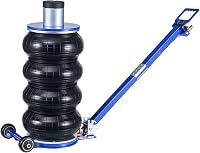
Pneumatic lifting tools use shop air to raise a load fast, then hold it with hydraulics or an air bag. The VEVOR Air Jack lifts 6 tons with an air bag and reaches 26.5 in with its extension column.
That range suits cars, SUVs and pickup trucks in a garage.
The VEVOR air bag jack has a four layer air bag, a widened base and steel pipes inside for controlled descent. It includes 1/4 inch US and EU couplers and an adjustable handle with rubber wheels.
It is listed for 0.8 to 1.0 MPa compressors, so check your shop supply before you order. Use a jack stand for long support, as the maker advises.
The VEVOR Air Hydraulic Bottle Jack takes a different approach at 20 tons. It lifts from 10.4 to 19.7 in and runs in pneumatic or manual mode.
That dual mode helps when you need air speed in the shop or hand power in the field.
Its all welded body uses cast iron and carbon steel, with a built in overload valve and dual springs that reset the piston. The screw adds fine height adjustment in tight spaces.
The E-HEELP Electric Car Jack Kit is not pneumatic, but it solves the same roadside problem with 12V power. It lifts up to 5 tons from 6.1 to 17.7 in and includes an impact wrench and a tire pump.
That kit suits drivers who do not carry shop air.
E-HEELP says it reaches full height in under 2 minutes and stops with overload protection at max height or load. It runs from a 12V socket or cigarette lighter and has a pressure display on the pump.
On level ground, with the load within limits, that setup covers sedan, SUV, MPV and truck tire changes. The waterproof connectors and LED lights help in rain or at night.
The SPECSTAR 20 Ton Pneumatic Air Hydraulic Bottle also offers dual lift modes. It is rated at 20 tons and 200 PSI maximum pressure, with a 10.2 to 20 in range in its highlight specs.
The splicing handle can be joined for reach and stored as two pieces.
SPECSTAR describes a double spring reset, heavy duty iron body and simple bayonet handle connection to the oil return valve. Connect the air pipe, press the switch to raise, and turn the valve slowly to lower.
For heavy farm gear, trucks and mobile machinery, that capacity class is the point. For a passenger car in a small garage, the 6 ton air bag jack above is easier to position.
Our best air compressor jack guide compares these lifting types by capacity and range. Read it before you choose between an air bag jack, a bottle jack and an electric kit.
How does the VEVOR air bag jack handle low cars and tall SUVs?
The VEVOR air bag jack solves the range problem with an extra extension column. Without the column, it lifts from 6.7 to 23 in.
With the column, it lifts from 10.2 to 26.5 in.
That split matters in a real garage. A low profile car needs a low starting height.
A high clearance SUV or pickup needs a high top height.
The jack is listed at 6 tons, or 13227 lbs, for sedans, SUVs, pickups and trucks. Its reinforced four layer air bag and widened base plate are meant to keep the lift stable.
Controlled descent is built in with six heavy steel pipes inside the bag. Each pipe has a shorter stroke, which helps the load lower smoothly and stops sudden drops.
The top has a thick rubber pad that grips the contact point. That pad helps keep the hold non slip and helps protect the chassis point.
The valve includes 1/4 inch US and EU couplers. It is listed for compressors in the 0.8 to 1.0 MPa range, so check your supply before you plan to use it.
The adjustable handle and rubber wheels help you align the jack under the vehicle. Once connected, it lifts in 2 to 5 seconds, which is the main time saving over hand pumping.
The jack weighs 56.7 pounds and measures 48.03 x 12.8 x 6.69 inches. That size and weight shape how you store it and move it in a small garage.
For long support, use a jack stand as the maker advises. The air bag lifts fast, but a stand is the right support for work that lasts.
How do the two 20 ton bottle jacks differ in use?
The VEVOR and SPECSTAR bottle jacks both sit in the 20 ton class, but their details point to different habits. The VEVOR model is listed at 20 tons, or 44092 lbs, with a 10.4 to 19.7 in range.
Its body is all welded and built from cast iron and carbon steel. A built in valve helps avoid overload, and dual springs reset the piston for the next job.
The VEVOR jack runs in pneumatic mode with quick connect fittings or in manual mode with its handle. That dual mode helps in the shop and in the field.
A 2.6 in screw adds fine height tuning. That helps when space is tight and the top of the jack needs a small adjustment before a lift.
The SPECSTAR model is also rated at 20 tons, with a maximum pressure of 200 PSI. Its highlight specs list a 10.2 to 20 in lifting range.
SPECSTAR uses a heavy duty iron body and a double spring reset. The handle splices into two pieces for reach in use and compact storage.
Its operation is direct. One end of the handle connects by bayonet to the oil return valve and tightens clockwise.
The air pipe connects to the compressor, and the switch raises the load.
To lower, the oil return valve turns anticlockwise and slowly, and the jack drops on its own. That slow turn is the control point for a steady descent.
Both jacks suit box trucks, RVs, pickups, SUVs, farm gear and heavy equipment. The choice comes down to handle style, height range and how you prefer to connect and store the tool.
When does an electric jack kit make more sense than shop air?
The E-HEELP kit answers a different question. It lifts up to 5 tons, or 11023 lbs, from 6.1 to 17.7 in with 12V power.
It is hydraulic driven and reaches full height in under 2 minutes. That is slower than an air bag jack, but it needs no compressor.
Power comes from a battery clip with a 12V DC socket or from a car cigarette lighter. The kit includes an impact wrench, a toolbox and a tire inflator pump.
The pump has a tire pressure display, so you can monitor pressure while you inflate. That adds roadside value beyond the lift itself.
Overload protection stops the lift at max height or when load exceeds the limit. Cross lines on the top of the bar head improve friction while lifting.
Waterproof connectors and two LED lights help in rain and in the dark. The kit is listed for sedan, SUV, MPV, truck, pickup and similar vehicles.
At 1.3 kg, the jack itself is light to carry. That portability is the point for road trips, farm use and emergency work away from a shop.
For a home garage with shop air, a pneumatic jack will usually save more time. For a vehicle that travels, the electric kit removes the need to carry air.
How should you set up, maintain and store air tools?
Good setup starts at the wall and ends at the tool. Drain the tank, fit a regulator and filter, then set pressure at the tool while it runs.
A gauge on the tool reads true pressure under load.
Oil matters for many tools, but not all. Our best air compressor tool oil guide explains which tools need oil and which are oil free.
Synthetic oil can help in cold shops where standard oil thickens. The best synthetic air tool oil picks cover pour point and viscosity for that use.
Moisture is the quiet enemy in most shops. It collects in the tank and line, then shows up as weak power, rust inside tools and poor finishes.
Draining the tank on a schedule and checking the filter bowl keeps that problem down. Pressure should be set at the tool while it runs, since a tank gauge can read high while the tool still starves.
Check couplers before you blame a tool for low power. A worn coupler leaks air, drops pressure and wastes compressor run time, so couplers deserve regular checks.
Store tools on a holder or in a cabinet so hoses do not kink. Hanging a tool by its hose can damage the inlet fitting over time.
At the end of each day, blow out the line and drain moisture. Some tools need oil daily, and some are oil free and can be harmed by the wrong oil, so oil needs a tool by tool call.
Which air tools should you buy if you buy only a few?
Buy for your most common job first, then add depth. A mechanic should start with lifting, an impact wrench, a ratchet and a blow gun.
A fabricator should start with a die grinder, a belt sander and a hammer.
A painter should start with spray equipment and a clean, dry air supply. A general shop should start with a drill, a grinder and a needle scaler.
A small core set should cover lifting, fastening, removal and cleanup. Those four jobs show up in almost every repair and build.
For a mechanic, lifting comes first because the whole job waits on it. An impact wrench and ratchet handle most fastening.
A blow gun keeps the work clean all day.
For a fabricator, removal comes first. A die grinder, a belt sander and a hammer cover cutting, grinding, scaling and shaping.
For a painter, air quality comes first. Spray equipment needs clean, dry air more than any other tool in the shop.
For a general shop, that drill, grinder and needle scaler trio covers holes, cleanup and rust prep for most small jobs.
Use this guide as your hub and follow the cluster links for each specialty. Each linked guide gives specs, trade offs and buyer patterns for one tool type.
Add depth by specialty, not by brand loyalty. That order keeps your first purchases useful even if your shop grows, and avoids replacing a core tool a month later.
Frequently asked questions
What types of air tools are most useful in a workshop?
The most useful types of air tools cover fastening, cutting, grinding, sanding and painting and lifting. Start with an impact wrench, ratchet, die grinder, blow gun and a jack, then add specialty tools as your jobs change.
Each type has a different air demand, so match the compressor to the tools you will run most.
What size compressor for sandblasting do I need?
What size compressor for sandblasting depends on your blasting gun and cabinet size. Small bench cabinets need far less air than a full-size cabinet or a portable blaster.
Check the gun's CFM rating at your pressure, then allow extra capacity so the tank can recover between cycles.
What size air compressor for sandblasting handles continuous work?
What size air compressor for sandblasting should run the gun at its rated CFM without the tank draining too fast. Look for a compressor whose CFM at 90 PSI meets or beats the gun rating, with a larger tank for longer blasts.
A small tank will cycle hard and shorten pauses between blasts.
What size compressor for air tools should a beginner buy?
What size compressor for air tools suits a beginner is usually a 20 to 30 gallon tank with enough CFM at 90 PSI for common tools. That size runs ratchets, grinders and jacks well without constant cycling.
Check each tool you plan to buy before you settle on a smaller portable unit.