9 Best Fuji HVLP Spray Systems (November 2026)
The best Fuji HVLP spray systems include the Fuji Spray 2203G Semi-PRO for detailed furniture finishing, the Fuji Spray 3005-T70 Q5 Platinum for maximum power and quiet work, and the Fuji Spray 2904-T70 Mini-Mite 4 Platinum for all-around shop finishing.
On this page (9 sections)
- Best Fuji HVLP spray systems for furniture, cabinets and shop work
- How we compared these Fuji spray systems
- How many turbine stages do you need for Fuji HVLP?
- Should you pick gravity feed or bottom feed?
- How much PSI does a paint sprayer need for Fuji turbines?
- Which Fuji system is quieter for indoor use?
- When should you look beyond Fuji to another sprayer type?
- How should you set up and care for a Fuji HVLP system?
- Our verdict on the best Fuji HVLP spray systems
The best Fuji HVLP spray systems for most people are the Fuji Spray 2203G Semi-PRO for fine work and the Fuji Spray 3005-T70 Q5 Platinum for power. Our score weighs specs, features and buyer feedback against what you are shopping for.
Fuji splits this range by turbine stages from 2 to 5, and that choice drives pressure more than any other detail.
You also need to pick a cup style. Gravity guns with 400cc or 600cc cups suit furniture and touch-ups.
Bottom-feed guns with 1 quart cups suit cabinets, doors and longer runs. Read our best paint spray gun guide first if you are new to HVLP, because it explains atomization and transfer efficiency in plain terms.
Our picks at a glance
-
1

-
2
 Best for maximum power and quiet work
Fuji Spray 3005-T70 Q5 Platinum
9.6/10 our score
See it on Amazon -
3
 Best for all-around shop finishing
Fuji Spray 2904-T70 Mini-Mite 4 Platinum
9.4/10 our score
See it on Amazon
- 4
 Check it
Fuji Spray 2804-T75G Mini-Mite 4 Platinum
Best 4-stage gravity system - 5
 Check it
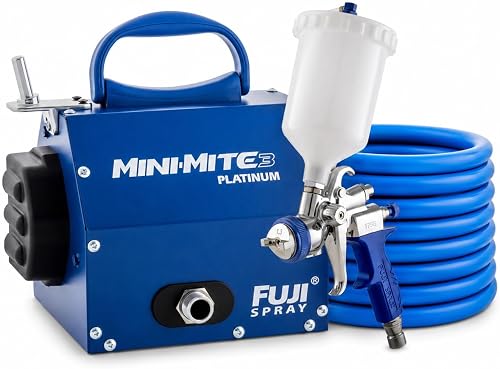
Fuji Spray 2903-T70 Mini-Mite 3 Platinum
Best for beginners stepping up - 6
 Best for hobby and weekend projectsCheck it
- 7
 Check it
Fuji Spray 2805-T75G Mini-Mite 5 Platinum
Best 5-stage gravity system - 8
 Check it
Fuji Spray 2905-T70 Mini-Mite 5 Platinum
Best 5-stage bottom-feed system - 9
 Check it
Fuji Spray 2803-T75G Mini-Mite 3 Platinum
Best compact 3-stage gravity system
Best Fuji HVLP spray systems for furniture, cabinets and shop work
The Semi-PRO 2 wins for detailed work at a lower stage. The Q5 Platinum wins when you want top pressure and quieter running.
Mini-Mite 3 and 4 models sit in the middle for most shop users. Choose by coating thickness and job size before you look at extras.
Fuji Spray 2203G Semi-PRO: Best for detailed furniture finishing
- 2-stage 1400 watt turbine
- 5 psi maximum pressure
- 400cc gravity cup
- 1.3mm air cap set installed
- 25ft hose with air control valve
A compact 2-stage turbine system with a gravity gun and pattern control for fine finishing work.
Pros
- Strong 2-stage motor for a 2-stage class
- Gravity cup for small finish volumes
- Pattern control from small round to wide fan
Cons
- Lower pressure than 4 and 5-stage picks
- 400cc cup needs more refills on large jobs
The Fuji Spray 2203G Semi-PRO suits finishers who spray chairs, tables and small parts. Its 1400 watt 2-stage turbine gives strong air for a 2-stage class, and Fuji rates it at 5 psi.
That suits lacquers, shellacs and thinned enamels on furniture sized work.
The 400cc gravity cup helps you mix small batches and clean up fast. Its 1.3mm air cap set is installed, which suits fine finishing rather than wall paint.
The M-Model gun is non-bleed, so air flows only when you pull the trigger, and the fan control knob adjusts pattern from small round to wide.
Trade-off is pressure. Thicker latex and heavy polyurethanes will need more thinning than with a 4 or 5-stage turbine.
If your work is mostly furniture, that limit rarely matters. If you spray cabinets all week, a Mini-Mite 4 or 5 will save thinning time.
Fuji Spray 3005-T70 Q5 Platinum: Best for maximum power and quiet work
- 5-stage turbine at 9.5 psi
- Variable speed control dial
- T70 non-bleed gun with pattern control
- 1 quart bottom-feed cup
- 25ft hose with air control valve
The most powerful Fuji system here, with a quiet 5-stage turbine and a 1 quart bottom-feed gun.
Pros
- Highest pressure in this group
- Variable speed control
- Large 1 quart cup for longer runs
Cons
- Heaviest turbine package here
- Bottom-feed cup needs care when refilling
The Fuji Spray 3005-T70 Q5 Platinum suits professional and serious hobby users who spray often. Its 5-stage turbine at 9.5 psi is the strongest output in this group with the Mini-Mite 5 models.
Fuji says that extra power lets you apply thicker coatings faster with less thinning.
The T70 gun is non-bleed with a side pattern control knob. Its 1 quart bottom-feed cup means fewer refills on doors and cabinets.
A variable speed control dial lets you turn motor speed down for delicate work. Fuji also adds patented noise reduction and a Heat Dissipation Chamber that channels heat out of the case.
Trade-off is size and weight. This is a heavy metal-case turbine, so it suits a shop bench more than carrying up stairs.
If you want top power and quieter operation, this is the pick. If you want a lighter gravity setup, the Mini-Mite gravity models are easier to move.
Fuji Spray 2904-T70 Mini-Mite 4 Platinum: Best for all-around shop finishing
- 4-stage Platinum turbine at 9 psi
- T70 bottom-feed gun with 1 quart cup
- Pattern control knob
- Heat Dissipation Chamber
- 25ft hose with air control valve
A 4-stage bottom-feed system with enough pressure for most coatings and a full quart cup.
Pros
- Strong 4-stage pressure
- 1 quart cup reduces refill breaks
- Heat Dissipation Chamber for cooler running
Cons
- No patented Q-model noise reduction
- Bottom-feed gun is less handy for small touch-ups
The Fuji Spray 2904-T70 Mini-Mite 4 Platinum suits cabinet and furniture shops that need a step up from 3 stages. Its 4-stage turbine at 9 psi handles all known coatings when properly thinned, according to Fuji.
That pressure gap over a 3-stage unit shows up with waterborne finishes and heavier enamels.
The T70 bottom-feed gun carries 1 quart, so you can finish a set of doors without stopping to refill. The side pattern control knob adjusts fan size on the fly.
The Heat Dissipation Chamber moves heat to the rear of the case, which Fuji says helps turbine life. The metal case has a handy gun holder.
Trade-off is noise and cup style. Fuji notes this model does not have the patented Q-model noise reduction, though noise is no more than a standard HVLP turbine.
Bottom feed also needs a steadier hand when you tilt the gun. For a 4-stage bottom-feed balance, this is the core pick.
Fuji Spray 2804-T75G Mini-Mite 4 Platinum: Best 4-stage gravity system
- 4-stage Platinum turbine at 9 psi
- T75G gravity gun with 600cc cup
- Pattern control knob
- Heat Dissipation Chamber
- 25ft hose with air control valve
The same 4-stage turbine as the bottom-feed Mini-Mite 4, paired with a 600cc gravity gun.
Pros
- 4-stage pressure with gravity feed
- 600cc cup for medium jobs
- Side pattern control knob
Cons
- No patented Q-model noise reduction
- Gravity cup tilts with steep gun angles
The Fuji Spray 2804-T75G Mini-Mite 4 Platinum suits users who want 4-stage power with gravity feed. It uses the same 4-stage turbine at 9 psi as the bottom-feed Mini-Mite 4.
Fuji positions that pressure for less thinning than a 3-stage model.
The T75G gravity gun carries 600cc, which is a good middle size for tabletops, chair sets and cabinet parts. Gravity feed makes small batches easy and cleanup is direct.
The side pattern control knob adjusts fan size from small to large. The gun is non-bleed with an ergonomic stay-cool handle.
Trade-off is cup angle and noise. A gravity cup can starve or spill if you spray steep overhead angles for long periods.
Like the other Mini-Mite 4, it lacks the Q-model patented noise reduction. If your jobs are mostly horizontal and small, gravity feed is simpler.
If you spray ceilings or tall work, bottom feed is safer.
Fuji Spray 2903-T70 Mini-Mite 3 Platinum: Best for beginners stepping up
- 3-stage Platinum turbine at 6.5 psi
- T70 bottom-feed gun with 1 quart cup
- Pattern control knob
- Heat Dissipation Chamber
- 25ft hose with air control valve
A 3-stage bottom-feed system that handles properly thinned coatings with a large cup.
Pros
- Large 1 quart cup
- 3-stage pressure for thinned coatings
- Lighter turbine than 5-stage picks
Cons
- Less pressure for thicker coatings
- No patented Q-model noise reduction
The Fuji Spray 2903-T70 Mini-Mite 3 Platinum suits beginners moving from a brush or a small electric sprayer. Its 3-stage turbine at 6.5 psi gives more pressure than 2-stage systems, according to Fuji, and handles properly thinned coatings plus waterborne finishes.
That makes it a practical first turbine system.
The T70 bottom-feed gun carries 1 quart, so you can spray a dresser or a set of interior doors with fewer stops. The side pattern control knob lets you narrow the fan for edges and widen it for flat panels.
The Heat Dissipation Chamber helps the turbine run cooler in the metal case.
Trade-off is thickness. Heavier, less thinned coatings will push this turbine harder than a 4 or 5-stage unit.
Fuji also notes no patented Q-model noise reduction here. For the price step and the work most beginners do, the extra pressure over 2 stages is worth it.
For heavy shop volume, step up to a 4-stage.
Fuji Spray 2250 Hobby-PRO: Best for hobby and weekend projects
- 2-stage turbine at 5 psi
- 1.8mm tip for thicker paint
- 1 quart bottom-feed cup
- Pattern control knob
- 25ft hose with air control valve
A hobby-focused 2-stage system with a larger 1.8mm tip for latex and larger surfaces.
Pros
- Larger tip for thicker paint
- 1 quart cup for fences and decks
- Bonus filters and cup parts included
Cons
- Lower pressure than Mini-Mite models
- Less suited to fine lacquer work
The Fuji Spray 2250 Hobby-PRO suits weekend users spraying fences, decks and larger painted surfaces. Its 2-stage turbine at 5 psi is aimed at the serious hobbyist, and Fuji installs a larger 1.8mm tip.
That tip helps with thicker latex paint that would struggle through a 1.3mm fine finishing setup.
The bottom-feed cup holds 1 quart, which suits long passes on outdoor wood. The M-Model non-bleed gun has a pattern control knob to adjust fan size from small to large.
It also has a stainless steel fluid nozzle and needle, and an insulated handle that Fuji says never gets hot. Bonus filters and a bottom-feed cup parts kit are included.
Trade-off is fine finishing. The larger tip and 5 psi output are not ideal for glass-smooth lacquer on fine furniture.
Choose this for thicker paint and larger surfaces. Choose a Semi-PRO 2 or Mini-Mite model for fine furniture work with a 1.3mm cap set.
Fuji Spray 2805-T75G Mini-Mite 5 Platinum: Best 5-stage gravity system
- 5-stage turbine at 9.5 psi
- T75G gravity gun with 600cc cup
- Noise reduction feature
- Heat Dissipation Chamber
- 25ft hose plus 6ft whip hose
A 5-stage gravity system with noise reduction and a whip hose for more gun movement.
Pros
- Joint top pressure in this group
- 600cc gravity cup
- Whip hose helps with gun control
Cons
- Gravity cup limits steep angles
- Heavier than 3-stage systems
The Fuji Spray 2805-T75G Mini-Mite 5 Platinum suits users who want top power in a gravity gun. Its 5-stage turbine at 9.5 psi matches the Q5 Platinum output.
Fuji recommends it for those who want extra power available for heavier coatings and faster application.
The T75G gravity gun carries 600cc and uses a standard #3 1.3mm air cap set for fine finishing with lacquers, enamels, polyurethanes and latex. The 25ft hose plus a 6ft whip hose gives you more freedom to move the gun without dragging the main hose.
Noise reduction covers and the Heat Dissipation Chamber are part of the Platinum design.
Trade-off is cup size and handling. The 600cc gravity cup will need refills on large cabinet jobs where a 1 quart bottom-feed cup wins.
Gravity feed also limits steep angles. If you want 5-stage power for furniture sized work and prefer gravity, this is the match.
If you spray large vertical panels, consider the 5-stage bottom-feed version.
Fuji Spray 2905-T70 Mini-Mite 5 Platinum: Best 5-stage bottom-feed system
- 5-stage turbine at 9.5 psi
- T70 gun with 1 quart cup
- Noise reduction feature
- Heat Dissipation Chamber
- 25ft hose plus 6ft whip hose
A 5-stage bottom-feed system with a quart cup and whip hose for long finishing runs.
Pros
- Top 5-stage pressure
- 1 quart cup
- Noise reduction and HDC
Cons
- Bottom-feed cup needs careful handling
- Larger package than 3-stage picks
The Fuji Spray 2905-T70 Mini-Mite 5 Platinum suits long finishing runs that need top pressure. It shares the 5-stage turbine at 9.5 psi with the Q5 system.
Fuji says added power allows heavier coatings and thicker finishes to be applied faster with less thinning time.
The T70 gun carries 1 quart in a bottom-feed cup, so you can spray doors, cabinets and large panels with fewer stops. The standard #3 1.3mm air cap set suits fine finishing.
A 25ft hose plus a 6ft whip hose helps with gun movement. Noise reduction covers and the Heat Dissipation Chamber help the turbine run cooler and quieter than a standard turbine.
Trade-off is package size. This is a fuller shop setup than a 3-stage Mini-Mite, and bottom feed needs care when you refill or tilt the gun.
It also costs more in effort to move around a small shop. If your work is large and frequent, the power pays.
If your work is small furniture, a 3 or 4-stage gravity system is simpler.
Fuji Spray 2803-T75G Mini-Mite 3 Platinum: Best compact 3-stage gravity system
- 3-stage Platinum turbine at 6.5 psi
- T75G gravity gun with 600cc cup
- Pattern control knob
- Heat Dissipation Chamber
- 25ft hose with air control valve
A 3-stage gravity system with a 600cc cup for furniture sized work at a lower stage.
Pros
- Gravity feed for small jobs
- 600cc cup
- Heat Dissipation Chamber
Cons
- Lower pressure for thick coatings
- No patented Q-model noise reduction
The Fuji Spray 2803-T75G Mini-Mite 3 Platinum suits small shop users who want gravity feed at 3 stages. Its 3-stage turbine at 6.5 psi sits above the 2-stage systems and below the 4-stage picks.
Fuji says it handles properly thinned coatings and waterborne finishes.
The T75G gravity gun carries 600cc, which is enough for chair sets, small tables and touch-up work. The side pattern control knob adjusts fan size, and the gun is non-bleed with an ergonomic stay-cool handle.
The Heat Dissipation Chamber adds to the Platinum turbine design. The 25ft hose includes an air control valve to reduce overspray and bounce back.
Trade-off is pressure and noise. Thicker coatings will need more thinning than with a 4-stage Mini-Mite.
Fuji notes no patented Q-model noise reduction, though noise matches a standard HVLP turbine. For small gravity jobs on a tighter budget step, this is a solid entry.
For regular cabinet work, the 4-stage gravity model is the better long-term pick.
How we compared these Fuji spray systems
We compared turbine stage, maximum pressure, cup type and capacity, nozzle size where stated, hose length, noise features and included accessories. We checked specs for each Fuji system and grouped them by finishing workload.
A 2-stage system at 5 psi suits fine finishes and thinned paint. A 3-stage system at 6.5 psi adds margin for waterborne coatings.
A 4-stage system at 9 psi reduces thinning for most shop coatings. A 5-stage system at 9.5 psi adds top power for thicker finishes and longer work days.
Cup choice mattered as much as stage. Gravity cups at 400cc and 600cc suit small batches.
Bottom-feed cups at 1 quart suit doors and cabinets. We also weighed noise features, since Q and Mini-Mite 5 Platinum models list noise reduction while Mini-Mite 3 and 4 models do not list the patented Q feature.
How many turbine stages do you need for Fuji HVLP?
You need 2 stages for furniture and hobby work, 3 or 4 stages for general shop work, and 5 stages for thick coatings and high volume. More stages mean more pressure and less thinning.
2 stages for fine finishing
A 2-stage turbine at 5 psi suits lacquer, shellac and thinned enamel on furniture. The Semi-PRO 2 and Hobby-PRO use this class.
The Hobby-PRO adds a 1.8mm tip for thicker latex on larger surfaces.
3 stages for a first upgrade
A 3-stage turbine at 6.5 psi suits beginners who spray dressers, doors and trim. Fuji says a 3-stage system handles properly thinned coatings and waterborne finishes.
Gravity and bottom-feed versions are both available in the Mini-Mite 3 line.
4 stages for most shops
A 4-stage turbine at 9 psi is the middle ground for cabinets and furniture. It reduces thinning compared with 3 stages.
If you spray weekly, this class often pays for itself in prep time.
5 stages for top power
A 5-stage turbine at 9.5 psi suits heavy coatings and long runs. The Q5 and Mini-Mite 5 models use this class.
Choose it when pressure matters more than package weight.
Should you pick gravity feed or bottom feed?
Pick gravity feed for small jobs and bottom feed for long runs. Gravity cups at 400cc and 600cc are quick to fill for small batches.
Bottom-feed cups at 1 quart cut refill stops on doors and cabinets.
Gravity feed is handy for touch-ups and small parts. It also makes cleanup direct when you switch colors.
Bottom feed lets you spray at varied angles without starving the gun, which helps on tall or vertical work.
If you often spray overhead or at steep angles, bottom feed is safer. If you mostly spray flat panels and small parts, gravity feed is simpler.
Many buyers own one gun and choose based on their most common job size.
How much PSI does a paint sprayer need for Fuji turbines?
Fuji turbine systems here range from 5 psi to 9.5 psi, and you should match that range to coating thickness. Higher pressure atomizes thicker paint with less thinning.
Our guide on How Much PSI Does a Paint Sprayer Need? explains pressure in general terms for compressor and turbine systems.
A 2-stage system at 5 psi works for fine finishes and thinned coatings. A 3-stage system at 6.5 psi adds room for waterborne finishes.
A 4-stage system at 9 psi and a 5-stage system at 9.5 psi suit heavier enamels and polyurethanes.
Turbine pressure is not the same as compressor PSI at the gun. HVLP turbine systems run at low pressure by design.
That low pressure helps transfer efficiency and reduces overspray compared with high pressure conventional spraying.
Which Fuji system is quieter for indoor use?
The Q5 Platinum and Mini-Mite 5 Platinum are the quieter picks here because they list noise reduction features. The Q5 uses patented noise reduction plus a Heat Dissipation Chamber.
Mini-Mite 5 models also list noise reduction covers and HDC.
Mini-Mite 3 and 4 models do not have the patented Q-model noise reduction. Fuji says their noise level is no more than a standard HVLP turbine.
That puts them in the normal turbine range rather than a quiet class.
If you spray in a shared space, choose a model with listed noise reduction. Also plan for ventilation and hearing protection regardless of model.
Turbine systems are quieter than many compressor setups, but they are not silent.
When should you look beyond Fuji to another sprayer type?
Look beyond Fuji when you need wall paint speed, compressor air, or a lower cost electric option. If you compare options, our best electric HVLP spray gun guide covers corded electric models for home use.
Our best HVLP turbine spray gun guide covers turbine systems from other brands, and our best Graco paint sprayer guide covers airless and air-assisted options for house painting. A guide to designing an air compressor system helps if you prefer a compressor and a separate spray gun.
For large house painting jobs, a best paint spray gun for house painting guide may point you to a different tool class. Fuji turbines shine for furniture and cabinets.
Airless systems often win for walls and fences at scale.
How should you set up and care for a Fuji HVLP system?
You should thin coatings to the viscosity cup, strain paint, and test pattern on cardboard first. Fuji includes a viscosity cup with most systems here.
That cup helps you match thickness to turbine pressure.
Set pattern size with the side or rear knob, then set fluid flow for an even fan. Use the air control valve on the 25ft hose to reduce overspray and bounce back.
Keep the turbine intake filter clean and let the Heat Dissipation Chamber do its job by leaving rear vents clear.
Clean the gun right after use with the included brush and wrench. Flush with the right solvent for your coating type.
Store the hose without tight coils and keep the turbine case dry in a dust-free spot.
Our verdict on the best Fuji HVLP spray systems
Pick the Fuji Spray 2203G Semi-PRO if you finish furniture and want fine control at 2 stages. Pick the Fuji Spray 3005-T70 Q5 Platinum if you want top 5-stage power with noise reduction.
Pick a Mini-Mite 4 if you want strong shop pressure without going to 5 stages.
Pick the Mini-Mite 3 if this is your first turbine system and you spray thinned coatings. Pick the Hobby-PRO if you spray thicker latex on fences and decks.
Match stage to coating thickness, cup size to job size, and noise features to your space, and the best Fuji HVLP spray system for you will be clear.
Our top 3 picks at a glance
-
1
-
2
Best for maximum power and quiet work
Fuji Spray 3005-T70 Q5 Platinum
9.6/10 our score
See it on Amazon -
3
Best for all-around shop finishing
Fuji Spray 2904-T70 Mini-Mite 4 Platinum
9.4/10 our score
See it on Amazon
Frequently asked questions
How many turbine stages do I need?
Choose 2 stages for small furniture and hobby work with thinned finishes. Choose 3 or 4 stages for cabinets and larger shop work.
Choose 5 stages for thicker coatings and faster work.
More stages add pressure, weight and cost.
Is gravity feed or bottom feed better?
Gravity feed suits small jobs and easy cleanup of small volumes. Bottom feed suits long runs with a 1 quart cup and spraying at varied angles.
Pick the cup you will refill less often for your typical job size.
What pressure do Fuji turbine systems produce?
In this group, 2-stage systems reach about 5 psi, 3-stage systems reach about 6.5 psi, 4-stage systems reach about 9 psi, and 5-stage systems reach about 9.5 psi. Higher pressure atomizes thicker coatings with less thinning.