9 Best Quiet High CFM Air Compressors (November 2026)
The best quiet high CFM air compressors include the California Air Tools 10020C 2.0 HP Ultra for high airflow with less noise, the VEVOR Air Compressor for a larger oil-free tank, and the VEVOR 13-Gallon Air Compressor for quiet general workshop use.
On this page (14 sections)
- The best quiet high CFM air compressors compared
- California Air Tools 10020C: Best for high airflow with less noise
- VEVOR 15-Gallon: Best for a larger oil-free tank
- VEVOR 13-Gallon: Best for quiet general workshop use
- RyanTek 15-Gallon: Best for quiet vertical storage
- Stealth 20 Gallon: Best for maximum tank capacity
- Makita MAC2400: Best for an oil-lubricated pump
- Limodot 5-Gallon: Best for included hose and tools
- Metabo HPT Quiet Air Compressor: Best for compact quiet portability
- Metabo HPT Portable Pancake: Best for multiple nailers
- How do you choose CFM for a quiet air compressor?
- Does a bigger tank make an air compressor quieter?
- How should you set up a quiet high CFM air compressor?
- Which quiet high CFM air compressor should you buy?
The best quiet high CFM air compressor for most workshops is the California Air Tools 10020C, with 5.30 CFM at 90 PSI and a 70 dB noise level.
That mix suits people who work in a garage or shop and need airflow without the loudest running noise.
Choose VEVOR for a larger 15-gallon tank.
Choose Stealth for 20 gallons of stored air.
Choose Metabo HPT for compact portability and easier carrying.
We compared airflow, tank capacity, stated noise levels, pump type, portability and the tasks each compressor suits.
A high CFM rating helps support air-hungry tools.
A quieter compressor may still need a larger tank or more recovery time for continuous work.
CFM at 90 PSI is a useful point of comparison because many tools are rated around that pressure.
Tank size helps with how long a tool can run before the motor has to cycle again.
Noise level helps with whether you can work indoors, talk nearby or share the space with others.
Pump type changes routine care, with oil-free designs avoiding oil changes and oil-lubricated designs calling for oil checks.
Portability changes where you can use the unit, from a fixed workshop spot to moving between rooms or jobsites.
We also looked at weight and size because a compressor that is hard to move may end up unused.
If low noise is your first concern, see our guide to the Best Quiet Air Compressor.
Buyers who need a smaller unit can also compare the best quiet compact air compressor.
Use the links above to narrow the choice before you look at individual models.
Match a tool to the compressor first, then check tank size and noise.
That order tends to prevent paying for capacity that your tools will not use.
It also helps you avoid a unit that is quiet on paper but too small for steady work.
Start with the tool, then work through pressure, airflow, tank and sound.
Our picks at a glance
-
1
 Best for high airflow with less noise
California Air Tools 10020C 2.0 HP Ultra
8.8/10 our score
See it on Amazon -
2
-
3
 Best for quiet general workshop use
VEVOR 13-Gallon Air Compressor
9.6/10 our score
See it on Amazon
- 4
 Check it
RyanTek 15-Gallon Air Compressor
Best for quiet vertical storage - 5
 Check it
Stealth 20 Gallon Ultra Quiet Air Compressor
Best for maximum tank capacity - 6
 Check it
Makita MAC2400 2.5 HP* Big Bore™ Air
Best for an oil-lubricated pump - 7
 Check it
Limodot Quiet Oil-Free Air Compressor
Best for included hose and tools - 8
 Check it
Metabo HPT Quiet Air Compressor
Best for compact quiet portability - 9
 Check it
Metabo HPT Portable Pancake Air Compressor
Best for multiple nailers
The best quiet high CFM air compressors compared
The best quiet high CFM air compressors split into 3 groups: high-airflow workshop units, large-tank compressors and compact models for lighter tasks.
The California Air Tools 10020C leads on the balance of airflow and noise.
High-airflow workshop units suit spray work, sanding and tools that use air in short bursts.
Large-tank compressors suit longer sessions because stored air can carry a tool while the motor catches up.
Compact models suit trim, repair and light nailing where carrying the unit matters more than reserve air.
Our score weighs specs, features and buyer feedback against what you're shopping for.
Noise figures are manufacturer-stated values, so room acoustics, distance and the work surface can change how loud a compressor seems.
A hard floor can carry more vibration than a mat or a soft surface.
A closed garage can also make a unit sound louder than the same unit used outdoors.
Distance matters because even a small change in where you stand can affect perceived loudness.
Treat dB figures as a guide for comparison rather than a promise about your exact room.
Check the full specs for each model before you decide.
Look at CFM at the pressure your tool needs, not just the headline number.
Look at tank size to judge how often the motor will cycle.
Look at weight and dimensions to judge storage, lifting and movement.
That wider check gives a clearer picture than any single score.
| Product | Best for | Tank | Airflow | Noise | Our score |
|---|---|---|---|---|---|
| California Air Tools 10020C 2.0 HP Ultra | high airflow with less noise | 10 gallons | 5.30 CFM at 90 PSI | 70 dB | 8.8 |
| VEVOR Air Compressor | a larger oil-free tank | 15 gallons | 5.3 CFM at 90 PSI | 9.4 | |
| VEVOR 13-Gallon Air Compressor | quiet general workshop use | 13 gallons | 4.6 SCFM at 90 PSI | 9.6 | |
| RyanTek 15-Gallon Air Compressor | quiet vertical storage | 15 gallons | 4.5 CFM at 90 PSI | 8.7 | |
| Stealth 20 Gallon Ultra Quiet Air Compressor | maximum tank capacity | 20 gallons | 5 CFM at 90 PSI | 8.6 | |
| Makita MAC2400 2.5 HP* Big Bore™ Air | an oil-lubricated pump | 4.2 gallons | 4.2 CFM at 90 PSI | 9.5 | |
| Limodot Quiet Oil-Free Air Compressor | included hose and tools | 5 gallons | 2.8 CFM at 90 PSI | 9.4 | |
| Metabo HPT Quiet Air Compressor | compact quiet portability | 1 gallon | 59 dB | 9.6 | |
| Metabo HPT Portable Pancake Air Compressor | multiple nailers | 6 gallons | 4 CFM at 90 PSI | 73 dB | 9.5 |
California Air Tools 10020C: Best for high airflow with less noise
California Air Tools 10020C 2.0 HP Ultra: Best for high airflow with less noise
- 5.30 CFM at 90 PSI
- 70 dB noise level
- 10-gallon steel tank
- Oil-free dual piston pump
The 10-gallon tank and 5.30 CFM at 90 PSI make this the strongest airflow choice here for a quieter shop or garage.
Pros
- Highest airflow in this group
- Oil-free pump
- Wheels for moving it
Cons
- 82.5 lb weight
- Taller 35.9 in design
The California Air Tools 10020C is the top pick because it delivers 5.30 CFM at 90 PSI while operating at a stated 70 dB. That airflow gives it the strongest position here for tools that need a steady supply, including workshop spray-painting setups when the gun's requirements fit.
Its 10-gallon steel tank balances stored air with a footprint that is smaller than the 15- and 20-gallon choices. Wheels help you move the 82.5 lb compressor around a garage or shop, but this is still a unit to place carefully before connecting a hose.
The oil-free dual piston pump keeps routine oil changes out of the setup. California Air Tools states that the pump has a life cycle of over 3,000 hours, while the 2 HP motor runs at 1,680 RPM.
Choose it when airflow matters more than the smallest footprint. For a taller compressor with more stored air, compare it with our guide to the best large quiet air compressor.
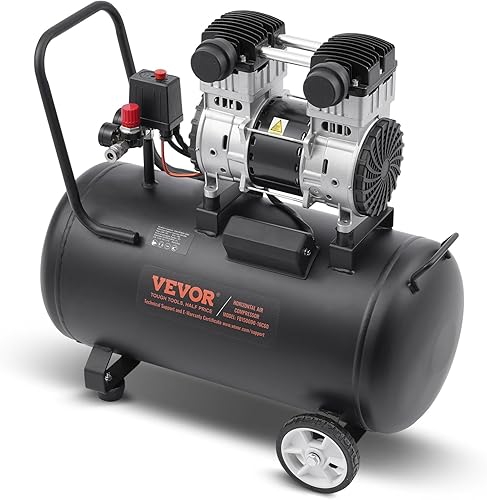
VEVOR 15-Gallon: Best for a larger oil-free tank
VEVOR Air Compressor: Best for a larger oil-free tank
- 15-gallon steel tank
- 5.3 CFM at 90 PSI
- 78 dB noise level
- 2 HP oil-free motor
This VEVOR combines a 15-gallon tank with 5.3 CFM at 90 PSI for auto repair, spray painting, tire inflation and pneumatic tools.
Pros
- Large tank
- High airflow
- Oil-free operation
Cons
- 78 dB is louder than the top pick
- 81.6 lb weight
The VEVOR 15-gallon compressor gives you 5.3 CFM at 90 PSI and a 125 PSI maximum, so it matches the California Air Tools model on stated 90 PSI airflow while offering a larger tank.
Its 2 HP oil-free motor runs at 1,680 RPM.
The compressor uses a silencer with a thickened cover, rubber muffler pipe and filter cotton, but its stated noise level is 78 dB, so it is not as quiet as the 66 to 70 dB choices.
This model suits auto repair, tire inflation, spray painting and pneumatic tools.
It weighs 81.6 lb and measures 28.3 x 15.4 x 28 in, so measure the route to your work area before settling on a permanent position.
A larger tank can reduce motor cycling during intermittent tasks.
That can help when you move between inflating a tire, blowing debris and using a tool.
The trade-off is sound, because 78 dB sits above the quieter workshop picks here.
It also takes more floor space than a compact or vertical layout.
Place it where ventilation is open and hoses can run without crossing walkways.
Check fittings and hose size before first use so tools connect without strain.
Drain moisture as directed and keep the filter area clean for steady output.
Choose it when stored air and 5.3 CFM matter more than minimum noise.
Its oil-free design also keeps oil changes out of routine care.
VEVOR 13-Gallon: Best for quiet general workshop use
VEVOR 13-Gallon Air Compressor: Best for quiet general workshop use
- 13-gallon tank
- 4.6 SCFM at 90 PSI
- 66 dB noise level
- 2 HP oil-free motor
A 13-gallon tank, 4.6 SCFM at 90 PSI and 66 dB operation give this model a useful balance for home workshops.
Pros
- Quiet 66 dB operation
- Large tank
- Wheels and included parts
Cons
- 71 lb weight
- Less airflow than the California Air Tools model
The VEVOR 13-Gallon Air Compressor is a balanced workshop pick with 4.6 SCFM at 90 PSI, a 2 HP motor and a stated 66 dB noise level. Its 13-gallon tank provides more reserve than the compact models without reaching the size of a 20-gallon unit.
The oil-free tank design is aimed at low-maintenance use. Two 7-inch reinforced rubber wheels help move the 71 lb compressor between indoor and outdoor work areas.
The package includes 2 plastic air filters, 2 wheels, 2 foot pads, 2 pressure gauges, mounting screws and a manual. That makes it useful for buyers assembling a basic workshop station, although you should still confirm that your hose and tool fittings match.
Choose this model for a practical mix of noise, tank size and general-purpose use. Its 4.6 SCFM output is below the highest-airflow picks, but it remains suitable for inflation, woodworking, auto repair and spray painting when tool requirements fit.
RyanTek 15-Gallon: Best for quiet vertical storage
RyanTek 15-Gallon Air Compressor: Best for quiet vertical storage
- 15-gallon tank
- 4.5 CFM at 90 PSI
- 66 dB noise level
- Twin-cylinder oil-free pump
The vertical 15-gallon design saves floor space while delivering 4.5 CFM at 90 PSI for inflation, nailing, painting and workshop tasks.
Pros
- 66 dB operation
- Vertical footprint
- Wheels and handle
Cons
- 68.3 lb weight
- Lower airflow than the 5.3 CFM models
RyanTek's 15-gallon compressor uses a vertical tank to save floor space while delivering 4.5 CFM at 90 PSI.
Its stated 66 dB noise level makes it a strong choice for a home workshop where both sound and storage area matter.
The 2 HP twin-cylinder oil-free pump reaches 125 PSI.
Wheels and a handle help with movement, and the upward-facing gauge keeps the controls visible when the compressor is positioned near a wall.
Included parts are 2 plastic shell air filters, 2 7-inch rubber wheels and 2 foot pads.
The compressor weighs 68.3 lb, so it is easier to reposition than the 20-gallon Stealth but still needs a clear path and stable floor.
The vertical layout can fit beside a bench or against a wall more easily than a wide horizontal tank.
That shape may suit smaller garages where floor space is tight.
The airflow is slightly below the 5.3 CFM models, so check spray gun and sander requirements first.
For nailing, inflation and general workshop use, the balance of tank and output is practical.
Keep the gauge side accessible so pressure checks do not require moving the unit.
Leave space around the pump for cooling and filter care.
Inspect wheels, pads and fittings before moving it across a floor.
Choose RyanTek when you want a large tank in a vertical layout.
It gives up a small amount of airflow compared with the 5.3 CFM units.
Stealth 20 Gallon: Best for maximum tank capacity
Stealth 20 Gallon Ultra Quiet Air Compressor: Best for maximum tank capacity
- 20-gallon steel tank
- 5 CFM at 90 PSI
- 68 dB noise level
- Oil-free 1.8 HP motor
The 20-gallon tank gives this Stealth the most stored air in the group, while 5 CFM at 90 PSI supports larger pneumatic tasks.
Pros
- Largest tank here
- 68 dB operation
- Two quick couplers
Cons
- 121.4 lb weight
- 42 in height
The Stealth 20 Gallon is the choice for buyers who want the most stored air in this group.
Its 20-gallon steel tank pairs with 5 CFM at 90 PSI, a 1.8 HP oil-free motor and a 150 PSI peak rating.
At 68 dB, it is quieter than the Makita and Metabo HPT pancake compressor, though not as quiet as the 59 dB Metabo HPT compact model.
Two quick couplers make it easier to switch between connected tools.
The trade-off is size and weight.
The Stealth measures 20 x 18 x 42 in and weighs 121.4 lb, so it is best treated as a workshop or garage compressor rather than a carry-around unit.
The large tank can support longer sessions with fewer motor cycles.
That helps with nailers and inflation work where pauses would slow progress.
The tall cabinet needs overhead clearance and a firm place on the floor.
Wheels help with movement, but they do not turn a 121.4 lb unit into a light carry.
Plan the route from delivery, storage and work area before you buy.
Check that the 150 PSI peak and 5 CFM at 90 PSI fit your tools.
Some tools work best at lower pressure, so set the regulator rather than relying on tank pressure.
Two couplers can make tool changes quicker when you switch tasks.
Choose it for longer sessions with nailers, inflation tools or other pneumatic equipment that benefits from a large reserve.
Measure overhead and floor clearance before choosing the 42 in cabinet.
Makita MAC2400: Best for an oil-lubricated pump
Makita MAC2400 2.5 HP* Big Bore™ Air: Best for an oil-lubricated pump
- 4.2 CFM at 90 PSI
- 79 dB noise level
- 4.2-gallon tank
- Cast iron Big Bore pump
The Makita uses an oil-lubricated cast iron pump and delivers 4.2 CFM at 90 PSI, making it a durable jobsite option when quietness is relative.
Pros
- Cast iron pump
- Low-RPM operation
- Roll-cage construction
Cons
- 79 dB noise level
- 77 lb weight
The Makita MAC2400 delivers 4.2 CFM at 90 PSI through a cast iron Big Bore pump and a 2.5 HP motor.
Its oil-lubricated design is different from the oil-free compressors above, so plan for the care required by an oil pump.
Makita says the pump runs at a lower 1,730 RPM and produces a stated 79 dB.
The 4.2-gallon twin-stack tank is smaller than the workshop tanks here, while the roll-cage construction protects the compressor during jobsite movement.
The low amp draw is designed to reduce tripped breakers at startup.
The compressor includes compressor oil and a coupling, and its stated maximum pressure is 130 PSI.
The cast iron pump is built for durability in demanding work.
Lower RPM operation can also affect wear and sound compared with faster pumps.
The smaller tank means the motor will cycle more often during steady use.
That is a practical trade-off for a compact jobsite footprint.
The roll cage helps when the unit is moved, loaded or worked around.
Oil care is the main routine difference from the oil-free models.
Check oil level before use and follow Makita instructions for service.
Keep the air filter clean so the pump can draw air efficiently.
Low amp draw may help on shared circuits at startup.
Choose the Makita when cast iron construction, a low-RPM pump and oil-lubricated operation matter more than the lowest noise figure.
It is not the quietest choice for an enclosed workspace.
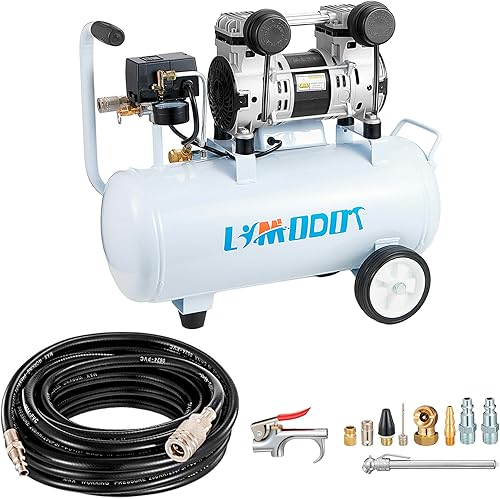
Limodot 5-Gallon: Best for included hose and tools
Limodot Quiet Oil-Free Air Compressor: Best for included hose and tools
- 5-gallon tank
- 2.8 CFM at 90 PSI
- 68 dB noise level
- 25 ft hose and 13-piece accessory kit
The Limodot includes a 25 ft PVC air hose and 13-piece air tool accessories kit, which helps buyers starting a small pneumatic setup.
Pros
- 68 dB operation
- Included hose and accessories
- Oil-free design
Cons
- Lower airflow
- Smaller tank than the larger picks
The Limodot gives you a 5-gallon tank, 2.8 CFM at 90 PSI and a stated 68 dB noise level. It is a useful starter setup because it includes a 25 ft PVC air hose, a 13-piece air tool accessories kit and a wheels kit.
The 1.2 HP oil-free compressor reaches 120 PSI. Limodot states that the tank can refill from empty in 80 seconds and recover in 25 seconds, which may help during intermittent nailing or inflation work.
This model supports tasks such as staple guns, brad nail guns, roofing nail guns, airbrushes, blow guns and tire inflation when the tool's air requirement stays within the compressor's output. Its 5-gallon tank is easier to place than the larger workshop models.
Choose it when the included hose and accessories reduce the number of separate setup decisions. Choose a higher-CFM model for continuous spray work or tools with larger air demands.
Metabo HPT Quiet Air Compressor: Best for compact quiet portability
Metabo HPT Quiet Air Compressor: Best for compact quiet portability
- 1-gallon tank
- 59 dB noise level
- 25.2 lb weight
- Universal quick coupler
At 25.2 lb and 59 dB, this 1-gallon Metabo HPT is the easiest pick to carry between rooms or jobsites where low noise matters most.
Pros
- Quietest model here
- Lightest model here
- Quick coupler
Cons
- Smallest tank
- Not suited to sustained high-airflow work
The Metabo HPT Quiet Air Compressor is the quietest and lightest pick here, with a stated 59 dB noise level, a 1-gallon tank and a 25.2 lb weight.
Its compact design suits indoor repairs, trim work and jobs where you carry the compressor often.
The oil-free motor needs no routine oil changes, and an overload protection circuit cuts power if the motor overloads.
A universal quick coupler supports quick changes between compatible nailers and other tools.
The integrated control panel allows PSI adjustments, while the rubber handle and steel roll cage make carrying easier.
Its small tank is the clear trade-off, so it is not the right match for sustained high-CFM work.
The low noise level can make a real difference in a home or shared space.
You may be able to talk nearby while the unit cycles.
The light weight makes stairs, ladders and room moves more manageable.
The 1-gallon tank is best for short bursts and lighter tools.
Long spray passes or continuous sanding would drain that reserve quickly.
The quick coupler helps when you move between compatible tools.
The control panel helps you set pressure for the task instead of using full tank pressure.
Keep the handle and cage in mind when you lift it by one hand.
Store it where the coupler and panel stay clean and accessible.
Choose it when quiet portability matters more than tank reserve.
For a larger quiet model, compare it with the Best Large Quiet Air Compressors.
Metabo HPT Portable Pancake: Best for multiple nailers
Metabo HPT Portable Pancake Air Compressor: Best for multiple nailers
- 6-gallon tank
- 4 CFM at 90 PSI
- 200 PSI rating
- 42 lb portable design
Metabo HPT's 6-gallon pancake compressor supplies 4 CFM at 90 PSI and is designed to run multiple framing, roofing, siding, finish or brad nailers.
Pros
- 4 CFM airflow
- 200 PSI rating
- Portable 42 lb design
Cons
- 73 dB noise level
- Smaller tank than workshop models
The Metabo HPT Portable Pancake Air Compressor supplies 4 CFM at 90 PSI from a 6-gallon tank. Its stated 200 PSI rating and 42 lb weight make it a jobsite-focused option for buyers who need more pressure and portability than a large workshop compressor provides.
Metabo HPT says the compressor can run 2 framing nailers, 2 roofing nailers, 2 siding nailers, 3 finish nailers or 5 brad nailers simultaneously. Those tool counts are maker-stated use claims, so check each nailer's actual air requirement before connecting several tools.
The compressor operates at a stated 73 dB, which is louder than the quietest picks here. Its pancake shape remains easier to store and move than the 15- and 20-gallon models.
Choose it for portable nailing work and multiple compatible nailers. Pick a quieter oil-free tank model if your main goal is reducing sound in an enclosed room.
How do you choose CFM for a quiet air compressor?
Choose a compressor by its delivered CFM at the PSI your tool uses, then compare tank size and noise. The highest tank capacity does not automatically mean the highest airflow, as the 20-gallon Stealth delivers 5 CFM at 90 PSI while the 10-gallon California Air Tools model delivers 5.30 CFM.
Read our guide to What Is CFM on an Air Compressor? before comparing numbers from different pressure points. A compressor rated at 6.40 CFM at 40 PSI may show a lower figure at 90 PSI.
For nailers, match the compressor to the number of tools you plan to run. The Metabo HPT pancake model is built around multiple nailers, while the smaller Metabo HPT EC28M is better suited to lighter, intermittent use.
For spray painting, compare the spray gun's CFM requirement with the compressor's CFM at the gun's working pressure. A larger tank can reduce cycling during short passes, but it cannot replace adequate delivered airflow.
Does a bigger tank make an air compressor quieter?
A bigger tank can reduce how often the motor starts during intermittent work, but it does not change the compressor's stated operating noise.
The Stealth has the largest tank here at 20 gallons and a 68 dB rating, while the 1-gallon Metabo HPT is rated at 59 dB.
That gap shows why tank size and sound level should be judged separately.
A large tank stores more air for tools between motor cycles.
It does not make the pump itself run more quietly.
A small quiet unit can still be the better sound choice for indoor work.
A large tank can still be loud if its pump rating is higher.
Think about your work pattern first.
Short bursts favour a quieter pump and a smaller tank.
Longer sessions favour stored air so tools keep running while the motor recovers.
Place the compressor on a stable surface and leave room around its cooling areas.
Keep hoses arranged so they do not create a trip hazard, and use the correct fittings for your tool.
A mat or firm floor can change how vibration travels through the room.
Close walls and corners can also make sound feel stronger.
Keep the unit away from where you mainly work if noise is a concern.
If sound control is the main goal, start with the published dB figure.
If work time is the main goal, compare both the tank size and CFM at the pressure your tool needs.
Both checks matter because a quiet unit with too little air can stall a job.
A large tank with high noise can also make indoor work unpleasant.
Match tank, airflow and sound to the room and the task.
That balance will suit you better than size alone.
How should you set up a quiet high CFM air compressor?
Set up the compressor on a stable surface with enough room for ventilation, then connect a correctly sized hose and inspect the fittings before use.
Keep the tank drain and gauges accessible so routine checks do not require moving the unit.
Choose a spot where the power cord will not be pulled or trapped.
Route the hose along walls or under benches where you can manage it safely.
Oil-free models reduce oil-related maintenance, but they still need general care.
Keep air filters clear, drain moisture as directed by the manual and inspect hoses, couplers and power cords before work.
Clean filters help the pump work efficiently and keep output steadier.
Moisture in the tank can affect tools and shorten the life of parts.
Check couplers for wear before they start to leak under pressure.
Set the regulator pressure for the tool rather than filling to tank maximum.
That can improve control and reduce wasted air.
The Makita MAC2400 is oil-lubricated, so its care routine differs from the oil-free models.
Use the correct compressor oil and follow Makita's maintenance instructions for the pump.
Check oil before use and keep the pump area clean.
Follow the manual for drain intervals and filter care on every model.
High CFM equipment can supply tools quickly, but compressed air remains hazardous.
Wear suitable eye and hearing protection, never point air at people, and follow the compressor and tool manuals.
Keep bystanders clear of the hose path and tool exhaust.
Release pressure before you change tools or fittings.
Store the unit dry and upright where practical.
Which quiet high CFM air compressor should you buy?
The California Air Tools 10020C is the best overall pick when you want 5.30 CFM at 90 PSI, a 10-gallon tank and a 70 dB noise level.
Choose the VEVOR 13-Gallon for a quieter 66 dB workshop balance, the Stealth for a 20-gallon reserve, or the Metabo HPT EC28M for the quietest portable setup.
Choose the VEVOR 15-Gallon when 5.3 CFM and a larger tank matter more than low noise.
Choose the Metabo HPT pancake compressor for multiple nailers, and the Limodot when an included hose and accessory kit are useful.
For the next step, compare your tool's required CFM at its working PSI with the compressor's published output.
That single check will narrow the best quiet high CFM air compressors more reliably than tank size or horsepower alone.
Our top 3 picks at a glance
-
1
Best for high airflow with less noise
California Air Tools 10020C 2.0 HP Ultra
8.8/10 our score
See it on Amazon -
2
-
3
Best for quiet general workshop use
VEVOR 13-Gallon Air Compressor
9.6/10 our score
See it on Amazon
Frequently asked questions
What is the best quiet high CFM air compressor?
The California Air Tools 10020C is the strongest overall match because it combines 5.30 CFM at 90 PSI with a 70 dB noise level and a 10-gallon tank.
Choose the VEVOR 15-gallon model for more stored air, or Stealth for the largest 20-gallon tank.
How much CFM do I need for pneumatic tools?
Match the compressor's delivered CFM at your tool's working PSI, then allow extra capacity for cycling and pressure loss. The models here range from 2.8 to 5.3 CFM at 90 PSI.
Check the tool's required CFM before choosing a compressor, especially for spray guns, grinders and sanders.
Are quiet air compressors powerful enough for painting?
Some are. The California Air Tools 10020C delivers 5.30 CFM at 90 PSI, while the VEVOR 15-gallon model delivers 5.3 CFM at 90 PSI.
Compare that output with your spray gun's air requirement, and remember that tank size affects how often the motor cycles.
Is a 20-gallon air compressor better than a 10-gallon model?
A 20-gallon compressor stores more air between motor cycles, which can help during longer tasks. The Stealth 20-gallon model also delivers 5 CFM at 90 PSI.
A 10-gallon compressor takes less space and may be easier to move, so choose by airflow, work time and available floor area.
What does CFM mean on an air compressor?
CFM means cubic feet per minute, the volume of air a compressor delivers. The pressure matters too, so compare CFM at the PSI your tool uses.
Our guide to What Is CFM on an Air Compressor? explains why the same compressor can show different CFM figures at different pressures.