
How Many Types Of Air Compressor?
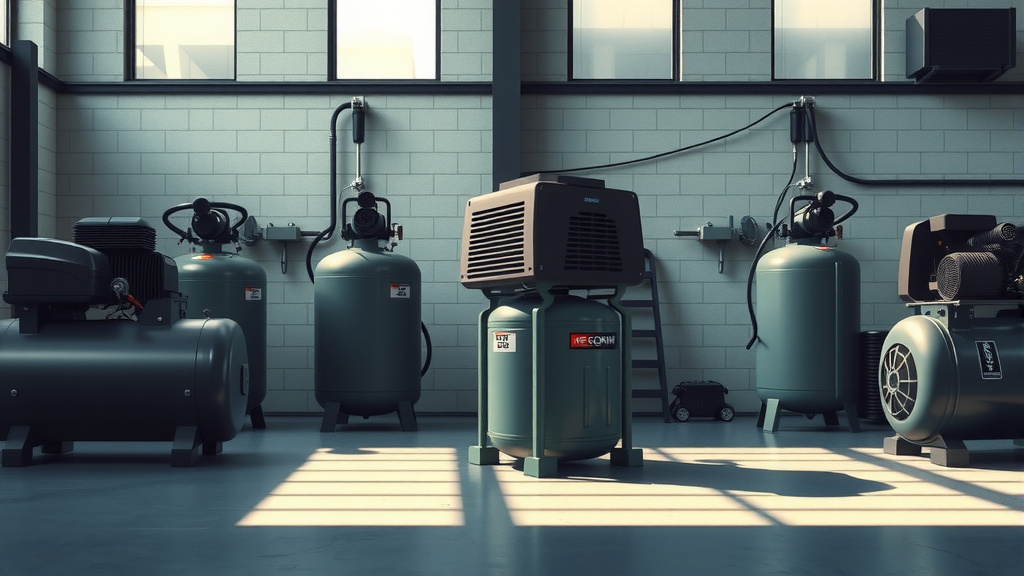
There are primarily two main categories of air compressors: positive displacement and dynamic. Each category then breaks down into several specialized types, like piston, rotary screw, and centrifugal compressors.
When considering how many types of air compressor exist, you’ll find common options such as reciprocating (piston) for smaller needs, rotary screw for continuous industrial work, and centrifugal for very large-scale applications requiring high volume.
Here’s a quick overview of what you’ll learn about air compressors:
- You will find air compressors mainly fall into two groups: positive displacement and dynamic.
- Piston compressors are great for home and small shop use, offering reliability.
- Rotary screw compressors shine in industrial settings, running continuously and quietly.
- Centrifugal compressors are giants, moving massive air volumes for big factories.
- Choosing the right one means looking at your needs for power, size, and how you’ll use it.
How Many Types Of Air Compressor?
You’re probably wondering, “How many types of air compressor are there?” Well, it boils down to two core groups: positive displacement and dynamic. Think of these as the two big families in the compressor world. Each family works differently to squeeze air into a smaller space.
Understanding the Two Big Families
Air compressors don’t all operate the same way. The method they use to compress air is what really sets them apart. Knowing this helps you pick the right tool for your tasks.
Positive Displacement Air Compressors
This family works by trapping a fixed amount of air and then physically reducing its volume. It’s like squeezing a balloon to make the air inside denser. This method is super common and reliable.
Reciprocating (Piston) Compressors
This is likely the type you picture when someone says “air compressor.” They use a piston moving back and forth within a cylinder. It’s much like how a car engine works. These are versatile and widely used.
Single-Stage Piston Compressors
With a single-stage compressor, air gets compressed once. The piston moves down, drawing air into the cylinder. Then it moves up, pushing the compressed air out. These are generally more affordable and perfect for home or small workshop tasks (Industry Standard).
Two-Stage Piston Compressors
Need more pressure? A two-stage compressor compresses air twice. Air is first compressed in a larger cylinder, then sent to a smaller one for a second squeeze. This delivers higher pressure and greater efficiency for more demanding jobs, making them popular in auto shops (Mechanical Engineering Handbook).
Oil-Lubricated vs. Oil-Free Piston Compressors
Piston compressors also come in two lubrication styles. Oil-lubricated models use oil to reduce friction and heat. They are often more durable and quieter. Oil-free compressors don’t use oil in the compression chamber. They’re vital for applications where air purity is key, like dental offices or food processing (Research suggests).
Rotary Screw Compressors
Imagine two giant, interlocking screws spinning together. That’s essentially a rotary screw compressor. Air gets trapped between these screws and compressed as it moves along. These are the workhorses of many industries, running continuously and quietly.
They are excellent for demanding applications requiring a steady, high volume of air. You’ll find them in manufacturing plants and large commercial operations. Many experts say they are highly efficient for continuous use.
Rotary Vane Compressors
These compressors use a rotor with several blades (vanes) inside a cylinder. As the rotor spins, the vanes slide in and out, trapping and compressing air. They offer smooth, quiet operation and a constant airflow. They are often chosen for applications needing a consistent supply without pulsation.
Scroll Compressors
Scroll compressors use two interleaved spiral-shaped scrolls, one fixed and one orbiting. Air gets trapped in pockets between the scrolls and compressed as the orbiting scroll moves. They are known for being very quiet, vibration-free, and oil-free. They are a good choice for sensitive applications like laboratories or medical facilities.
Dynamic Air Compressors
This family operates differently. Instead of trapping air, they use rapidly rotating components to speed up the air. This velocity is then converted into pressure. Think of it like a fan accelerating air and then pushing it into a tight space.
Centrifugal Compressors
Centrifugal compressors are the big guns, often found in very large industrial settings. They use a rapidly spinning impeller to accelerate air, then slow it down to increase pressure. They can handle massive air volumes. We found they are ideal for operations needing huge amounts of air, such as steel mills or chemical plants.
These units are generally more complex and require a significant initial investment. However, for sheer volume and power, they are unmatched (Mechanical Engineering Review).
Key Factors When Choosing Your Compressor
With so many options, how do you pick? It really depends on what you need to do. Here’s a quick checklist to guide your decision:
- What tools will you power? (Nail guns, sanders, impact wrenches, etc.)
- How often will you use it? (Intermittently, continuously, for hours?)
- What air volume (CFM) do you need? (Check your tools’ requirements.)
- What air pressure (PSI) is required? (Again, tool specifications are key.)
- Is noise a concern? (For home use, quietness might matter more.)
- Is air purity vital? (Food, medical, or breathing air applications.)
- What’s your budget? (Purchase price vs. operating costs.)
Comparing Common Compressor Types
Let’s look at some of the most popular types side-by-side to help you visualize their strengths and weaknesses. This table breaks down key features for your consideration.
| Compressor Type | Best Use Cases | Key Benefits | Common Downsides |
|---|---|---|---|
| Piston (Reciprocating) | Home, small shops, intermittent use | Affordable, portable, high pressure | Noisy, produces heat, intermittent use best |
| Rotary Screw | Industrial, manufacturing, continuous use | Quiet, continuous airflow, energy efficient | Higher initial cost, larger footprint |
| Scroll | Dental, medical, laboratories, quiet needs | Very quiet, oil-free air, smooth operation | Lower CFM output, higher cost than piston |
| Centrifugal | Heavy industrial, large factories, high volume | Extremely high volume, very durable | Very high cost, large size, complex |
Which Type is Right for You?
Choosing an air compressor is like picking the right car. Do you need a compact car for quick errands or a heavy-duty truck for hauling? A small piston compressor might be perfect for your garage air tools. If you’re running a busy auto repair shop, a two-stage piston or a smaller rotary screw might be better. For a large factory, only a robust rotary screw or centrifugal unit will do. Consider your power demands and operational needs carefully (Many experts say).
Conclusion
Understanding the types of air compressors is the first step toward finding your perfect match. From the familiar piston compressor in your garage to the powerful centrifugal giants in factories, each type brings unique advantages. Focus on your specific needs: how much air you need, how often, and the required air purity. By doing so, you’ll make an informed choice that keeps your projects humming and your tools powered reliably.
What is the most common type of air compressor?
The most common type of air compressor, especially for home users and small workshops, is the reciprocating or piston compressor. They are widely recognized for their versatility, affordability, and ability to generate good pressure for various tools.
Are rotary screw compressors better than piston compressors?
Whether rotary screw compressors are “better” depends on the application. For continuous, heavy-duty industrial use, rotary screw compressors are generally superior due to their efficiency, quiet operation, and constant air supply. Piston compressors are often better for intermittent use, lower budgets, and when portability is important.
Can I use an oil-lubricated compressor for painting?
You can use an oil-lubricated compressor for painting, but you will absolutely need an in-line air filter and possibly a dryer. This helps to remove oil vapor and moisture from the compressed air, preventing contamination of your paint job. Without proper filtration, oil residue can ruin your finish.
How do I know what size air compressor I need?
To determine the right size, you need to know the CFM (Cubic Feet per Minute) and PSI (Pounds per Square Inch) requirements of the air tools you plan to use. Add up the CFM for all tools that might run simultaneously and choose a compressor that exceeds this total. Always look at your tools’ specifications.
What is the main difference between positive displacement and dynamic compressors?
The main difference lies in their compression method. Positive displacement compressors trap a fixed volume of air and reduce that volume to increase pressure. Dynamic compressors accelerate air using rotating impellers and then convert that velocity into pressure, handling much larger volumes of air.
