15 Gauge Nailer vs Framing Nailer: Which Do You Need? (November 2026)
Pick a 15 gauge nailer for finish trim and a framing nailer for structural framing. In this 15 gauge vs framing nailer comparison, the fastener size and the job decide the tool, not the brand.
On this page (12 sections)
- 15 Gauge vs Framing Nailer: The Quick Verdict
- 15 Gauge Nailer vs Framing Nailer Side by Side
- Nail Size and Holding Power
- Trim Work: Where the 15 Gauge Nailer Wins
- Framing Work: Where the Framing Nailer Wins
- Weight, Control and Fatigue
- Trigger Modes and Driving Speed
- Nail Collation and Magazine Fit
- Power Source and Air Needs
- Set-Up, Safety and Care
- Who Should Buy Which
- 15 Gauge vs Framing Nailer: Final Pick
Pick a 15 gauge nailer for finish trim and a framing nailer for structural framing. This 15 gauge vs framing nailer guide separates finish carpentry fastening from structural framing needs, so you buy the tool for the joint in front of you.
A 15 gauge finish nailer drives thinner nails with small heads that fill and hide. A framing nailer drives longer, thicker nails that tie studs, plates and sheathing together.
That gap in nail size changes everything else. It changes holding power, hole size, weight, speed and the wood you can safely fasten.
15 Gauge vs Framing Nailer: The Quick Verdict
The 15 gauge nailer wins for trim, and the framing nailer wins for structure. Neither tool does the other tool's job well.
Choose the 15 gauge side when you install crown molding, baseboards, casings, cabinets, picture frames or furniture. For pneumatic model options, see 15 gauge finish nailers.
The nails are strong for trim, and the head stays nearly invisible after you fill it.
Choose the framing side when you frame walls, build trusses, lay subfloors, attach roof decking or sheath a wall. Those joints need long nails with heads that resist pull-out.
Our nail gun guide walks through the main nailer types before you narrow the choice. Compare nail guns and staple guns when deciding which fastener tool fits the job.
It helps you match nail size, power source and weight to the work you do most.
Maker claims below are labeled by brand.
meite 15 Gauge Angled Finish Nails 2-1/2: Best for trim fasteners

- 15 gauge, 2-1/2 in, 34 degree angled tape collation
- Galvanized steel, D-style head
- 2,400 pieces per box
These finish nails suit crown molding, baseboards and casings where a small filled head matters. Check that your nailer takes 34 degree angled tape collated nails before you buy.
Pros
- Small D-style head hides well after filling
- 2,400 pieces cover many trim jobs
- Galvanized coating resists rust
Cons
- Not for structural framing
- Requires a 34 degree angled finish nailer
- Not suited to straight magazine nailers
These nails measure 2-1/2 in long and use 34 degree angled tape collation. The D-style head gives strong holding power while staying small enough to countersink and fill.
You need a 15 gauge angled finish nailer that takes 34 degree tape collated nails. Straight magazine nailers will not take this collation, so check the magazine first.
Galvanized steel resists rust for interior and exterior trim. For damp spots such as bathrooms, stainless steel is the safer pick.
Metabo HPT Framing Nailer: Best for framing crews
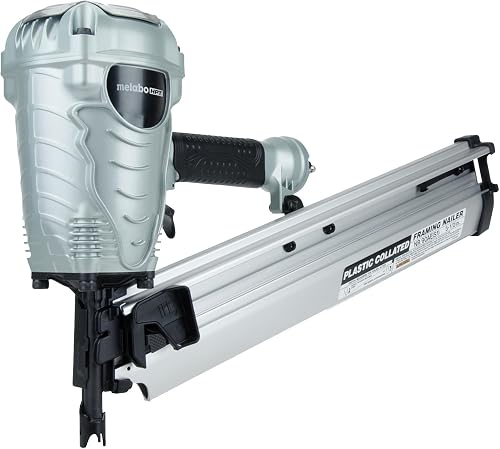
- 21 degree plastic collated framing nailer
- Drives 2 in to 3-1/2 in nails
- 7.5 lb, selective actuation
This 21 degree framing nailer fits flooring, framing, sheathing and decking work. It drives plastic collated framing nails from 2 in to 3-1/2 in.
Pros
- Long nails for structural joints
- Light for all day framing
- Tool-less depth adjustment
Cons
- Too large for fine trim
- Makes large holes in finish wood
- Pneumatic, so it needs a compressor
This is a 21 degree plastic collated framing nailer. It drives nails from 2 in to 3-1/2 in long.
Metabo HPT lists flooring, framing, truss build-up, window build-up, subflooring, roof decking, wall sheathing and housing construction as uses. It weighs 7.5 lb and offers selective actuation for sequential or contact nailing.
It includes safety glasses with the nailer. Metabo HPT covers it with a 5-year tool warranty.
NuMax SFR2190 Pneumatic 21 Degree 3-1/2 Framing: Best for budget framing

- 21 degree, drives 2 in to 3-1/2 in nails
- 0.113 in to 0.131 in nail diameter
- 8.6 lb, dual mode trigger
This pneumatic framing nailer covers framing, subfloors, roof decking and fencing. It takes 21 degree plastic collated full round head nails.
Pros
- Fits common framing nail sizes
- Anti-dry-fire helps protect the tool
- Adjustable exhaust keeps air off your face
Cons
- Heavier than the Metabo HPT model
- Too large for finish trim
- Pneumatic, so it needs an air supply
This is a pneumatic 21 degree framing nailer that drives 3-1/2 in nails at full length. It takes 21 degree plastic collated full round head nails from 2 in to 3-1/2 in, with 0.113 in to 0.131 in diameter.
NuMax lists framing, subfloors, roof decking, pallet and crate assembly and wood fencing as uses. It weighs 8.6 lb and has a dual mode trigger.
It has an anti-dry-fire mechanism, tool-free depth adjustment, a no-mar tip and a 360 degree adjustable exhaust. NuMax covers it with a 1 year limited warranty and a 30 day wearable parts warranty.
15 Gauge Nailer vs Framing Nailer Side by Side
Finish nailers use small fasteners, and framing nailers use long structural fasteners. That split shows up in every spec.
A 15 gauge nail is about 0.14 in in diameter. A framing nail in these models ranges from 0.113 in to 0.131 in, but it is much longer and usually has a full round head.
Length is the clearest divide. The finish nails here are 2-1/2 in.
The framing nailers drive up to 3-1/2 in, and framing joints often need that reach.
| Feature | 15 gauge finish | Framing nailer |
|---|---|---|
| Main job | Trim and finish carpentry | Structural framing |
| Nail length here | 2-1/2 in | 2 in to 3-1/2 in |
| Head size | Small D-style head | Full round head |
| Hole in wood | Small, fills cleanly | Large, shows in finish wood |
| Holding goal | Hold trim flat and neat | Resist pull-out in a joint |
| Weight feel | Lighter, more control | Heavier, built for lumber |
Use that table as a filter. If the joint is structural, start with framing.
If the surface will show, start with finish.
Nail Size and Holding Power
Framing nails hold by length and head size, while 15 gauge nails hold trim without marring it. Each design trades one kind of strength for another.
A 3-1/2 in framing nail passes through a stud and into a plate with room to spare. Its full round head bears against the wood and resists pulling through under load.
A 2-1/2 in 15 gauge nail has a thinner shank and a smaller head. It grips trim well, but it cannot tie structural lumber the way a long framing nail can.
The meite nails use a D-style head for holding power in trim. After you countersink and fill, the head stays nearly invisible on crown molding, baseboards and casings.
Framing nails leave a bigger mark. That mark is fine on subfloor or sheathing, but it ruins the look of painted trim.
So judge holding power by the job. Trim needs neat hold.
Framing needs structural hold. The wrong nail fails at one of those goals.
Trim Work: Where the 15 Gauge Nailer Wins
A 15 gauge nailer fits crown molding, baseboards, casings and cabinets. Its lighter feel helps you place each nail with care.
The 34 degree angled magazine helps you reach tight corners. That angle also narrows the tool profile near trim, which helps in detailed assemblies.
The meite nails have a smooth shank and a chisel point. That shape helps the nail enter dense hardwood and delicate trim with less splitting.
The galvanized coating resists rust. That helps trim stay clean through paint cycles and normal room moisture.
For exterior trim, think again about moisture. Stainless steel nails handle damp areas better than galvanized steel.
If you are torn between finish sizes, our brad nailer vs framing nailer guide helps you place 18 gauge brads in the same lineup. Brad nails are thinner and shorter, so they suit lighter trim.
Framing Work: Where the Framing Nailer Wins
A framing nailer fits studs, plates, trusses, subfloors and sheathing. Those jobs need long nails driven fast and deep.
The Metabo HPT model drives 2 in to 3-1/2 in plastic collated nails. It suits flooring, framing, truss work, window build-up, subflooring, roof decking and wall sheathing.
The NuMax model drives the same length range. It suits framing, subfloors, roof decking, pallet and crate assembly and fencing.
Both tools use 21 degree plastic collated nails. That collation feeds fast in bulky lumber and keeps strips from breaking during rapid fire.
Depth control matters on framing too. Both models let you adjust depth without tools, so nails sit flush instead of overdriving into soft wood.
If framing is your main work, start with our best nail gun for framing picks. They focus on power, weight and nail capacity for structural jobs.
Weight, Control and Fatigue
A 15 gauge nailer is easier to guide in trim, while a framing nailer challenges your arms over long shifts. Weight and balance set the real limit.
The Metabo HPT framing nailer weighs 7.5 lb. Metabo HPT notes its balance helps with maneuverability and less fatigue.
The NuMax framing nailer weighs 8.6 lb. Its comfort grip handle helps reduce fatigue and improve placement over long shifts.
That 1.1 lb gap matters when you hold the tool overhead for sheathing or decking. A lighter framing nailer can make a full day feel shorter.
Finish nailers are lighter still, which helps you set trim with fine control. You still need to watch pressure so you do not dent soft trim.
Choose by task length. Short trim runs favor control.
Long framing runs favor low weight and balance.
Trigger Modes and Driving Speed
Sequential mode gives precision, and contact mode gives speed. Both framing models here let you switch between the two.
The Metabo HPT model uses selective actuation. You flip a switch to move between sequential and contact nailing.
The NuMax model uses a dual mode trigger. It switches between single sequential firing for precision and bump firing for speed.
Sequential fire needs a fresh pull for each nail. That slows you down, but it helps you place each nail where it belongs.
Contact fire drives as fast as you can move the tool. That speed suits sheathing and decking, where pattern matters more than single nail placement.
Finish nailers also offer trigger choices on many models. For trim, slower sequential fire often keeps nails centered on narrow pieces.
Nail Collation and Magazine Fit
Collation angle decides whether the nails fit your nailer at all. Check angle and type before you buy a bulk box.
The meite finish nails use 34 degree angled tape collation. They fit 15 gauge angled finish nailers from brands such as Paslode, DeWalt, Bostitch, Metabo HPT, Milwaukee, Senco and Porter Cable, when the magazine takes that collation.
Both framing nailers here use 21 degree plastic collated nails. That collation is common for framing, but head shape and diameter still must match your tool.
The NuMax model takes full round head nails from 0.113 in to 0.131 in diameter. The Metabo HPT model takes 2 in to 3-1/2 in plastic collated framing nails.
Wrong collation jams, misfires or damages the magazine. Tape collation and plastic collation are not interchangeable.
Measure twice here. Note the angle, the collation type, the length range and the diameter range.
Then match the box to the tool.
Power Source and Air Needs
Pneumatic nailers need a compressor, while cordless nailers cut the hose. Your power choice affects weight, cost and jobsite mobility.
Both framing nailers in this post are pneumatic. They need an air supply with enough pressure and volume for repeated framing shots.
Check our guide on How Much PSI Does a Framing Nailer Need? before you size a compressor. Too little air leads to shallow nails and slow cycles.
Our Best Air Compressor For Framing Nailer guide helps you pair tank size and output with framing work. Framing uses more air than finish work.
Cordless framing nailers exist, and they suit work where a hose gets in the way. Compare battery run time, nail capacity and weight against your daily nail count.
For trim, many 15 gauge finish nailers are pneumatic, but cordless options are common too. Choose the power source you will actually carry up stairs or across a yard.
Set-Up, Safety and Care
Set depth, check fit and wear eye protection before the first shot. Good habits protect you and keep nails uniform.
Read the manual for your exact nailer. Check nail length, diameter, collation angle and head shape against the magazine.
Set depth on a scrap piece first. Adjust until nails sit flush without sinking into soft wood or bending thin trim.
Wear safety glasses. The Metabo HPT framing nailer includes safety glasses in the box.
Keep hands clear of the nosepiece and the nail path. Disconnect air or remove the battery before you clear a jam or change nails.
Store nails dry and keep strips clean. Bent strips and dirty magazines feed poorly and jam more often.
After framing work, wipe the tool, check the exhaust and store it with the trigger locked or the battery removed. For finish work, check the no-mar tip so it does not dent trim.
Who Should Buy Which
Buy the 15 gauge side for finish carpentry, and the framing side for construction framing. Most shops that do both keep both tools.
Pick the 15 gauge route if you install trim, build cabinets, hang doors or do furniture work. You want small holes, fine control and nails that fill cleanly.
Pick the framing route if you frame walls, lay subfloors, sheath walls or build decks and fences. You want long nails, fast firing and depth control in lumber.
If you do remodels, you may need both. Framing ties the walls together, and finish work makes the room look done.
Cordless buyers should weigh a best cordless framing nailer against pneumatic power. Kits that bundle nails, batteries and cases are covered in our best framing nailer kit guide.
DIY buyers often start with one tool. Start with the job you will do first, then add the second tool when that work arrives.
15 Gauge vs Framing Nailer: Final Pick
Pick the 15 gauge nailer for trim and the framing nailer for structure. That rule settles most 15 gauge vs framing nailer choices in one step.
For trim, the 15 gauge nailer wins on control, small holes and clean fill. The meite 2-1/2 in finish nails fit that work when your magazine takes 34 degree tape collation.
For framing, the framing nailer wins on nail length, head size and speed. The Metabo HPT model is the lighter pick at 7.5 lb, while the NuMax model is the value pick at 8.6 lb with an adjustable exhaust.
Use this decision rule: if the joint holds weight or ties lumber together, buy framing. If the surface shows and the nail must hide, buy 15 gauge finish.
Start with our nail gun guide to confirm the nailer type for your next job. Then match the nails to the magazine before you order a bulk box.
Frequently asked questions
Can a 15 gauge nailer replace a framing nailer?
No. A 15 gauge finish nailer drives thinner, shorter nails for trim, while a framing nailer drives longer nails for structural joints.
Building codes and joint strength call for framing nails in framing, so finish nails do not substitute there.
What is a 15 gauge nailer best for?
A 15 gauge nailer is best for crown molding, baseboards, door and window casings, cabinets and other trim. Its nails hold well and the small head fills cleanly, which keeps the finished surface smooth and paint-ready.
What nails does a framing nailer use?
The framing nailers here use 21 degree plastic collated framing nails from 2 in to 3-1/2 in long. Check your nailer first, since collation angle, head shape and diameter must match the magazine.
Which nailer is easier to use all day?
A finish nailer is lighter and easier to control in tight trim work, while a framing nailer is built for repeated driving in bulky lumber. Weight, balance and trigger mode matter more on long framing days than on short trim jobs.
Do I need a compressor for either nailer?
The pneumatic framing nailers here need an air supply, and many 15 gauge finish nailers are pneumatic too. Cordless models remove the hose, so compare power, weight and battery needs for the exact tool you plan to buy.


