Nail Guns: The Complete Buying Guide
This nail gun guide helps you match the tool to the job: pick an 18 gauge brad nailer for trim, a crown stapler for upholstery and light fastening, or a framing nailer for structural work, then choose pneumatic, battery or manual power to fit where you work.
On this page (14 sections)
- What is the best nail gun for your project?
- What are the main types of nail guns?
- How do nail gun types differ in fastener size?
- Which power source is right for a nail gun?
- How do you match a nail gun to trim and molding?
- How do you choose a nail gun for upholstery and craft work?
- What is a 2 in 1 pneumatic nail gun good for?
- How do you choose a nail gun for framing, roofing and flooring?
- What is the difference between a brad nailer and a finish nailer?
- Which brands and kits should you compare first?
- How do you narrow picks for home use and trim work?
- How do you buy a nail gun without overpaying?
- How do you use a nail gun safely and keep it in shape?
- Which nail gun should you pick first?
What is the best nail gun for your project?
The best nail gun is the one that drives the right fastener, at the right depth, in the material you are joining. Start with the fastener and the material, not the brand.
Trim needs thin brads. Upholstery needs staples.
Framing needs full size nails with real holding power.
This nail gun guide breaks down nail gun types, power sources and fastener sizes so you can make that match with less guesswork. Our score weighs specs, features and buyer feedback against what you are shopping for.
If you already own a battery platform, that fact alone can settle the choice. If you already own a compressor, pneumatic power may suit you best.
If you work on light craft and repair tasks on a table, a manual or small cordless tool may be enough.
What are the main types of nail guns?
The main types are brad nailers, finish nailers, framing nailers, roofing nailers, flooring nailers, pin nailers, palm nailers and staple guns. Each type is shaped around one fastener and one kind of joint.
That is why a trim nailer is a poor choice for framing and a framing nailer is a poor choice for delicate trim.
Brad nailers drive thin 18 gauge nails for molding, casing and light trim. Finish nailers drive thicker 15 or 16 gauge nails for heavier trim and built in work.
Pin nailers drive very thin 23 gauge pins for small details that need almost no visible mark.
Framing nailers drive full size nails for studs, sheathing and structural joints. Roofing nailers drive short, wide head nails for shingles and felt.
Flooring nailers pull or drive flooring fasteners to hold boards tight. Palm nailers fit in tight spots where a full gun will not reach.
Staple guns drive crown staples for upholstery, house wrap, craft work and light framing of thin stock. For upholstery on plastic, see upholstery staple guns for plastic.
A 2 in 1 brad and staple tool covers two jobs in one body.
That can save money for light DIY work, but it will not replace a dedicated framing nailer or a heavy roofing nailer.
How do nail gun types differ in fastener size?
Fastener size sets the limits of what a nail gun can do. Gauge tells you thickness and length tells you reach.
A thin, short fastener holds light trim. A thick, long fastener holds structural lumber.
18 gauge brads are thin and leave a small mark, which suits painted trim and furniture details. 16 gauge finish nails are thicker and hold better in heavier casing and cabinets.
15 gauge nails are thicker still and suit dense trim and built in shelving.
Staples come in crown widths as well as lengths. A 1/4 in crown staple is common for upholstery and trim work.
T50 staples are common for fabric, foam, canvas and thin softwood. The staple length must suit the material thickness, or the legs will bend, miss the wood or tear the fabric.
For a full breakdown of common sizes, see what air nailer explain nail size covers before you load a magazine. Also check the best nails for pneumatic nailers so the fasteners you buy match the gauge and length range of your tool.
Which power source is right for a nail gun?
Nail guns run on pneumatic air, battery power, gas cartridges or manual force. Pick the power source you can use for the whole job without stopping to rearrange your setup.
That choice affects weight, mobility, running cost and how fast you can move.
Pneumatic tools need a compressor and a hose. They give steady power for long sessions and many models are light because the motor is simple.
The trade off is the hose, which can snag on ladders, stairs and doorways. If you already own a compressor, pneumatic is often the low cost path per fastener.
Battery tools run a motor from a rechargeable pack. They remove the hose and suit work overhead, outdoors or far from a compressor.
You trade hose management for battery management, since you need charged packs and spare packs to avoid pauses. If you already own batteries from another tool, a bare tool can be good value.
Gas powered tools use a fuel cell plus a battery. They suit framing and roofing work where a hose is a problem.
They add ongoing fuel cell cost and they need storage care for the cartridges. Manual staple guns use hand force and suit light, occasional work on a bench.
They need no air, battery or fuel, but they ask more of your hand on hard material.
For more on power options, see how are nail guns powered and match the answer to the rooms and outdoor areas where you plan to work.
How do you match a nail gun to trim and molding?
Trim work needs a tool that places small fasteners with care. For casing, crown and shoe molding, an 18 gauge brad nailer is the usual starting point.
The thin nail leaves a small mark that is easy to fill, and the tool is light enough for overhead work.
Choose brad length by the thickness of the trim plus the wood behind it. A 1 in brad often suits light shoe molding.
A 1 1/2 in or 2 in brad suits thicker casing and crown. Test on scrap first, then check the back side for point show through.
Depth control matters as much as length. A tool free depth adjustment lets you set the nail head flush or just below the surface.
That control saves time on painted work and keeps thin stock from splitting around the nail head.
The DEWALT DCN680B is a battery powered 18 gauge brad nailer for decorative molding, casing, kitchen crown and shoe molding. It drives 18 gauge brads from 5/8 in to 2 1/8 in.
It is sold as a tool only, so you supply the 20V MAX battery and charger.
DEWALT says the brushless motor and battery power remove the need for gas, a compressor and a hose. Tool free depth adjustment helps you set nails flush.
Tool free jam release helps you clear a jam fast. The micro nose aims to improve line of sight compared with the DC608.
How do you set depth and clear a jam on a brad nailer?
Set depth on scrap wood that matches your trim thickness. Drive one test nail, then check whether the head sits flush, proud or buried.
Adjust in small steps and test again, since small changes in depth can split thin stock.
The DCN680B uses tool free depth adjustment and tool free jam release. That means you can make those checks without reaching for a screwdriver.
Use the low nail lockout as a guard against dry firing, which can leave a mark on finished wood.
Keep your hands clear of the nose while you thread nails or clear a jam. A sequential trigger setting also helps you avoid extra firings while you move the tool into place.
Our full nail gun safety talk covers trigger modes, contact trips and safe handling in more depth.
How do you choose a nail gun for upholstery and craft work?
Upholstery and craft work need a tool that holds fabric and foam without tearing them. For upholstery, a staple gun with the right staple type matters more than raw power.
The staple crown spreads the load across fabric and foam.
T50 staples are a common choice for fabric, foam, canvas and thin softwood. Crown staples in a 2 in 1 tool can also suit upholstery and furniture work.
Test on scrap fabric over foam first, since too much force can cut or pucker the material.
The YEAHOME 4 in 1 staple gun accepts D shaped, U shaped, T shaped and pin staples. It comes with 4000 staples in the kit, with 1000 of each type.
It is a manual tool with power adjustment, so you set the force by hand for soft or hard materials.
YEAHOME says the all chrome steel build is made to resist rust and handle tough loads. The bottom load design and steel magazine aim to make loading quick.
The steel handle has an over molded grip for comfort during repeated squeezes.
The populo Bielmeier 2 in 1 cordless tool puts T50 staples first. It drives 1/2 in T50 staples for upholstery, fabric, foam, canvas, cardboard and thin softwood.
It also drives 18 gauge brads up to 9/16 in for light trim, picture frames and small finishing details.
populo says this tool is built for soft materials and thin softwood. It is not designed for hardwood, plywood, OSB, thick lumber, framing or heavy construction.
That limit is important, since it tells you where the tool stops and a stronger nailer starts.
How do you decide between a manual and a cordless staple gun?
A manual staple gun suits occasional work on a bench. It needs no charging and it costs less to run.
It also needs hand strength for each shot, which can tire you during a large upholstery job.
A cordless staple gun suits longer sessions and awkward angles. The Bielmeier tool weighs 1.6 lb and charges by Type C in about 2 hours. populo says it works at up to 50 fasteners per minute, which helps when you set many staples in a row.
Test the staple length on scrap before you start. Load the magazine from the bottom, press the contact nose flat at 90 degrees, then pull the trigger.
That habit helps staples sit flat and legs land where you aim.
If you are torn between tools, compare the nail gun vs staple gun breakdown before you buy. It lays out where each tool wins and where a 2 in 1 tool is a fair middle path.
What is a 2 in 1 pneumatic nail gun good for?
A 2 in 1 pneumatic tool fires both brads and crown staples from one body. It suits DIYers who switch between trim and upholstery in the same week.
You save the cost and storage space of two tools, at the cost of some depth and power control.
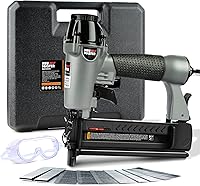
The NEU Master NPT5040 fires 18 gauge brads from 5/8 in to 2 in and 1/4 in crown staples from 5/8 in to 1 5/8 in. It runs at 60 to 120 PSI from a standard compressor with a 1/4 in NPT inlet.
The compressor is not included.
NEU MASTER says the 360 degree exhaust directs air and debris away from your face. Tool free jam clear aims to get you back to work without disassembly.
The transparent magazine window shows remaining fasteners to help you avoid dry fire marks.
The kit includes 400 2 in brads, 400 1 1/4 in brads and 200 1 1/4 in crown staples. It also includes a BMC case, safety glasses, a bottle of lubricating oil and 2 Allen wrenches.
NEU MASTER backs the tool with a 2 year replacement warranty.
How do you get set up with a pneumatic 2 in 1 tool?
Start by confirming your compressor can hold 60 to 120 PSI at the tool while you work. A tank that drops pressure under load will change nail depth from one shot to the next.
Set the regulator, then test on scrap wood.
Load only the fastener type you plan to drive, and confirm the magazine is set for that type. The NEU Master has a quick release 100 fastener magazine, so reloads should be fast.
Keep the transparent window in view so you can spot a low magazine before it runs dry.
Add a drop of oil on a regular schedule if your tool needs it, and store the tool dry. The oil bottle in this kit covers that basic care.
Keep the exhaust pointed away from your face and the workpiece while you drive.
For compressor sizing, read what is the best air compressor for a nail gun and best air compressor for nail gun before you buy a tank. The right pair will save you more trouble than any single tool feature.
How do you choose a nail gun for framing, roofing and flooring?
Framing, roofing and flooring need dedicated tools with real holding power. Do not use a trim brad nailer for structural joints.
The fastener is too thin and too short to hold lumber under load.
Framing nailers drive full size nails for studs, plates and sheathing. Roofing nailers drive short nails with wide heads that hold shingles against wind.
Flooring nailers drive or pull flooring fasteners to keep boards tight and flat.
Compare a roofing nailer vs siding nailer if your build includes both roof and wall coverings. The nail length, head size and magazine shape differ for a reason, and using the wrong shape can damage shingles or siding.
For flooring work, see the best hardwood flooring nailer guide and the how to use a concrete nail gun guide if your job moves from wood to masonry. Concrete fasteners need a tool and a nail made for that base material.
Palm nailers help in tight joist bays and low clearance spots. See pneumatic palm nailer reviews for that niche.
Keep them as a second tool, not a first tool, since they need hand skill to place each nail.
What is the difference between a brad nailer and a finish nailer?
A brad nailer drives thin 18 gauge nails. A finish nailer drives thicker 15 or 16 gauge nails.
Choose brad for light trim and finish for heavier trim, cabinets and built in work. The thicker nail holds better, but it leaves a larger mark.
Brad nailers suit shoe molding, light casing and small decorative pieces. Finish nailers suit thicker casing, crown built for load, stair parts and cabinet face frames.
Both tools leave marks you will fill and sand on painted work.
Use the nail gun vs brad nailer guide to sort out the naming, since sellers use nail gun as a broad term for all of these tools. The fastener gauge and length range tell you more than the product name.
If you plan to buy more than one tool, a best nailer combo kit can spread the cost across a brad nailer, a stapler and a finish nailer. Compare what is in the case against the jobs you actually plan to do.
Which brands and kits should you compare first?
Brand choice matters most when you already own batteries or air gear from that brand. Compare kits by fastener range, weight and what is in the case, not by color or badge alone.
A kit that includes fasteners, glasses and a case can save a second trip.
Start with best dewalt cordless nail gun 20v if you run DEWALT 20V batteries. The DCN680B above is a tool only model, so add the battery and charger to your total cost if you do not own them.
Compare the best dewalt nail gun roundup for other DEWALT options. Also compare best nail gun makita if you run Makita batteries, since a shared battery cuts cost across tools.
For air powered kits, see best nail gun kit and senco nail gun reviews. Those reads help you judge case contents, fastener counts and warranty terms before you order.
If you want a value focused light tool, check the best vevor nail gun guide as well.
If you own Paslode gas gear, compare best nail gun paslode. Gas tools add fuel cell cost, so weigh that against the freedom from a hose on your job site.
How do you narrow picks for home use and trim work?
Home use usually means trim, repair and light build work. For most homes, an 18 gauge brad nailer plus a staple gun covers 90 percent of jobs.
Add a finish nailer only if you plan heavy casing or cabinet work.
Start with best nail guns for home use to see how other buyers sized their first tool. Then check best nail gun for trim for trim specific features like nose size and depth control.
If you need more holding power in trim, compare best nail gun for framing. That guide marks the line where trim tools stop and framing tools start.
Do not cross that line with a brad nailer on a structural joint.
For fine details, compare best 23 gauge pin nailer and best 18 gauge brad nailer. Pins leave almost no mark for small parts.
Brads give more hold for casing and crown. A best cordless brad nailer can suit you if you hate hose management.
How do you buy a nail gun without overpaying?
A smart buy starts with a list of three jobs you will do in the next year. Buy the tool that fits the most common job, then add tools for the rest.
That order keeps you from paying for power you will rarely use.
Check whether the tool is sold bare or as a kit. The DCN680B is a tool only model, so a battery and charger are extra if you do not own them.
The NEU Master kit includes fasteners, a case and glasses, which changes the value math.
Look for best nail gun on sale deals after you pick the type. A sale on the wrong type is not a deal.
Compare the sale price against fastener counts, case contents and warranty terms in a full kit.
Keep replacement parts in mind from day one. See best nail gun parts for drivers, magazines and seals.
A tool with ready parts will last longer in your shop.
If you want a tool that staples and nails, compare the best nail gun and stapler options. Also check best cordless crown stapler and best upholstery staple gun for upholstery focused picks before you settle on a 2 in 1 tool.
How do you use a nail gun safely and keep it in shape?
Safe use starts with eye protection and a clear work area. Keep your hands back from the nose, keep the trigger locked when you load or move, and never drive toward your body.
Those habits prevent most nail gun injuries.
Read the manual for your exact trigger mode. Sequential mode fires one nail per trigger pull.
Contact mode fires as you bump the nose and pull the trigger. Contact mode is faster for framing, but it asks for more control.
Learn the steps in how to use a milwaukee nail gun if you run that brand, since the steps cover loading, depth checks and jam clearing in plain order. Those steps apply to most battery and pneumatic tools with small changes.
For care, store fasteners dry and keep the magazine clean. Add oil to pneumatic tools on the maker schedule.
Keep battery contacts clean and charge packs before they sit for months. Check hoses and couplers for cracks before each session.
Which nail gun should you pick first?
Pick an 18 gauge brad nailer first if trim is your main job. Pick a staple gun first if upholstery and craft work lead your list.
Pick a 2 in 1 tool only if you will switch between those jobs often and you accept lighter duty limits.
For trim, the DEWALT DCN680B fits battery users who want 5/8 in to 2 1/8 in brads without a hose. For upholstery on a bench, the YEAHOME manual staple gun fits light work with 4 staple shapes and power adjustment.
For mixed trim and upholstery with a compressor, the NEU Master 2 in 1 fits a kit buyer who wants fasteners and a case in the box. For light cordless craft work, the populo Bielmeier fits T50 staple use in fabric and thin softwood.
This nail gun guide comes back to one rule. Match the fastener to the material, match the power source to the room, and test on scrap before you drive the first nail in good wood.
That order will help you buy once and buy right.
Frequently asked questions
What type of nail gun do I need for trim?
For trim, start with an 18 gauge brad nailer that handles 5/8 in to 2 in brads. That range covers casing, crown, shoe molding and light decorative pieces.
Check the fastener length against the thickness of the trim and the wood behind it before you drive the first nail.
Are pneumatic or battery nail guns better?
Pneumatic nail guns give steady power from a compressor and suit long shop sessions. Battery nail guns remove the hose and suit ladders, stairs and rooms far from an outlet.
Match the power source to how often you move, how much you drive and what air or battery gear you already own.
What is the difference between a brad nailer and a stapler?
A brad nailer drives thin nails for trim and fine joinery. A stapler drives crown staples that hold fabric, paper, thin wood and upholstery material over a wider area.
Many DIYers choose a 2 in 1 tool when they switch between trim work and upholstery, but dedicated tools give you more control for repeated use.
What nail size should I use in an 18 gauge brad nailer?
Use the shortest brad that gives a firm hold, often 1 in to 1 1/2 in for trim and up to 2 in for thicker pieces. Longer is not always better because a long nail can split thin stock or poke through the back.
Test on scrap wood first and check the back side before you start.
How do I choose fasteners for a nail gun?
Match the fastener to the tool first, then to the material. Confirm gauge, length and shape, such as 18 gauge brads or 1/4 in crown staples, and confirm the tool accepts that size.
Store fasteners dry and load only the type the magazine is set for.