
How Many Watts Does A 3 Gallon Air Compressor Use?
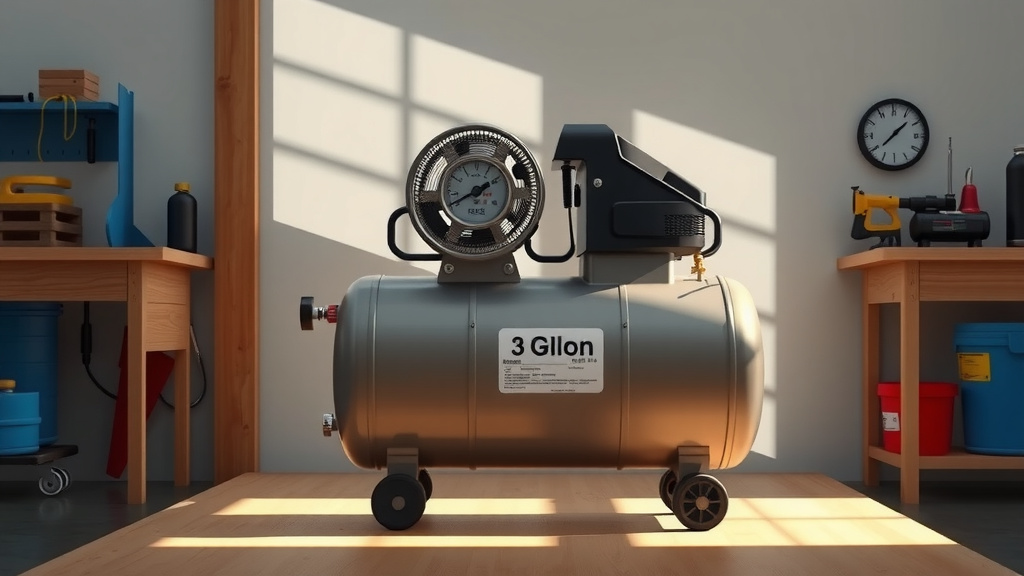
A typical 3-gallon air compressor generally uses between 700 to 1500 watts while running, though this can vary.
The exact wattage for a 3-gallon air compressor depends on its motor’s horsepower and whether it’s starting up or running steadily.
- A 3-gallon air compressor usually needs 700-1500 running watts.
- Starting watts can be much higher, often 2-3 times the running wattage.
- The compressor’s horsepower (HP) is the biggest factor in its power consumption.
- Voltage (120V or 240V) also affects current but not the total wattage used.
- Efficient use and proper maintenance can help you save on energy.
How Many Watts Does A 3 Gallon Air Compressor Use?
You’re probably wondering just how much juice your compact air compressor sips from the outlet, right? It’s a smart question. A 3-gallon air compressor, a common choice for home tasks, typically pulls anywhere from 700 to 1500 watts when it’s actively compressing air. Think of it like a small vacuum cleaner or a microwave.
However, that number isn’t set in stone. The specific wattage your unit uses can fluctuate based on its motor size and what it’s doing at the moment. We found that most models fall within this range, making them quite manageable for standard household circuits.
Understanding Your Compressor’s Power Needs
Knowing your compressor’s wattage is more than just trivia. It helps you pick the right extension cord, decide if your generator can handle it, or simply understand your electricity bill. It’s about being prepared and avoiding tripped breakers.
Imagine plugging in a powerful appliance without checking; that’s what we want to avoid! Getting familiar with its power demands helps you operate safely and efficiently.
Horsepower (HP) and Watts: The Connection
When you look at an air compressor, you’ll often see its power listed in horsepower (HP). This is the key to understanding its wattage. One horsepower is roughly equivalent to 746 watts. So, a 1 HP motor would theoretically use about 746 watts.
Most 3-gallon compressors feature motors ranging from around 0.5 HP to 2 HP. This means their power draw is directly linked to how powerful their motor is. Many experts say that the HP rating is your best indicator of energy consumption.
Factors Affecting Wattage Use
It’s not just the motor size that dictates wattage. Several elements work together to determine how much power your air compressor truly consumes. Let’s break down these factors so you can understand your machine better.
The “Starting Wattage” Surge
When your air compressor first kicks on, its motor needs a burst of energy to get going. This initial surge is known as “starting wattage” or “peak wattage.” It can be two to three times higher than the running wattage.
For example, a compressor that runs at 1000 watts might demand 2000-3000 watts for a split second during startup. This is why a generator or circuit breaker might trip even if the running watts seem fine. It’s like pushing a car from a standstill – it takes more effort initially.
Motor Size (HP)
As we mentioned, the higher the horsepower (HP), the more watts your compressor will typically consume. A 1.5 HP motor will use more electricity than a 0.5 HP motor. This is a straightforward relationship and a good way to estimate power usage quickly.
Pressure (PSI) and Flow (CFM)
The amount of air pressure (PSI) and airflow (CFM) your compressor needs to produce also impacts wattage. If you’re demanding higher PSI or continuous CFM, the motor works harder. Harder work means more electricity consumption.
Efficiency of the Motor
Not all motors are created equal. A more efficient motor can convert electrical energy into mechanical energy with less waste, meaning it uses fewer watts for the same output. Look for compressors with energy-efficient motor designs.
Duty Cycle
The duty cycle refers to how long the compressor can run continuously before needing to cool down. If your compressor runs for longer periods, it will naturally use more watts over time. Short, intermittent tasks are less power-intensive overall.
Calculating Your Compressor’s Wattage
Want a more precise idea of your specific unit’s wattage? You can often find this information on the compressor’s data plate or in its owner’s manual. If it only lists amperage (A) and voltage (V), you can use a simple formula: Watts = Volts x Amps.
For example, if your 3-gallon compressor is rated at 10 Amps at 120 Volts, then 120V x 10A = 1200 Watts. This formula gives you a good baseline for its running wattage. Always check your specific model for the most accurate numbers.
| Approximate HP | Approximate Running Watts (120V) | Approximate Starting Watts (120V) |
|---|---|---|
| 0.5 HP | ~500 – 750 W | ~1000 – 1500 W |
| 1.0 HP | ~750 – 1000 W | ~1500 – 2000 W |
| 1.5 HP | ~1000 – 1500 W | ~2000 – 3000 W |
| 2.0 HP | ~1500 – 2000 W | ~3000 – 4000 W |
How Voltage Plays a Role
Most small 3-gallon air compressors for home use operate on standard 120V household current. Some larger models might use 240V, but this is less common for a 3-gallon size. While voltage changes the amperage, the total wattage drawn by the motor remains fairly constant for a given power output.
So, a 1200-watt compressor will still be 1200 watts, whether it pulls 10 amps at 120V or 5 amps at 240V. The key is knowing what your specific unit requires to match it to the correct power source.
Real-World Examples: What You Can Power
A 3-gallon air compressor is a versatile tool for many tasks. It’s ideal for smaller jobs around the house or garage. You can easily inflate tires, sports equipment, and air mattresses. It’s also great for operating brad nailers, staplers, and small airbrushes.
You probably won’t be running heavy-duty impact wrenches or sanders with it, but for most DIY projects, it offers plenty of power. Consider your typical projects to see if a 3-gallon model fits your needs.
Can a 3-Gallon Compressor Run on a Generator?
Yes, many 3-gallon air compressors can run on a portable generator, but you need to be careful. Remember that starting wattage surge we discussed? Your generator needs to be able to handle that temporary spike.
Here’s a quick checklist to make sure your generator is up to the task:
- Check your compressor’s starting wattage.
- Ensure your generator’s “surge” or “peak” wattage rating is higher.
- Avoid running other high-wattage tools simultaneously.
- Use a heavy-duty, appropriate extension cord.
- Keep your generator well-maintained for optimal performance.
Energy Efficiency Tips for Your Air Compressor
You want your tools to work for you without breaking the bank on electricity. Keeping your air compressor running efficiently can save you money and extend its lifespan. A few simple habits can make a big difference over time.
For instance, always make sure you’re using the right tool for the job. Don’t try to power a large impact wrench with a small compressor; it will just run constantly, wasting energy. Also, check for air leaks in your hoses and connections. Even small leaks can make your compressor work harder than it needs to (NIH).
Maintenance Matters for Power Consumption
Just like your car, your air compressor needs a little TLC to perform its best. Regular maintenance can keep it running smoothly and efficiently, which directly affects its power draw. A well-maintained compressor doesn’t have to work as hard.
Simple tasks like draining the tank regularly to prevent rust, keeping the air filter clean, and checking for loose connections can prevent energy waste. We found that a dirty air filter can significantly increase the motor’s workload, using more watts unnecessarily.
When to Consider a Larger Compressor
While a 3-gallon compressor is fantastic for many tasks, there are times when you might need something bigger. If you find yourself waiting for your compressor to refill constantly, or if your tools aren’t getting enough power, it might be a sign.
For continuous use with larger air tools, like sanders or grinders, a bigger tank size and higher CFM rating would be more suitable. It’s about matching the tool to the task for best performance and efficiency.
Conclusion
So, how many watts does a 3-gallon air compressor use? Typically, you’re looking at a running wattage between 700 to 1500 watts, with a higher surge during startup. This makes them quite efficient for their size, capable of handling a wide array of household and DIY tasks without excessive power demands.
By understanding the factors that influence wattage, like motor size and starting surge, you can make informed decisions about how to power and use your compressor effectively. With a little care and knowledge, your 3-gallon compressor will be a reliable and energy-conscious helper for years to come.
How many amps does a 3-gallon air compressor draw?
A typical 3-gallon air compressor, operating on 120V, will generally draw between 6 to 12.5 amps while running. This can spike much higher, possibly up to 20-30 amps, during the initial startup phase.
Can I plug a 3-gallon air compressor into any household outlet?
Most 3-gallon air compressors are designed to plug into standard 120V household outlets. However, due to their starting wattage, it’s always best to plug them into a dedicated circuit if possible, or one that isn’t already overloaded with other appliances, to avoid tripping breakers.
Does the tank size affect wattage usage?
The tank size itself doesn’t directly affect the instantaneous wattage used by the motor. Instead, the motor’s horsepower and its efficiency determine wattage. A larger tank might allow the compressor to run less frequently for intermittent tasks, but when the motor is running, its power draw is consistent with its HP rating.
How can I reduce the energy consumption of my 3-gallon air compressor?
You can reduce energy consumption by regularly draining the tank (to prevent rust and maximize air capacity), cleaning the air filter, checking for and repairing air leaks in hoses or connections, and ensuring you’re using the right size tool for the job. Avoid letting the compressor run longer than necessary.
Is a 3-gallon air compressor powerful enough for painting?
A 3-gallon air compressor can be powerful enough for small painting jobs, especially with touch-up guns or airbrushes that require lower CFM. For larger painting projects or continuous spraying, you might find it cycles on too frequently to keep up, suggesting a larger compressor with higher CFM might be more suitable.
