
How Many Watts Does A 6 Gallon Air Compressor Use?
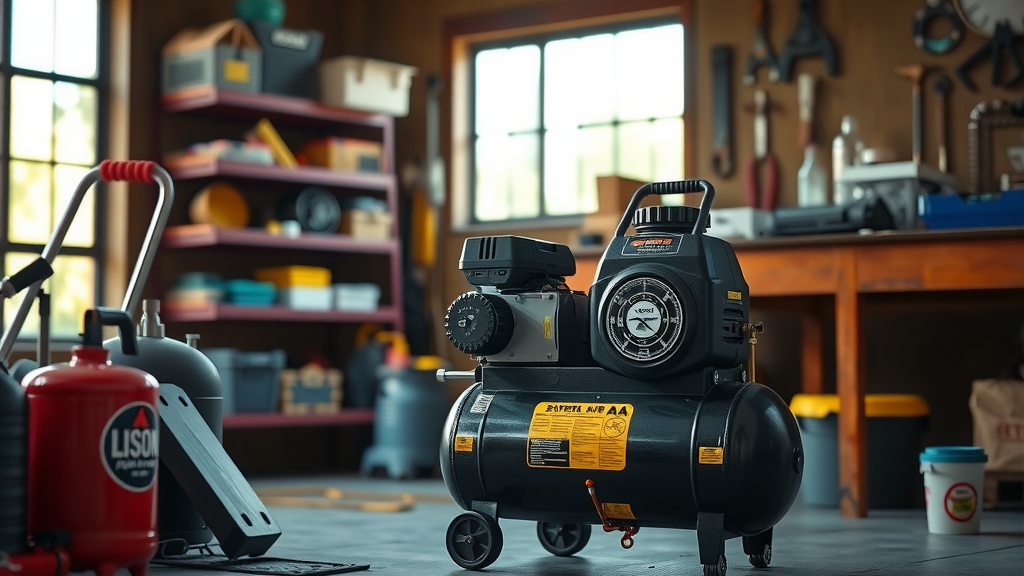
A typical 6-gallon air compressor generally uses between 750 to 1500 watts when running, depending on its horsepower and efficiency.
This wattage translates to roughly 1 to 2 horsepower (HP) for most models you’ll find in home workshops.
- Running a 6-gallon air compressor usually requires 750-1500 watts of power.
- This power consumption is vital for understanding electricity costs and circuit breaker compatibility.
- Factors like motor size, PSI, and duty cycle all affect how many watts your compressor truly uses.
- Checking your compressor’s nameplate for amperage and voltage helps you calculate exact wattage.
How Many Watts Does A 6 Gallon Air Compressor Use?
Most 6-gallon air compressors draw between 750 to 1500 watts during operation. This range can fluctuate based on the specific model, its motor, and the pressure it’s building. Understanding this wattage helps you prepare your workspace.
Why Does Wattage Matter for Your Air Compressor?
Knowing your compressor’s wattage is more than just a number; it’s about practical planning. It directly impacts your electricity bill, helps you avoid tripping circuit breakers, and ensures compatibility with power sources like generators. Think of it as knowing the fuel efficiency of your car.
Unpacking Compressor Power: HP vs. Watts
You often see air compressors rated in horsepower (HP). But what does HP mean for your power outlet? We know that 1 horsepower equals about 746 watts. So, a 1 HP compressor would theoretically use around 746 watts. However, manufacturers sometimes list “peak HP,” which is different from “running HP,” causing a bit of confusion.
The Real Wattage Range: What to Expect
For a 6-gallon compressor, most often rated around 1 to 1.5 HP, you can expect real-world running wattage to be somewhere in that 750 to 1500 watt sweet spot. This accounts for motor inefficiencies and what’s known as the service factor. Many experts suggest focusing on running wattage over peak for accuracy.
Factors That Influence Your Compressor’s Wattage
Several elements play a role in how much power your compressor needs. It’s not just a fixed number. Understanding these factors helps you make smarter choices.
- Motor Size (HP): A larger horsepower motor naturally requires more watts to operate. This is often the biggest factor.
- PSI Requirements: Building higher pressure (PSI) demands more effort from the motor, drawing more power.
- Duty Cycle: If your compressor runs continuously for long periods, it uses more total energy than if it cycles on and off frequently.
- Motor Type: Different motor designs have varying efficiencies. Induction motors are common and generally efficient.
- Voltage: Most 6-gallon compressors use standard 120V household power, impacting the current (amps) drawn.
Decoding the Nameplate: Your Compressor’s Power Tag
The easiest way to find your specific compressor’s power draw is to check its nameplate. This small sticker often provides essential details like amps (A) and voltage (V). You can use a simple formula: Watts = Volts x Amps. For example, if your compressor draws 12 amps at 120 volts, it’s using 1440 watts.
Practical Power Considerations for Your Home or Workshop
When you plug in your compressor, you want it to work without issues. This means thinking about your home’s electrical system. Most household circuits are 15-amp or 20-amp. A 15-amp circuit can safely handle about 1800 watts (15A x 120V). A 20-amp circuit can handle 2400 watts. Your 6-gallon compressor likely fits within these limits, but it’s still wise to be mindful.
What if Your Compressor Trips the Breaker?
It’s a common frustration, isn’t it? Your compressor fires up, and *click*, the power goes out. This usually means your circuit breaker detected an overload. Here’s a quick checklist to consider:
Compressor Breaker Trip Checklist:
- Is the circuit breaker rated for enough amps (e.g., 20A)?
- Are other high-draw appliances running on the same circuit?
- Is your extension cord too long or too thin (low gauge)?
- Could the compressor motor be struggling or nearing its end of life?
- Is the air tank already full, indicating a pressure switch issue?
Running Your 6-Gallon Compressor on a Generator
Taking your compressor on the go means you might need a generator. Here, you must match the generator’s output to your compressor’s needs. Remember that a compressor has a “starting watts” requirement, which is a brief surge of power when it first kicks on, and a “running watts” requirement for continuous use. The starting watts can be 2-3 times higher than the running watts, so choose a generator that can handle that initial spike.
Comparing Compressor Power
Let’s look at a quick comparison to give you an idea of power usage across different small compressors. This helps put the 6-gallon model into perspective.
| Compressor Size (Gallons) | Typical HP | Approx. Running Watts (120V) | Approx. Running Amps (120V) |
|---|---|---|---|
| 2-4 Gallon | 0.75 – 1 | 600 – 900 | 5 – 7.5 |
| 6 Gallon | 1 – 1.5 | 750 – 1500 | 6.5 – 12.5 |
| 8-10 Gallon | 1.5 – 2 | 1100 – 1800 | 9 – 15 |
Saving Energy: Smart Tips for Compressor Use
Want to be a bit more energy-conscious? There are simple steps you can take. Think of it as giving your compressor a little TLC while saving a few pennies.
- Regular Maintenance: Keep your compressor clean and well-maintained. A dirty filter can make the motor work harder.
- Fix Leaks: Even small air leaks in hoses or fittings make your compressor run more often to maintain pressure.
- Match Tool to Compressor: Use the right air tool for the job. Don’t use a large, air-hungry tool with a small compressor for long periods.
- Turn Off When Not Needed: It sounds obvious, but switching off your compressor when you’re done or taking a long break saves a lot of power.
The Cost of Power: A Quick Look at Your Electric Bill
How do those watts translate to dollars? It’s pretty straightforward. Take the wattage, multiply it by the hours you use it, divide by 1000 (to get kilowatt-hours), and then multiply by your local electricity rate. So, if your 1500-watt compressor runs for 1 hour, that’s 1.5 kWh. If electricity costs 15 cents per kWh, that’s 22.5 cents for that hour. Not bad for occasional use, but it adds up!
Conclusion
Understanding “how many watts does a 6-gallon air compressor use” is about more than just a number; it’s about making smart choices for your home and workshop. Most models fall between 750 and 1500 watts, a crucial figure for managing your electricity use and keeping your circuit breakers happy. By checking your compressor’s nameplate, considering its specific demands, and practicing good maintenance, you can ensure efficient and trouble-free operation. Always match your power source to your compressor’s needs, and you’ll have plenty of air for all your projects.
What is the starting wattage for a 6-gallon air compressor?
The starting wattage, also known as surge wattage, for a 6-gallon air compressor can be 2 to 3 times its running wattage. So, if it runs at 1000 watts, it might momentarily spike to 2000-3000 watts when it first kicks on. This is important when selecting a generator.
Can a 6-gallon air compressor run on a standard 15-amp circuit?
Yes, most 6-gallon air compressors are designed to run on a standard 15-amp, 120-volt household circuit. They typically draw around 6 to 12.5 amps, which is well within the 15-amp limit (1800 watts). However, avoid running other high-draw appliances on the same circuit simultaneously to prevent tripping the breaker.
Does the tank size (6 gallons) affect wattage usage?
Indirectly, yes. While the 6-gallon tank itself doesn’t use watts, it determines how often the compressor motor needs to run. A larger tank might mean the motor runs less frequently for small tasks, but the actual wattage drawn *while the motor is running* is determined by the motor’s horsepower and efficiency, not directly by the tank volume.
Is a higher HP always better for a 6-gallon compressor?
Not necessarily. While higher HP means more power, it also means higher wattage draw. For most DIY tasks a 6-gallon compressor is used for (like inflating tires, nailing, or airbrushing), a 1 to 1.5 HP motor is usually sufficient. Going significantly higher might be overkill for the tank size and lead to unnecessary power consumption.
How can I accurately measure my air compressor’s wattage?
The most accurate way is to use a watt meter (also called a power meter or kill-a-watt meter). You simply plug the meter into your wall outlet, and then plug your compressor into the meter. It will display the real-time wattage being used, both when starting and running, giving you precise data for your specific unit.
