What Size Nails Does an Air Nailer Use?
Most air nailers use 18 gauge brad nails from 5/8 inch to 2 inches for trim, 16 gauge finish nails up to 2-1/2 inches for larger trim, and thicker framing nails up to 3-1/2 inches for structural work. Always match the gauge, length, head style and magazine type to the exact gun first, then pick length for the material you are fastening.
On this page (11 sections)
- How does air nailer explain nail size by gauge and length?
- What size nails do brad nailers use?
- What size nails do finish nailers use?
- What size nails do framing nailers use?
- What size staples do staple guns use?
- How do you choose nail length for the material?
- What air pressure and compressor size do you need?
- How do you avoid splits, jams and dry fires?
- Which nail sizes should you stock for common jobs?
- How do you pick the right air nailer for your nail size?
- Final decision rule for air nailer nail size
Most air nailers use 18 gauge brad nails, 16 gauge finish nails, or framing nails, and the right choice depends on gauge and length together. This air nailer explain nail size guide walks through each common family so you can match fasteners to trim, furniture, framing and upholstery without guessing.
Gauge answers how thick the nail is. Length answers how far it drives.
Head style answers how it sits on the surface and how much load it carries.
You also need the magazine type. Some guns take only brads, some take only finish nails, and some take staples.
If the fastener shape does not match the magazine, the gun will not cycle it.
Start with the gun, not the box of nails. Find its gauge, length range and fastener type, then choose a length that crosses the top piece and embeds well into the piece below.
How does air nailer explain nail size by gauge and length?
Gauge and length work as a pair. Gauge controls thickness and holding strength, while length controls reach and embed depth.
A thin nail can be long, and a thick nail can be short.
In North American nailers, lower gauge numbers mean thicker nails. An 18 gauge nail is thinner than a 16 gauge nail.
A 15 gauge finish nail is thicker still.
That numbering feels backwards at first. Think of gauge as a wire size code, not as a direct thickness measurement in inches.
Length is simpler. It is measured in inches or fractions of an inch, from the tip to the underside of the head.
A 2 inch nail is 2 inches long, not counting any sticking tip.
Head style matters too. Brad nails have a small head that sits nearly flush.
Finish nails have a slightly larger head. Framing nails have a larger head for structural loads.
How to read a nail size label
A box label may show gauge, length and count in a short code. Read it as three separate facts, not as one general size.
For example, 18GA x 2 inch means an 18 gauge nail that is 2 inches long. The 18GA tells you the gun and material fit, while the 2 inch tells you the reach.
Staples use a different label. Crown width and leg length matter more than gauge.
A 1/4 inch crown staple has legs that measure around that crown.
Rule: check gauge first, length second, and head or crown third, because all three must match the magazine.
What size nails do brad nailers use?
Brad nailers use 18 gauge brad nails, most often from 5/8 inch to 2-1/8 inches long. For model options, compare pneumatic brad nailers.
That thin profile suits trim, molding, casing and light furniture work where you want a small hole and a flush head.
Brad nails are the small finish fasteners in most workshops. For finer trim work, compare cordless 23 gauge pin nailers as another small-fastener option.
They hold decorative pieces in place while glue does much of the work.
Common brad lengths include 5/8, 3/4, 1, 1-1/4, 1-1/2, 1-3/4, 2 and 2-1/8 inches. Short nails suit thin trim and small parts, while longer nails suit thicker casing and built-up molding.
The DEWALT DCN680B 20V MAX* XR® 18 GA is a cordless example in this family. DEWALT says it drives 18 gauge brad nails from 5/8 inch to 2-1/8 inches.
That length range covers shoe molding, kitchen crown, decorative molding and casing. It does not cover framing work, because brads are too thin and too small headed for structural loads.
Brad nailers split less material than thicker finish nails. You still need to keep nails away from edges, especially on narrow trim or MDF.
Rule: use 18 gauge brads for light trim and molding, and do not use them as a substitute for framing nails.
What size nails do finish nailers use?
Finish nailers use 16 gauge finish nails, commonly from 1 inch to 2-1/2 inches, and some use 15 gauge nails up to 2-1/2 inches. Those thicker nails suit baseboards, door and window casing, cabinet parts and furniture where brads may not give enough hold.
A finish nailer sits between a brad nailer and a framing nailer. It gives more holding power than an 18 gauge brad while keeping a head small enough for finished work.
Length choice follows the parts you join. A 1-1/4 inch nail may suit thin cabinet trim, while a 2 inch or 2-1/2 inch nail may suit wider casing fixed to a jamb or stud.
Head size matters in finish work. A larger head carries more load, but it also leaves a more visible hole that needs filler and sanding.
Do not assume a finish nailer and a brad nailer share fasteners. Even if lengths overlap, the gauge and magazine shape are different.
Our nail gun guide breaks down the main gun types when you are still deciding which family fits your work.
Rule: pick a finish nailer when you need more hold than a brad can give, but still need a neat finished surface.
What size nails do framing nailers use?
Framing nailers use thicker nails, commonly 8d to 16d sizes, with lengths up to 3-1/2 inches for many full-head and clipped-head guns. Those nails suit studs, plates, sheathing, decking and other structural or semi-structural work.
For joist hangers, check the specified nail size.
Framing nails are not just longer finish nails. They have larger heads, thicker shanks and patterns designed for shear and pull-out resistance.
Length is often described in penny size, or d. A 16d common nail is about 3-1/2 inches long, while an 8d nail is about 2-1/2 inches long.
Gun magazines may accept full round head, clipped head or offset round head nails. Those head shapes affect how nails sit in the magazine and how they drive.
Mixed loads are common in framing. For roofing work, compare palm nailers for roofing nails.
For exterior fastening choices, compare roofing and siding nailers. A gun may accept galvanized nails for exterior work and bright nails for interior work, but the size and head style still must match.
If you plan to run a framing nailer from a compressor, our What Size Air Compressor for Framing Nailer? guide helps you check tank and flow needs.
Rule: use framing nails only in a framing nailer, and match length, head style and coating to the job and code needs.
What size staples do staple guns use?
Staple guns use crown staples measured by crown width and leg length, most often 1/4 inch crown for fine work and 3/8 inch to 1/2 inch crown for heavier work. Leg length commonly ranges from 3/8 inch to 2 inches depending on the gun.
Upholstery work often uses fine crown or fine wire staples. Fencing, roofing and house wrap work often uses wider crown staples.
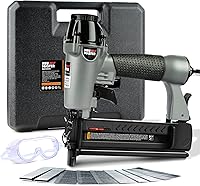
The NEU Master Nail Gun in the products above is a 2 in 1 example. It fires 1/4 inch crown staples from 5/8 inch to 1-5/8 inches, alongside 18 gauge brads from 5/8 inch to 2 inches.
That example shows why crown and length must be read together. A staple with the right crown but the wrong leg length can fail to hold, or it can drive through thin material.
Manual staple guns are a separate case. The YEAHOME Upholstery Staple Gun Heavy Duty accepts D-shaped, U-shaped, T-shaped and pin staples, and it is a manual tool rather than a pneumatic staple gun.
Rule: match staple crown to the gun and the material, then choose leg length so the legs embed in the base piece without piercing through.
How do you choose nail length for the material?
Choose nail length so the nail crosses the top piece and embeds at least a few times the top piece thickness into the base piece. That embed depth gives the nail something to grip.
For trim, a common starting point is a nail about 2 to 3 times the thickness of the trim. A 3/4 inch thick casing would point toward a 1-1/2 to 2-1/4 inch nail.
That ratio is a starting point, not a code rule. Softwood, hardwood, MDF and plywood all react differently to the same nail.
Short nails suit thin parts, small puzzles, beadboard and light molding. Long nails suit thicker baseboards, casing and built-up assemblies.
Too short is the most common mistake. The nail may look seated, but it may not reach the base piece with enough depth to hold under load.
Too long creates other problems. It can split thin trim, hit hidden wiring or plumbing, or poke through the back of a panel.
Our nail gun vs brad nailer comparison helps you decide which tool family to use before you focus on exact lengths.
Rule: measure the top piece, then add enough length to embed firmly into the base piece, and test in scrap first.
What air pressure and compressor size do you need?
Air pressure must be high enough to set the nail head flush without driving it deep or splitting the wood. Start low, test in scrap, and raise pressure in small steps.
The NEU Master example works at 60 to 120 PSI with a 1/4 inch NPT inlet. That range is for that gun, and other guns have their own ranges.
Pressure interacts with nail size. A thin brad needs less force than a thick framing nail of the same length.
Compressor size affects recovery. A small tank and low flow can cause pressure drops during long runs, which can lead to shallow sets or misfires.
Our How to Size an Air Compressor for a Nail Gun? guide explains tank, flow and regulator checks in more detail.
Set pressure at the gun, not only at the compressor tank. Long hoses and quick couplers can change what the gun actually receives.
Rule: test pressure in scrap wood until heads sit flush, then lock that setting for that nail and material combination.
How do you avoid splits, jams and dry fires?
Most nail problems come from mismatched fasteners, wrong pressure, poor nail placement, or a magazine that is empty or damaged. Check those four areas before you change tools.
Splits often follow thick nails, long nails, or nails too close to an end or edge. A thinner brad or a shorter nail can solve the problem in trim work.
Blunt nails also split more often. Keep fasteners dry and clean, and discard bent or rusty stock.
Jams often follow the wrong gauge, wrong crown, wrong head style, or a nail that is too long for the magazine. Read the range on the gun before you load it.
Dry fires happen when the magazine is empty or when a nail fails to feed. A transparent magazine window, depth adjustment and low nail lockout features can help you spot those issues sooner.
The NEU Master example includes a transparent magazine window and a 100-fastener quick-release magazine. The DEWALT example includes tool-free jam release and a low nail lockout.
Rule: if a nail splits, jams or fires blank, stop and check fastener match, pressure and placement before you drive another nail.
Which nail sizes should you stock for common jobs?
Stock a small set of 18 gauge brads in short, medium and long lengths, plus finish nails and staples for the guns you own. That covers most trim, cabinet, furniture and upholstery work.
For brads, keep 3/4, 1-1/4, 1-1/2 and 2 inch lengths on hand. Those four sizes handle most molding, casing and light assembly work.
For finish nails, keep 1-1/4, 1-3/4, 2 and 2-1/2 inch lengths if your gun accepts them. Those sizes cover baseboards, casing and cabinet face frames.
For staples, keep a short leg and a medium leg in the crown size your gun takes. Upholstery and furniture work rarely needs the longest staple legs.
Framing nails should be stocked by job, not as a general assortment. Sheathing, decking and structural work each call for specific sizes and coatings.
Our best nail gun on sale roundup can help you compare gun types before you buy large fastener boxes in bulk.
Rule: buy fasteners in the exact gauge, crown and length ranges your guns accept, and add lengths only as your jobs require them.
How do you pick the right air nailer for your nail size?
Pick the gun by the thinnest and thickest fasteners it must drive, then by the longest length it must reach. That order keeps you from buying a brad nailer for framing work or a framing nailer for delicate trim.
If most of your work is trim, molding and casing, an 18 gauge brad nailer is the usual starting point. Our best nailer combo kit roundup shows how kits bundle guns for mixed shop work.
If you switch between nails and staples, a 2 in 1 gun can reduce tool changes. The NEU Master example does that with 18 gauge brads and 1/4 inch crown staples.
If you work on site without a compressor, a battery brad nailer removes hose and tank limits. The DEWALT example is battery powered and drives 18 gauge brads up to 2-1/8 inches.
If you do framing, choose a gun built for framing nails, not a finish nailer with a long magazine. Head style, depth control and magazine capacity matter more in that class.
Rule: list your three most common jobs, find the fastener each job needs, then choose the smallest gun that drives those fasteners well.
Final decision rule for air nailer nail size
Use 18 gauge brads for light trim, 16 gauge finish nails for larger finished work, framing nails for structural work, and crown staples for upholstery and wide-load fastening. Match gauge, length and head or crown to the magazine every time.
Revisit this air nailer explain nail size chart before you open a new box of fasteners. A five minute check of gauge and length range will prevent most splits, jams and weak holds.
Start with your gun, measure your material, test in scrap, then set pressure. That sequence works for brads, finish nails, framing nails and staples alike.
Frequently asked questions
What does air nailer explain nail size mean in practice?
It means reading two numbers together: gauge tells you nail thickness, and length tells you how far the nail reaches. A 18 gauge, 2 inch brad is thin and long, while a 16 gauge, 2 inch finish nail is thicker at the same length.
Choose gauge for holding power and length for the wood you have to cross.
Can one air nailer use every nail length?
No. Each magazine has a minimum and maximum length, and many guns accept only one gauge or one staple crown.
Check the range stamped on the tool or printed in its manual before you buy a box of fasteners.
A nail that fits the magazine must also suit the thickness of the piece you are attaching.
Why does a nail split trim or blow out the back?
That usually points to a nail that is too thick, too long, too close to an edge, or driven with too much air pressure. Thinner brad nails split less trim, while a shorter nail can stop before it breaks through a panel.
Lower pressure and keep the nail centered in the material.
Do staples hold better than brad nails for upholstery?
Staples spread the load across a crown, so they often suit fabric, foam and thin backing materials. Brad nails suit trim and molding where a small head can sit flush.
Many 2 in 1 guns let you switch between the two, but the crown size and staple length still have to match the magazine.
What pressure should I use for 18 gauge brad nails?
Start at the low end of the gun maker's range and test one nail in scrap wood. Raise pressure in small steps until the head sits flush without sinking deep or splitting the piece.
More pressure is not better if the nail already seats cleanly at a lower setting.