7 Best Food Grade Air Tool Oils (November 2026)
The best food grade air tool oil include the Super Lube Silicone Oil High & Low for wide temperature ranges, the Petrol-Gel Food Grade Equipment Lubricant NSF for food equipment gears, and the Super Lube Air Tool Pneumatic Lubricant for air tools.
On this page (9 sections)
- Our top food grade air tool oil picks for every shop type
- How the best food grade air tool oils compare
- How we compared these food grade lubricants
- What does NSF H1 mean for air tool oil?
- Can food grade air tool oil replace regular tool oil?
- Which form fits your job: drip oil, spray, gel or penetrating oil?
- How do you oil an air tool with food grade oil?
- What viscosity should you choose for food grade air tool oil?
- Verdict: which food grade air tool oil should you buy?
The best air tool oil food grade for most pneumatic tools is the Super Lube Air Tool Pneumatic Lubricant, because it combines NSF H1 registration with a formula made for air tools. You get a 1 pint bottle, which lasts far longer than a small 4 ounce bottle or a 90 ml bottle.
Food grade status matters only when your tools work near food. In a general workshop, standard tool oil is enough.
In a food plant, bakery, meat shop, or packaging area, you need NSF H1 registered products by rule.
We compared 7 options by registration, form, viscosity, temperature range and size. Some are true drip oils for tool inlets.
Others are gels or sprays for food equipment that happens to share the same shelf.
If you want a broader oil comparison first, read our Best Air Compressor Tool Oil guide. It explains compressor oil, which is a different product from tool oil.
Our picks at a glance
-
1
 Best for wide temperature ranges
Super Lube Silicone Oil High & Low
9.6/10 our score
See it on Amazon -
2
 Best for food equipment gears
Petrol-Gel Food Grade Equipment Lubricant NSF
9.5/10 our score
See it on Amazon -
3

- 4
 Check it
CRC Food Grade Machine Oil Spray
Best for spot spraying - 5
 Check it
CRC Food Grade Silicone Lubricant Aerosol Spray
Best for silicone spray film - 6
 Check it
TrickShot Penetrating Lubricant Trick Shot
Best for freeing stuck parts - 7
 Best for small food machinesCheck it
Our top food grade air tool oil picks for every shop type
The Super Lube silicone oil leads on temperature range and precision. The Super Lube pneumatic lubricant leads for actual air tools.
The rest win on specific jobs like gears, sprays and stuck parts.
Super Lube Silicone Oil High & Low: Best for wide temperature ranges
- NSF H1 registered food grade lubricant
- 5000 cSt silicone oil
- 4 fluid ounces
- Rated from -58 F to 392 F
- For rubber, plastic and metal
A clear silicone oil with NSF H1 registration and a broad temperature range. It suits precise oiling of tools and parts that see heat or cold.
Pros
- NSF H1 registered
- Wide temperature range
- Clear medium viscosity oil
Cons
- Only 4 ounces
- Thicker 5000 cSt viscosity
This Super Lube silicone oil suits buyers who need one small bottle for tools, gauges and parts that run hot or cold. It is NSF H1 registered, so it fits incidental food contact rules that many shops require.
The oil is a 5000 cSt silicone fluid in a 4 ounce bottle. That viscosity is medium and thicker than light SAE 10 tool oil.
It spreads into a clear film on rubber, plastic and metal.
Super Lube rates it from -58 F to 392 F. That range covers cold storage rooms, ovens and outdoor winter work without a second product.
It also resists oxidation and hydrolysis, which helps in damp shops.
As a straight chained polydimethylsiloxane fluid, it keeps a low variance in viscosity as temperature changes. In daily use that means the film does not thin out as fast in heat or thicken as much in cold.
It is also chemically inert, which helps when it touches mixed materials.
The trade-off is size and thickness. Four ounces is fine for occasional oiling, but it will not last long in a shop running grinders all day.
The thicker film also may not mist through an air line as quickly as a light pneumatic oil.
Choose this for precision work and temperature extremes. Choose the Super Lube pneumatic oil below if you oil air tools daily and want a full pint.
Petrol-Gel Food Grade Equipment Lubricant NSF: Best for food equipment gears
- NSF approved for food processing equipment
- Mineral oil gel in tubes
- Pack of 2
- 4 fluid ounces per tube
- High viscosity gel
A thick food grade gel for machinery parts in contact with food. It stays in place better than a thin oil for gears and sliding parts.
Pros
- NSF approved for food equipment
- Gel stays in place
- Two tubes in the pack
Cons
- Too thick for most air tool inlets
- Gel format needs direct application
Petrol-Gel suits food equipment owners who need a thick lubricant that stays put. It is NSF approved for food processing equipment and comes as two 4 ounce tubes of mineral oil gel.
The gel form is the key difference. It does not run like a thin oil.
You apply it by hand or with a spatula to gears, mixers and sliding parts that would shed a light oil quickly.
Petrol-Gel rates the gel with a 185 F upper temperature rating and high viscosity. That makes it better for slow, loaded parts than for fast spinning air tool vanes.
The tube format also helps with control. You can place a small amount exactly on a gear tooth or a mixer part instead of trying to drip oil from a bottle.
The gel stays in place without dripping or melting off too easily under moderate temperatures.
That staying power is useful on gym equipment, garage door tracks and other machinery mentioned for versatile use. For food machinery it means less waste on parts that move slowly and carry load.
The trade-off is clear for air tools. This gel is too thick for most tool inlets and will not flow through an air line.
It also needs direct access to the part, so it cannot oil a tool from the coupler.
Pick this for meat grinders, mixers and food machinery. Pick a drip oil for impact wrenches, ratchets and die grinders.
Super Lube Air Tool Pneumatic Lubricant: Best for air tools
- NSF H1 registered food grade lubricant
- Made for air tools and pneumatic equipment
- 1 pint bottle
- ISO Grade 68
- Moisture resistant formula
A true air tool oil with NSF H1 status and a full pint for regular use. It is the most direct match for oiling impact wrenches, grinders and drills.
Pros
- Made for air tools
- NSF H1 registered
- Large 1 pint bottle
Cons
- ISO Grade 68 is heavier than SAE 10
- Not a spray for hard to reach parts
This Super Lube pneumatic lubricant is the most direct answer for air tool users who need food grade status. It is NSF H1 registered and made for high pressure air tools.
You get a 1 pint, 16 fluid ounce bottle. That size matters in a working shop.
A few drops per tool per day adds up fast, and a pint lasts much longer than 4 ounce bottles.
The oil is ISO Grade 68 and moisture resistant. Super Lube says it eliminates frost buildup down to -40 F and helps prevent rust and corrosion.
It suits impact tools, drills, grinders and sanders.
Its blended rust and corrosion inhibitors form a film strength barrier inside the tool. That barrier helps extend tool life and repair intervals for industrial, household and agricultural tools.
It also absorbs water instead of letting it sit inside the motor.
The trade-off is viscosity. ISO Grade 68 is heavier than the light SAE 10 oils many tool makers recommend.
In cold weather it may flow slowly, and it can leave a heavier film than you want on delicate airbrushes.
Pick this as your main food grade air tool oil. If you need a lighter or thinner option, compare it with the best air tool oil sae 10 picks.
CRC Food Grade Machine Oil Spray: Best for spot spraying
- NSF H1 registered for incidental food contact
- 11 oz spray can
- Non-silicone white mineral oil
- Colorless and odorless
- For metal and plastic
A non-silicone food grade spray for machine parts, conveyors and fasteners near food. It reaches parts that a bottle oil cannot reach easily.
Pros
- NSF H1 registered
- Spray reaches tight spots
- No silicone
Cons
- Spray is less precise for air tool inlets
- 11 oz can empties faster than a bottle
This CRC spray suits maintenance crews who need to reach food equipment parts without a bottle and brush. It is NSF H1 registered and supplied in an 11 ounce can.
The formula is a non-silicone white mineral oil that is colorless and odorless. It will not harm metal, wood, plastic or painted surfaces.
CRC says it penetrates and loosens rust, scale and dirt.
You can spray it from any position, even upside down. That helps with conveyors, chutes, racks, fillers and cooking appliances where a drip oil cannot reach.
The spray also works around fasteners and hose fittings on food processing equipment. That makes it a useful penetrating option when a part is partly seized and needs both loosening and lubrication.
For air tool users, the value is mostly external. It can free a stuck coupler or a rusted fitting without opening a bottle.
It is less useful as a measured dose inside a pneumatic motor.
The trade-off is precision inside air tools. A spray aimed at an inlet sends mist and overspray, not a measured dose to the vanes.
It also coats outside parts more than internal parts.
Pick this for food plant machinery and freeing fasteners. Pick a bottle oil for regular inlet oiling.
For a general comparison, see Can I Use Air Compressor Oil In Air Tools?.
CRC Food Grade Silicone Lubricant Aerosol Spray: Best for silicone spray film
- NSF H1 registered
- 10 oz aerosol spray
- Silicone lubricant
- Colorless and odorless film
- Rated to 400 F
A food grade silicone spray that leaves a dry, colorless film on chutes, guides and rails. It suits equipment more than it suits air tool internals.
Pros
- NSF H1 registered
- Dry film resists sticking
- Wide temperature range
Cons
- 12 pack is a large purchase
- Film spray is not a drip oil for tools
This CRC silicone spray suits food handling equipment that needs a dry, non-staining film. It is NSF H1 registered and meets FDA regulation CFR 21-178.3570.
Each can is 10 fluid ounces, and this listing is a 12 pack. That bulk format fits plants with many chutes, guides, rails and conveyor points to treat on a schedule.
The silicone formula forms a colorless, odorless film rated to 400 F. It lubricates and insulates metal to non-metal surfaces and resists dust and debris better than a wet oil film.
The wide range from -40 F to 400 F is the main practical benefit. It covers freezers, ovens and cold rooms without changing products.
The fast drying film also helps where a wet oil would attract dirt or transfer to packaging.
It can serve as a release agent on food contact surfaces that need less sticking. That role suits slicers, bottling machinery and guides where product build up slows work.
The trade-off is format and quantity. A 12 pack is expensive and takes storage space if you only need one can.
The dry film also does not provide the same internal lubrication as a drip oil in a pneumatic motor.
Pick this for conveyors, bottling machinery, slicers and vending equipment. Pick the Super Lube pneumatic oil for tools themselves.
TrickShot Penetrating Lubricant Trick Shot: Best for freeing stuck parts
- NSF H1 registered
- 16 fluid ounces
- Soy oil based penetrating lubricant
- Bottle with pump spray nozzle
- USDA biobased product
A thin plant based penetrating oil for loosening seized parts near food areas. It is a problem solver first and a regular air tool oil second.
Pros
- NSF H1 registered
- Thin penetrating formula
- Large 16 ounce bottle
Cons
- Thin viscosity may not last in fast tools
- Penetrating oil is not a dedicated air tool oil
TrickShot suits buyers who need a food grade penetrating oil more than a daily tool oil. It is NSF H1 registered and USDA biobased, with a soy oil based formula.
The bottle holds 16 fluid ounces and includes a pump spray nozzle. Its 5.2 centistokes viscosity is very thin, so it creeps into threads and seized joints quickly.
It is made to loosen seized bolts, stuck nuts and corroded parts. It also degreases and cleans as it works.
That makes it useful for freeing a rusted fitting on food equipment before you apply a proper lubricant.
The plant based formula contains zero petroleum distillates. That may matter in shops that want to limit petroleum products near food or in commercial kitchens.
It also gives a mild vegetable scent rather than a strong solvent smell.
As a multi purpose workshop product it can handle door hinges, garage door tracks and hand tools. That breadth helps a small shop keep one bottle for odd jobs near food areas.
The trade-off is film life. A thin penetrating oil will not hold up as long in a fast running grinder or impact wrench.
It also lacks the dedicated rust inhibitor blend of a true pneumatic oil.
Pick this to free stuck parts in food areas. If you are unsure which oil belongs inside the compressor itself, read Can I Use Air Tool Oil In My Compressor?.
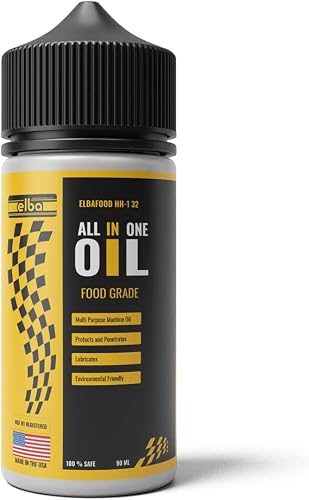
elba ALL-IN-ONE OIL: Best for small food machines
- NSF certified H1
- 90 ml bottle
- FDA food safe
- Halal and kosher certified
- For slicers, chains, belts and wheels
A small bottle of white, odorless food grade oil for slicers and light machinery. It suits light shop use where a large bottle would go stale.
Pros
- NSF H1 certified
- Small precise bottle
- Halal and kosher certified
Cons
- Only 90 ml
- Too small for daily air tool use
This elba oil suits small food shops that need a little food grade oil, not a full pint. It is NSF certified H1 and FDA food safe, in a 90 ml bottle.
The oil is white, clear and odorless. Elba says it is also halal and kosher certified.
It is aimed at electric slicers, chains, belts and wheels in food manufacturing and retail shops.
The small bottle is a benefit for light use. You can keep it in a drawer for a slicer or scale without buying a large container that may collect dust.
The precision pour format helps on small parts.
It is also positioned for restaurants, delis and supermarkets. In those settings the oil needs to be clean and safe for equipment around food, not necessarily strong enough for heavy industrial air tools.
The all in one positioning means it cleans, lubricates and protects light machinery in one step. That suits a slicer or a small mixer that sees daily but light duty use.
The trade-off is volume. At 90 ml, it will run out quickly if you oil air tools every day.
It is also aimed at food machines, not at pneumatic motors, so viscosity and film strength for tools are not its focus.
Pick this for delis, restaurants and small bakeries. Pick the 1 pint Super Lube pneumatic oil for a busy air tool shop.
How the best food grade air tool oils compare
How we compared these food grade lubricants
We compared registration, form, viscosity, temperature range and bottle size first. NSF H1 status was the filter, because a product without it does not belong in this roundup.
We then split the group by job. Drip oils can go in a tool inlet.
Gels stay on gears. Sprays reach external parts.
Penetrating oils free stuck parts. Mixing those jobs leads to the wrong purchase.
Score weighs specs, features and buyer feedback against what you are shopping for. A spray can score well for food equipment even if it is a poor choice for a tool inlet.
Temperature range mattered for shops with cold storage or hot equipment. Viscosity mattered because a 5000 cSt silicone oil and a 5.2 centistokes penetrating oil behave nothing alike.
Limits of this comparison
We treated manufacturer specs as the basis for each product. We did not add price, rating or test claims beyond the data listed for each item.
Bottle size was read as volume, not as cost per use. A 12 pack spray and a 90 ml bottle serve different buyer types even when both are food grade.
| Product | Best for | Form | Size | Viscosity | Our score |
|---|---|---|---|---|---|
| Super Lube Silicone Oil High & Low | wide temperature ranges | Oil | 4 fluid ounces | 5000 cSt | 9.6 |
| Petrol-Gel Food Grade Equipment Lubricant NSF | food equipment gears | Gel | 2 x 4 fluid ounces | 9.5 | |
| Super Lube Air Tool Pneumatic Lubricant | air tools | Oil | 1 pint | ISO Grade 68 | 9.4 |
| CRC Food Grade Machine Oil Spray | spot spraying | Spray | 11 ounces | 9.2 | |
| CRC Food Grade Silicone Lubricant Aerosol Spray | silicone spray film | Spray | 10 fluid ounces | 9.0 | |
| TrickShot Penetrating Lubricant Trick Shot | freeing stuck parts | Oil and spray | 16 fluid ounces | 5.2 centistokes | 8.8 |
| elba ALL-IN-ONE OIL | small food machines | Oil | 90 ml | 8.5 |
For a buying guide, the best air tool oil gallon roundup helps if you go through oil quickly. Bulk size only makes sense when you know the viscosity suits your tools.
What does NSF H1 mean for air tool oil?
NSF H1 means the lubricant is registered for incidental food contact. It does not mean the oil is edible.
It means a small amount of incidental contact is acceptable under the registration rules.
That distinction matters in food plants. Auditors and shop rules often require H1 products on any equipment that could drip, mist or transfer lubricant near food.
Air tool oil is a common source of mist. When a tool exhausts, a fine spray can leave the tool and land on nearby surfaces.
That is why inlet oil near food equipment needs the same care as oil on the equipment itself.
H1 versus H2
H1 is for incidental food contact. H2 is for non-food contact areas.
For air tools used near food handling, H1 is the safer and more common requirement.
What H1 does not guarantee
H1 registration does not guarantee the oil will lubricate your specific tool well. Viscosity, film life and temperature range still decide performance for pneumatic motors.
Can food grade air tool oil replace regular tool oil?
Yes, for most tools, a food grade pneumatic oil can replace regular tool oil. The Super Lube pneumatic lubricant is made for air tools and carries H1 registration.
The replacement works best when viscosity matches your tool maker recommendation. A heavier ISO Grade 68 oil may feel sluggish in a small die grinder that expects a light oil.
Food grade oils also tend to be formulated for clean use. A clear, odorless oil is easier to use near food than a dark oil with a strong smell.
When to keep regular oil
Keep regular oil for tools that never work near food and need a specific viscosity. Food grade status adds cost, and you do not need to pay it everywhere.
Check your tool manual
Your tool manual may specify SAE 10 or another grade. Match that grade first, then choose an H1 version if your shop requires it.
Which form fits your job: drip oil, spray, gel or penetrating oil?
Drip oil fits tool inlets. You add a few drops to the coupler or inlet before use, and the air carries it to the vanes.
Spray fits external parts. It reaches conveyors, hinges, fasteners and sliding guards that a bottle cannot reach.
Form decides where the lubricant ends up. A drip oil goes inside the tool.
A gel stays where you put it. A spray coats a wide area with some waste.
Gel for gears and slow parts
Gel fits gears, cams and food equipment parts that need lubricant to stay in place. It will not flow through an air line, so do not use it in a tool inlet.
Penetrating oil for stuck parts
Penetrating oil fits seized bolts and corroded fittings. Use it to free the part, then follow with a proper lubricant for the job.
For messy work, a best air tool oil dispenser bottle helps you dose a few drops without spilling oil on the bench.
How do you oil an air tool with food grade oil?
Add oil to the inlet before connecting the hose. A few drops is enough for most tools, and excess oil will blow out as mist when you run the tool.
Run the tool briefly to spread the oil. Then wipe the inlet and coupler so oil does not get on workpieces, especially near food areas.
Disconnect the tool before you oil it. That simple step prevents a sudden start while the coupler is open.
How often to oil
Oil before each use for tools that run daily. For occasional use, oil before the session and again if the tool runs dry or sounds rough.
Storage tips
Store oil upright with the cap tight. Keep food grade oils separate from regular oils so crews do not mix them by mistake.
Label the bottle with the product name. That habit helps when two similar bottles sit on the same bench.
What viscosity should you choose for food grade air tool oil?
Light viscosity, around SAE 10, flows easily and suits most small pneumatic tools. It mists well and reaches vanes quickly.
Heavier viscosity, such as ISO Grade 68 or 5000 cSt silicone, forms a thicker film. It suits slower parts, seal lubrication and wide temperature swings.
Viscosity also affects how the oil behaves in winter. A light oil flows faster in cold air.
A heavy silicone oil holds its film better in heat.
Thin penetrating oils
Very thin oils, around 5 centistokes, creep into threads and joints. They are poor choices for daily lubrication of fast tools because the film runs out quickly.
Match the tool first
Start with your tool maker recommendation. Then choose between food grade and regular versions of that viscosity.
Verdict: which food grade air tool oil should you buy?
Pick the Super Lube Air Tool Pneumatic Lubricant if you want one food grade oil for daily air tool use. Its 1 pint bottle and H1 registration make it the best all-around match.
Pick the Super Lube Silicone Oil if you need wider temperature stability in a small bottle. Pick Petrol-Gel for food equipment gears.
Pick a CRC spray for external parts and stuck fasteners near food.
For most shops, this food grade air tool oil choice comes down to form first and brand second. Drip oil for tools, gel for gears, spray for reach, penetrating oil for freeing parts.
Next, check your tool manual for viscosity, then buy the H1 oil that matches it. That order prevents the most common mistake in this category.
Our top 3 picks at a glance
-
1
Best for wide temperature ranges
Super Lube Silicone Oil High & Low
9.6/10 our score
See it on Amazon -
2
Best for food equipment gears
Petrol-Gel Food Grade Equipment Lubricant NSF
9.5/10 our score
See it on Amazon -
3
Frequently asked questions
What makes an air tool oil food grade?
A food grade oil is registered for incidental food contact, commonly under NSF H1. That registration matters when a tool is used near food handling equipment, food packaging, or food plant machinery.
Can I use regular air tool oil near food equipment?
Regular air tool oil is not registered for incidental food contact. If your shop rule or plant rule requires H1 products, use a food grade oil even if the tool itself is not a food machine.
Is a spray as good as a drip oil for air tools?
A spray is easier for external parts, conveyors and fasteners. A drip oil placed in the tool inlet reaches the vanes and valves inside a pneumatic tool more reliably.
What viscosity should food grade air tool oil have?
Many air tools use a light oil around SAE 10. Heavier ISO Grade 68 or 5000 cSt silicone oils form a thicker film and suit slower parts or harsher temperatures.


