9 Best Air Compressors for Sandblasting Wood (November 2026)
The best compressors for sandblasting wood include the LE LEMATEC Sand Blaster Gun Kit for wood furniture refinishing, the Metabo HPT Portable Pancake Air Compressor for portable jobsite use, and the ECOMAX Air Compressor 6 Gallon 150 PSI for budget starter setups.
On this page (7 sections)
- Best compressors for sandblasting wood compared side by side
- How we compared compressors for sandblasting wood
- What CFM and tank size do I need for sandblasting wood?
- What media and pressure are best for wood?
- How do I set up dry air and steady pressure?
- What safety gear do I need for blasting wood?
- Which compressor should I buy for my wood projects?
The best compressors for sandblasting wood deliver steady airflow near 4 CFM at 90 PSI and keep pressure stable at the gun. Wood needs gentle media and lower aggression than metal, so airflow and dry air matter more than maximum pressure.
Sandblasting wood suits furniture refinishing, paint removal from trim, and surface prep before refinishing. The goal is even cleaning without cutting into grain or raising a rough texture.
Our score weighs specs, features and buyer feedback against what wood blasting needs. We compared CFM at 90 PSI, tank size, pressure range and included accessories for each pick.
If you are still sizing a compressor, start with What Air Compressor Do I Need For Sandblasting? for the sizing rules. For enclosed setups, compare our best air compressor for sandblasting cabinet guide.
Our picks at a glance
-
1
 Best for wood furniture refinishing
LE LEMATEC Sand Blaster Gun Kit
9.6/10 our score
See it on Amazon -
2
 Best for portable jobsite use
Metabo HPT Portable Pancake Air Compressor
9.5/10 our score
See it on Amazon -
3
 Best for budget starter setups
ECOMAX Air Compressor 6 Gallon 150 PSI
9.3/10 our score
See it on Amazon
- 4
 Check it
Limodot Quiet Oil-Free Air Compressor
Best for indoor workshops - 5
 Check it
LE LEMATEC Sand Blaster Gun Kit
Best for gravity and siphon feed control - 6
 Check it
InoKraft Leak-Proof Sand Blaster Kit for Air
Best for small detailed woodwork - 7
 Best for high pressure tanks onlyCheck it
- 8
 Check it
VELPAX Ultra Quiet Air Compressor
Best for quiet garage work - 9
 Check it
Klutch 20-Gallon Air Compressor
Best for continuous blasting sessions
Best compressors for sandblasting wood compared side by side
The LE LEMATEC at 9.6 leads for wood furniture work because its gun is light and tuned for 90 PSI and 4 CFM. The Metabo HPT at 9.5 is the portable compressor pick, while the Klutch at 7.9 is the continuous session pick despite its lower score.
Tank size separates short spot work from long sessions. A 6-gallon tank recovers often, while a 20-gallon tank holds pressure through longer passes on panels and furniture.
The gun picks and compressor picks in this list solve different parts of the same job. A gun controls media flow and reach, while a compressor controls how long that flow can continue without a pause.
Wood work usually fails on the second point first, because soft grain shows every pressure dip as a patchy clean.
Pressure alone does not explain the ranking either. A unit rated at 200 PSI or 4500 PSI can still be wrong for wood if its flow at 90 PSI is low or if it cannot run a pneumatic gun at all.
That is why the comparison below puts CFM at 90 PSI and usable tank reserve ahead of headline maximum pressure.
| Product | Best for | Operating Pressure | Air Flow Required | Weight | Our score |
|---|---|---|---|---|---|
| LE LEMATEC Sand Blaster Gun Kit | wood furniture refinishing | 90 PSI | 4 CFM | 1.29 lb | 9.6 |
| Metabo HPT Portable Pancake Air Compressor | portable jobsite use | 42 lb | 9.5 | ||
| ECOMAX Air Compressor 6 Gallon 150 PSI | budget starter setups | 34.17 lb | 9.3 | ||
| Limodot Quiet Oil-Free Air Compressor | indoor workshops | 9.1 | |||
| LE LEMATEC Sand Blaster Gun Kit | gravity and siphon feed control | 90 PSI | 4 CFM | 8.9 | |
| InoKraft Leak-Proof Sand Blaster Kit for Air | small detailed woodwork | 60-120 PSI | 2.92 lb | 8.6 | |
| GOYOJO PCP Air Compressor | high pressure tanks only | 18 lb | 8.4 | ||
| VELPAX Ultra Quiet Air Compressor | quiet garage work | 8.1 | |||
| Klutch 20-Gallon Air Compressor | continuous blasting sessions | 90 lb | 7.9 |
How we compared compressors for sandblasting wood
We checked CFM at 90 PSI first because blaster guns list that number as the working target. A compressor rated only at low pressure may sound strong yet sputter at the gun.
We checked tank size next because wood jobs often involve large flat areas. Small tanks force constant recovery pauses that break your rhythm and cause uneven cleaning.
Media compatibility shaped the gun scores because wood needs walnut shell, soda or fine grit options. Guns that accept 46 to 220 grit give you control from paint stripping to gentle cleaning.
Moisture control mattered for every pick because wet air clumps media and ruins flow. Kits with an oil-water separator or a clear filter path scored better for wood work.
Noise and weight changed the ranking for indoor shops. A quiet 60 to 68 dB compressor suits shared spaces, while a 90 lb shop unit suits a dedicated garage.
Recovery time also mattered, because a compressor that refills quickly can support short bursts even with a small tank. We treated fast recovery as a partial offset for low tank size, not as a full replacement for reserve air on long furniture pieces.
How the scores reflect wood use
A high score here means the pick matches the airflow, media control and setup needs of wood blasting. It does not mean the unit is the strongest compressor in general terms.
Portability was scored only where it helps real wood jobs, such as moving between a garage, yard and workshop. Extra pressure beyond the regulated working point earned little credit, because wood blasting should not use it.
LE LEMATEC Sand Blaster Gun Kit: Best for wood furniture refinishing
- 90 PSI and 4 CFM optimal operation
- 46 to 220 grit media range
- 1.29 lb lightweight body
- Ceramic nozzle
- ABS housing
A lightweight gravity-fed blaster built for detail work on wood furniture and spot blasting. It needs steady 4 CFM at 90 PSI and dry air to keep media flowing.
Pros
- Lightweight for extended detail work
- Accepts walnut shells for gentle wood cleaning
- Ceramic nozzle resists abrasive wear
Cons
- Needs a 20+ gallon tank for continuous work
- Requires an inline moisture filter
This LE LEMATEC gun suits wood furniture refinishing and spot blasting where control matters. At 1.29 lb, it stays light during extended detail work on chair legs, trim and small panels.
It operates best at 90 PSI requiring 4 CFM, which is the standard target for steady media flow. A 20+ gallon tank helps you keep that flow continuous on larger projects.
Media range covers 46 to 220 grit, including walnut shells that clean wood gently. Aluminum oxide and glass beads are also listed for tougher coatings on harder surfaces.
The ceramic nozzle resists wear from abrasive media, and the ABS housing keeps weight low. The easy-pull trigger helps beginners avoid digging into soft grain.
This gun is best for users who already have, or plan to buy, a compressor with real reserve air. It rewards dry air, sealed media and a steady trigger hand on visible wood.
Trade-off: it needs an inline moisture filter to prevent clogs. Pair it with a larger tank if you plan long passes rather than short detail work.
Metabo HPT Portable Pancake Air Compressor: Best for portable jobsite use
- 6 gallon tank
- 200 PSI max pressure
- 4 CFM at 90 PSI
- 42 lb weight
- 1.3 hp motor
A portable 6-gallon pancake compressor that meets the 4 CFM at 90 PSI target for sand blaster guns. Its small tank means short blasting bursts with recovery time.
Pros
- Meets 4 CFM at 90 PSI for blaster guns
- Lightweight and easy to carry
- High max pressure for other tools
Cons
- 6 gallon tank limits continuous blasting
- Pancake shape can tip on uneven floors
The Metabo HPT suits portable wood blasting on job sites and in garages. Its 6 gallon tank and 4 CFM at 90 PSI match the airflow target for sand blaster guns.
At 200 PSI max pressure, it has headroom above the 90 PSI working point. That extra range helps other tools, but wood blasting should stay regulated near the gun target.
Weighing 42 lb, it carries easily between rooms and outdoor work areas. The pancake shape stores flat against a wall when not in use.
Its 1.3 hp motor and compact frame also suit nailers and other pneumatic tools, so the same compressor can serve a broader workshop. For wood blasting, the limit is tank reserve, not peak pressure.
This pick suits spot repairs, trim, small furniture parts and detail work where short passes are normal. It is less suited to stripping a full tabletop in one session.
Trade-off: a 6-gallon tank runs out quickly during continuous blasting. Expect recovery pauses, so this pick fits spot work better than full furniture stripping.
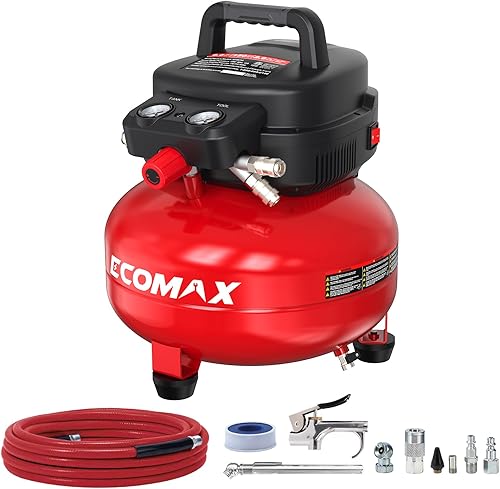
ECOMAX Air Compressor 6 Gallon 150 PSI: Best for budget starter setups
- 6 gallon tank
- 150 PSI max pressure
- 1.5 hp motor
- 25 ft PVC hose included
- 10 piece accessories kit
- Oil-free pump
A light 6-gallon starter compressor with hose and accessories included. It suits short wood blasting jobs if you accept frequent pauses for recovery.
Pros
- Hose and accessories included
- Lightweight at 34.17 lb
- Oil-free pump needs little upkeep
Cons
- Lower air flow than the 4 CFM target
- Small tank limits continuous blasting
The ECOMAX suits budget starter setups for small wood projects. Its 6 gallon tank and 150 PSI max pressure give you a compact shop unit at 34.17 lb.
It includes a 25 ft PVC hose and a 10 piece accessories kit, so you can connect a blaster gun without buying extras first. Dual gauges help you watch tank and tool pressure.
The oil-free pump reduces upkeep, which helps if you only blast wood a few times a year. Low voltage and cold-weather start features support garage use.
Dual quick couplers let you run two connections at once, which can help when you switch between a blow gun and a blaster. The flip-up handle makes storage in a small corner easier.
This pick suits tire inflation, light spraying, brad and staple work, and short wood cleaning jobs. It is a general starter compressor first and a blasting compressor second.
Trade-off: air flow is listed below the 4 CFM target, so expect sputtering on long runs. Use short bursts and let the tank recover between passes.
Limodot Quiet Oil-Free Air Compressor: Best for indoor workshops
- 8 gallon tank
- 2.8 CFM at 90 PSI
- 68 dB quiet operation
- 1.2 hp motor
- 25 ft hose included
- Oil-free design
A quiet 8-gallon compressor for indoor wood shops. At 2.8 CFM at 90 PSI it delivers less flow than ideal for continuous blasting, so short passes work best.
Pros
- Quiet at 68 dB for indoor use
- 8 gallon tank for short bursts
- Hose and accessories included
Cons
- 2.8 CFM at 90 PSI is below the 4 CFM target
- Will cycle often during blasting
The Limodot suits indoor workshops where noise matters. At 68 dB, it runs quieter than most shop compressors in this group during wood prep work.
Its 8 gallon tank and 2.8 CFM at 90 PSI support short blasting bursts on small wood pieces. The included 25 ft hose and accessories help you set up quickly.
The oil-free design removes oil checks and filter changes. Fast recovery helps after short nailer or blasting bursts, though continuous blasting will still cycle often.
The 1.2 hp induction motor runs at low speed, which helps keep operation smooth in a house or shared shop. A 120 second refill from empty also reduces waiting between small tasks.
This pick suits blow cleaning, stapling, brad nailing, airbrushing and light wood prep. It is best where quiet operation matters more than maximum blasting flow.
Trade-off: 2.8 CFM at 90 PSI is below the 4 CFM target for many blaster guns. Choose it for quiet indoor use, not for long furniture stripping sessions.
LE LEMATEC Sand Blaster Gun Kit: Best for gravity and siphon feed control
- Gravity feed and siphon feed modes
- 7 foot siphon hose included
- 90 PSI and 4 CFM minimum
- 150 PSI max pressure
- 1/4 inch NPT connector
- Ceramic nozzle
A two-mode blaster gun for detail work and larger flat wood surfaces. Gravity feed suits small jobs, while siphon feed needs full 4 CFM to lift media reliably.
Pros
- Two feed modes for different jobs
- Siphon hose included for flat surfaces
- Standard 1/4 inch NPT connection
Cons
- Siphon mode needs maximum CFM to work well
- Not suited to compressors under 6 gallons
This second LE LEMATEC gun suits users who want feed mode choice for wood. Gravity feed works for small, quick detail work, while siphon feed suits larger flat surfaces with the included 7 foot hose.
It requires 4 CFM at 90 PSI for continuous operation, with a 150 PSI max pressure. Siphon mode needs that full flow to lift media, so undersized compressors will struggle.
The 1/4 inch NPT connector fits standard hoses and fittings. Media range covers 46 to 220 grit, including walnut shell for gentle wood cleaning.
Hardened ceramic nozzle construction supports abrasive media better than plastic options. The serviceable design also makes routine cleaning and nozzle checks simpler during a project.
This gun suits users who move between detail work on turned parts and flat work on panels or doors. Switching feed modes lets you match media delivery to the surface, instead of forcing one setup for every piece.
Trade-off: it is not for pancake compressors under 6 gallons. Wet air will clump media, so an inline filter and dry media are essential for steady flow.
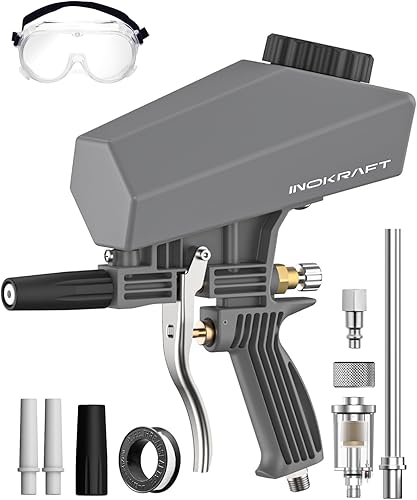
InoKraft Leak-Proof Sand Blaster Kit for Air: Best for small detailed woodwork
- 60 to 120 PSI operating range
- 900cc hopper
- Oil-water separator included
- Safety goggles included
- Extension nozzle included
- Walnut shell and soda compatible
A complete kit for small wood pieces and detailed work, with a 900cc hopper and moisture separator. It runs at 60 to 120 PSI, so pair it with a compressor that holds pressure steady.
Pros
- Oil-water separator helps prevent clogs
- 900cc hopper for longer work sessions
- Goggles and extension nozzle included
Cons
- Best with a 20+ gallon tank for continuous work
- Suited to small items under 20x20 cm
The InoKraft kit suits small detailed woodwork and spot repairs. Its 900cc hopper holds a useful amount of media for work on small parts and detailed surfaces.
It is designed for 60 to 120 PSI compressors, which gives you a lower working range for delicate wood. The included oil-water separator helps reduce moisture clogs.
The kit includes safety goggles, an extension nozzle and ceramic nozzles. Walnut shell, soda and other dry media options suit gentle cleaning on wood.
The extension nozzle helps reach grooves, corners and recessed carving where a standard nozzle would force you to hold the gun too close. Trigger control that stops flow on release also reduces waste on small pieces.
This pick suits tools, small auto parts, delicate wood elements and flat items under 20 by 20 cm. It is a detail kit, not a bulk stripping system for large furniture.
Trade-off: InoKraft recommends a 20+ gallon tank for continuous work. Smaller tanks suit short, intermittent jobs, so plan your project size before choosing this kit.
GOYOJO PCP Air Compressor: Best for high pressure tanks only
- 4500 PSI max pressure
- Auto shut-off
- 12V DC and 120V AC power
- Oil-free pump
- Built-in cooling fan
A high-pressure PCP compressor for airguns and small tanks under 1L. It cannot run pneumatic sand blaster guns or blow guns, so it does not fit wood blasting.
Pros
- Compact and portable at 18 lb
- Auto shut-off at set pressure
- Dual DC and AC power options
Cons
- Cannot operate pneumatic tools
- Not suitable for sand blasting wood
The GOYOJO suits high-pressure tank filling, not wood sand blasting. Its 4500 PSI max pressure and auto shut-off serve airguns and paintball tanks under 1L.
It runs on 12V DC or 120V AC and weighs 18 lb, which makes it portable for outdoor gear. The oil-free pump and cooling fan support repeated fills.
For wood work, the key limit is clear: GOYOJO states it cannot operate pneumatic tools such as blow guns. A sand blaster gun is a pneumatic tool, so this unit will not run it.
The unit is built around small high-pressure tanks, with a 1000cc capacity limit and a universal 8mm quick-connect fitting. That design matches airgun and paintball needs, not shop tools that expect steady flow at 90 PSI.
This pick can make sense for a shooter who also restores wood, but only as a separate fill station. It should not be counted as a compressor for blasting, spraying or nailing.
Trade-off: skip this pick for sandblasting wood entirely. Choose a standard shop compressor with CFM rated at 90 PSI instead.
VELPAX Ultra Quiet Air Compressor: Best for quiet garage work
- 6.4 gallon tank
- 6.71 CFM at 115 PSI
- 60 dB quiet operation
- 2 hp motor
- Oil-free design
- 115 PSI working pressure
A quiet 6.4-gallon compressor with strong stated flow for spray and woodwork tools. Its small tank still limits long blasting runs, so plan short passes with recovery time.
Pros
- Quiet at 60 dB for indoor garages
- Strong flow rating on paper
- Oil-free pump for low upkeep
Cons
- 6.4 gallon tank limits continuous blasting
- Working pressure caps at 115 PSI
The VELPAX suits quiet garage work on wood projects. At 60 dB, it is the quietest option here for indoor sanding and blasting prep areas.
Its 6.4 gallon tank and stated 6.71 CFM at 115 PSI suggest strong flow for spray and woodwork tools. The 2 hp motor supports steady recovery on short bursts.
The oil-free pump reduces maintenance, and the compact body with handle moves easily around a garage. A safety valve and overload protection support safe operation.
A G1/4 outlet, pressure gauge and condensate drain make setup straightforward for common pneumatic tools. The cooling fan system also helps during longer workshop sessions.
This pick suits spray painting, tire inflation, woodwork nailing and short blasting passes. It is best for users who prioritize low noise and low upkeep over long continuous blasting.
Trade-off: working pressure caps at 115 PSI, and the small tank limits long blasting runs. Use it for short passes and spot work rather than full panel stripping.
Klutch 20-Gallon Air Compressor: Best for continuous blasting sessions
- 20 gallon tank
- 175 PSI max pressure
- 4.2 SCFM at 90 PSI
- 2 hp motor
- Oil-free pump
- Large rubber wheels
A 20-gallon shop compressor that meets the recommended tank size for continuous blasting. At 4.2 SCFM at 90 PSI it pairs well with a blaster gun on larger wood pieces.
Pros
- 20 gallon tank for continuous work
- 4.2 SCFM at 90 PSI meets gun needs
- Wheels make shop moves easier
Cons
- Heavy at 90 lb for transport
- Loudest option in this group
The Klutch suits continuous blasting sessions in a shop. Its 20 gallon tank matches the recommended size for longer wood furniture and panel work.
It delivers 4.2 SCFM at 90 PSI, which meets the airflow target for blaster guns. With 175 PSI max pressure and a 2 hp motor, it has headroom for regulated wood blasting.
Large rubber wheels and an ergonomic handle help move the 90 lb unit around a shop. The oil-free pump cuts maintenance, and thermal overload protection supports longer runs.
Rubber foot stabilizers reduce vibration, which helps keep pressure and gun control steadier during use. Quick recovery also reduces downtime between passes on larger pieces.
This pick suits full furniture pieces, doors, panels and repeated shop work where you do not want to stop every minute. It is a fixed shop compressor, not a jobsite carry unit.
Trade-off: weight and noise limit portability. This is a shop-based pick, not a unit you carry between job sites often.
What CFM and tank size do I need for sandblasting wood?
You need about 4 CFM at 90 PSI for most blaster guns used on wood. That number tells you how much air the gun consumes at its working pressure.
Tank size decides how long you can blast before the compressor stops to recover. A 6-gallon tank suits spot work, while a 20-gallon tank suits furniture and panels.
Look at the CFM rating at 90 PSI, not at 40 PSI or other low pressure points. A high CFM at 40 PSI does not guarantee steady flow at 90 PSI.
CFM at 90 PSI is the right comparison because that is where the gun is meant to work. A compressor that looks strong at low pressure can still starve the gun once you set the regulator for wood.
Tank size then decides rhythm. A small tank gives you short bursts and frequent pauses, while a large tank lets you finish a panel without the cleaning pattern changing halfway through.
Small tanks for spot work
Pancake compressors at 6 gallons work for small wood pieces. Expect the motor to run often and pressure to dip during long passes.
Work in short bursts and let the tank refill fully between sections. That habit keeps media flow even and protects soft grain.
Small tanks also suit detail work on trim, small boxes and turned parts. The job is short enough that recovery pauses do not ruin the finish.
Large tanks for continuous work
A 20-gallon tank holds enough reserve for longer passes on furniture. The Klutch in this guide is the clearest example of that setup.
Larger tanks also reduce motor cycling, which helps pressure stay stable at the gun. That stability matters when you want an even finish on visible wood.
Large tanks help most on flat panels, table tops and chair sets. You can keep the gun moving at one speed and keep the cleaning pattern consistent across the surface.
What media and pressure are best for wood?
Walnut shell and soda are the gentlest media for wood cleaning. They remove dirt and loose paint without aggressive cutting into grain.
Fine grit media in the 100 to 220 range gives finer control for detail work. Coarse media strips faster but raises the risk of gouging softwood.
Start at low pressure on a hidden area and raise it in small steps. Wood shows damage quickly, so test before committing to a full surface.
Distance matters as much as pressure. Holding the gun farther away spreads the blast and lowers the cutting effect on soft grain.
Media choice should follow the finish you need to remove. Loose dirt needs gentle media, while stuck paint may need a stronger option used with more care.
Gentle media for soft wood
Walnut shell breaks down on contact, which limits how deep it cuts. That makes it a strong first choice for antique furniture and soft pine.
Soda also cleans gently and rinses cleanly from grain. Use dry media only, because wet media clumps and flows unevenly.
Gentle media also keeps the surface smoother for a later coat. That matters on furniture that will show every mark under stain or clear finish.
Stronger media for paint and stain
Aluminum oxide removes paint and stain faster on hard surfaces. Use it with care on hardwood and avoid long dwell in one spot.
Silicon carbide handles tough coatings but can mark wood if pressure is high. Keep the gun moving and check progress often.
Stronger media should be a second step, not the default. Test gentle options first, then move up only where the surface allows it.
How do I set up dry air and steady pressure?
Dry air comes from an inline moisture filter or oil-water separator near the gun. Wet air clumps media and causes sputtering that ruins an even finish.
Set pressure at the gun while the trigger is pulled, because pressure drops under flow. A regulator at the compressor alone will not show the true working pressure.
Use clean, dry media stored in a sealed container. Moisture in the hopper causes clogs even when the air supply is dry.
Place the filter close to the gun so it catches moisture that collects in the hose. A filter at the compressor alone may miss condensation that forms along a long line.
Check fittings for leaks before you start, because leaks waste flow and make pressure harder to hold. Even a small leak can push a borderline compressor below the flow the gun needs.
For general sizing help, read our Best Air Compressor For Sandblasting guide before you buy. It covers the same CFM and tank rules for metal and wood jobs.
What safety gear do I need for blasting wood?
You need eye protection, a respirator, gloves and protective clothing for blasting. Wood dust and media particles cause harm when inhaled or when they strike skin and eyes.
Work outdoors or with strong ventilation when possible. Sanding dust settles in garages, so clear nearby food, finishes and clean surfaces before you start.
Never point a blaster gun at skin or clothing. Trigger control stops media flow, but pressure alone can still injure, so treat the gun as a tool under load.
Hearing protection also matters during long sessions, since some shop compressors run loud enough to cause fatigue over time. Short breaks help with both hearing and hand fatigue on detail work.
Clean up media and dust with a vacuum or damp cloth after the job. Dry sweeping raises dust again and can undo the benefit of good ventilation.
Which compressor should I buy for my wood projects?
Pick the LE LEMATEC gun at 9.6 if you need a light, controlled blaster for furniture detail work. Pair it with a 20+ gallon compressor for continuous flow.
Pick the Metabo HPT at 9.5 if you need portability and exact 4 CFM at 90 PSI in a 6-gallon unit. Accept recovery pauses on larger pieces.
Pick the Klutch at 7.9 if continuous sessions matter most and the shop has room for a 90 lb unit. Its 20-gallon tank and 4.2 SCFM at 90 PSI fit long wood jobs.
Pick the InoKraft kit if your work is small and detailed. Its 900cc hopper, separator and extension nozzle suit grooves and delicate pieces better than a plain gun.
Pick a quiet 6 to 8 gallon unit if noise is your main limit. Expect shorter bursts, but gain a setup you can use in a shared indoor space.
Avoid the GOYOJO for wood blasting because it cannot run pneumatic tools. Choose any standard shop compressor rated near 4 CFM at 90 PSI instead.
Our score reflects how each pick matches wood blasting needs, not just raw pressure. Steady airflow, tank reserve and dry media flow matter more than maximum PSI.
Our top 3 picks at a glance
-
1
Best for wood furniture refinishing
LE LEMATEC Sand Blaster Gun Kit
9.6/10 our score
See it on Amazon -
2
Best for portable jobsite use
Metabo HPT Portable Pancake Air Compressor
9.5/10 our score
See it on Amazon -
3
Best for budget starter setups
ECOMAX Air Compressor 6 Gallon 150 PSI
9.3/10 our score
See it on Amazon
Frequently asked questions
What CFM do I need to sandblast wood?
Most sand blaster guns for wood need about 4 CFM at 90 PSI for steady flow. A compressor below that will sputter during continuous blasting, especially in siphon feed mode.
Choose a tank of 20 gallons or larger if you plan long sessions on furniture or panels.
What media is safest for sandblasting wood?
Walnut shells and soda are gentle options for wood because they clean without aggressive cutting. Aluminum oxide and silicon carbide strip faster but risk gouging soft grain.
Test media on a hidden area first and keep pressure low near the start.
Can a small pancake compressor sandblast wood?
Yes, for short spot jobs if it delivers close to 4 CFM at 90 PSI. A 6-gallon tank will need frequent recovery pauses, so work in short bursts.
Larger furniture pieces need a bigger tank for even pressure.
Why does sand blasting stall on wood?
Wet air, clumped media and low CFM are common causes. Use an inline moisture filter, keep media dry and sealed, and check that pressure at the gun holds steady.
A small tank cycling often also causes pressure dips.