9 Best Rubber Air Hoses for Compressors (November 2026)
The best rubber air hoses for compressors include the Flexzilla Air Compressor Hose for all weather flexibility, the YOTOO Polyurethane Recoil Air Hose for compact storage, and the Estwing E14100PVCR 1/4" x 100' PVC/Rubber Hybrid for extra long reach.
On this page (7 sections)
- How we compared these rubber air compressor hoses
- The best rubber air hoses for compressors
- Comparison of the top picks
- How to choose the best rubber air hose for compressor work
- What fittings should a rubber air compressor hose use?
- How do you store and care for a rubber air hose?
- Verdict: which rubber air hose should you buy?
The best rubber air hose for compressor use is the Flexzilla Air Compressor Hose, with a 3/8 in. x 50 ft. footprint, 300 PSI rating and flexibility from -40° to 140°F. Our score weighs specs, features and buyer feedback against what you are shopping for.
Choose a pure rubber option if you want traditional feel, and choose hybrid or recoil options if weight and storage matter more.
A rubber air hose for compressor work needs to do three jobs at once. It must move enough air to your tool, survive dragging across a shop floor and stay flexible when the garage gets cold.
Diameter controls air volume. Length controls reach and pressure drop.
Pressure rating sets your safety margin. Fittings control how fast you can swap tools.
Start with our air hose buying guide if you are new to fittings and sizes. For a direct material comparison, read air hose rubber vs pvc vs hybrid.
Those guides explain how rubber, PVC and hybrid differ before you compare the picks below.
Our picks at a glance
-
1

-
2
-
3
 Best for extra long reach
Estwing E14100PVCR 1/4" x 100' PVC/Rubber Hybrid
9.5/10 our score
See it on Amazon
- 4
 Best for high flow toolsCheck it
- 5
 Check it
Estwing E3850PVCR 3/8" x 50' PVC/Rubber Hybrid
Best for sprayers and automotive tools - 6
 Best for true rubber feelCheck it
- 7
 Check it
Goodyear 50' x 3/8" Red Rubber Air
Best for oil resistant shop use - 8
 Check it
Hromee Hybrid Lead-in Air Hose 3/8 Inch
Best for hose reels and lead in use - 9
 Best for compact 25 ft. hybrid useCheck it
How we compared these rubber air compressor hoses
We compared nine hoses by diameter, length, working pressure, material, fittings and stated temperature range. We checked the specs for each model and grouped them by the job they fit best.
Pure rubber, hybrid and polyurethane options all appear here because each one suits a different user.
We did not treat a higher pressure rating as better by itself. A 300 PSI hose is useful only if the bore and length also match your tool.
A 1/4 in. hose can starve a high flow tool even when its pressure rating looks strong. A 3/8 in. hose can feel heavy when you only need a blow gun.
Flexzilla scores highest here because it pairs a 3/8 in. bore and 50 ft. length with 300 PSI and a wide temperature range. The YOTOO recoil scores next for storage, even though its 150 PSI rating and 1/4 in. bore limit it to lighter tools.
The long Estwing and the high flow YOTOO hybrid follow because they solve reach and volume needs.
The best rubber air hoses for compressors
Each pick below includes who it suits, what its specs mean in daily use and where it falls short against the others. Use the trade off notes to match the hose to your compressor, your tools and your space.
Flexzilla Air Compressor Hose: Best for all weather flexibility
- 3/8 in. x 50 ft.
- 1/4 in. MNPT fittings
- 300 PSI maximum working pressure
- Flexible hybrid polymer
- -40° to 140°F
- Bend restrictor on aircraft aluminum fittings
A 50 ft. hybrid polymer hose that stays flexible in cold weather and lays flat after coiling.
Pros
- 300 PSI rating
- All weather -40° to 140°F flexibility
- Bend restrictor at fittings
- Lays flat with zero memory
Cons
- Hybrid polymer, not pure rubber
- 50 ft. may be long for a small bench setup
Flexzilla suits garage and professional users who work in cold or hot conditions and want a hose that cooperates instead of fighting back. Its 3/8 in. x 50 ft. size is a practical default for impact wrenches, ratchets and general shop tools.
The 300 PSI rating gives headroom for many compressors.
Flexzilla says the hybrid polymer stays flexible from -40° to 140°F and lays flat with zero memory. That matters when you coil the hose after work and unroll it the next morning.
Aircraft aluminum fittings with a bend restrictor help protect the hose ends where kinks usually start.
The trade off is material. This is a premium hybrid polymer, not traditional rubber.
Buyers who want the weight and feel of pure rubber may prefer WYNNsky or Goodyear below. Buyers who need a recoil hose for tidy storage may prefer the YOTOO polyurethane option.
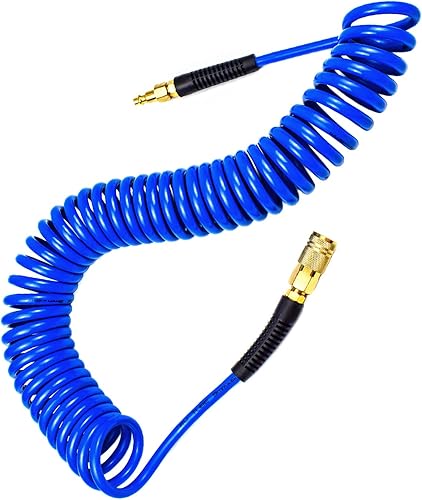
YOTOO Polyurethane Recoil Air Hose: Best for compact storage
- 1/4 in. inner diameter x 25 ft.
- Polyurethane construction
- 150 PSI maximum working pressure
- -40°F to +150°F
- 1/4 in. industrial quick coupler and plug
- Bend restrictors
A self coiling 25 ft. recoil hose with quick connectors for tidy storage and light tools.
Pros
- Self coiling for storage
- Lightweight polyurethane
- Quick coupler and plug included
- Bend restrictors reduce kinking
Cons
- 150 PSI is lower than most picks here
- 1/4 in. bore limits high flow tools
- 25 ft. reach is shorter than 50 ft. options
YOTOO suits buyers who value compact storage over maximum airflow. Its 25 ft. self coiling design snaps back after use and takes little wall space.
That makes it a good fit for a small garage, a bench setup or light duty tasks like blowing off parts.
The hose uses polyurethane with a 1/4 in. inner diameter and a 150 PSI maximum working pressure. YOTOO states a -40°F to +150°F range and includes a 1/4 in. industrial quick coupler and plug with bend restrictors.
You can connect it to a compressor and tool without buying separate fittings.
The trade off is capacity. A 1/4 in. bore and 150 PSI rating limit use with high demand tools.
Length is also shorter than the 50 ft. picks here. Choose this for storage and light tools.
Choose a 3/8 in. hose for sprayers, impact wrenches and longer runs.
Estwing E14100PVCR 1/4" x 100' PVC/Rubber Hybrid: Best for extra long reach
- 1/4 in. x 100 ft.
- PVC and rubber hybrid
- 300 PSI maximum working pressure
- -40°F to 164°F
- Solid brass 1/4 in. NPT fitting and universal coupler
- Bend resistors at each end
A 100 ft. hybrid hose for moving around a large shop without moving the compressor.
Pros
- 100 ft. reach
- 300 PSI rating
- Solid brass fittings
- Kink resistant design
Cons
- 1/4 in. bore can restrict high demand tools
- 100 ft. is heavy to coil and store
Estwing suits large shop and outdoor users who hate moving a heavy compressor. Its 100 ft. length lets you work far from the tank while the compressor stays in one place.
That reach helps with cars, trailers, framing work and yard tasks.
The 1/4 in. bore keeps the hose lighter than a 100 ft. 3/8 in. version would be.
Estwing rates it at 300 PSI and states all weather flexibility from -40°F to 164°F. Solid brass 1/4 in.
NPT fittings and a universal coupler resist corrosion and help seal cleanly. Bend resistors at each end reduce wear at the joints.
The trade off is airflow. A 1/4 in. bore over 100 ft. can restrict high flow tools more than a shorter 3/8 in. hose.
Storage is also harder because 100 ft. takes more reel or coil space. Choose this for reach.
Choose a 50 ft. 3/8 in. hose if tool performance matters more than distance.
YOTOO Air Hose 3/8 in x: Best for high flow tools
- 3/8 in. x 50 ft.
- Blended rubber and PVC
- 300 PSI maximum working pressure
- 1200 PSI burst pressure
- 1/4 in. industrial quick coupler fittings
- Bend restrictors at both ends
A 3/8 in. x 50 ft. hybrid hose sized for tools that need more air volume.
Pros
- 3/8 in. bore for higher flow
- 300 PSI working pressure
- Quick coupler fittings included
- Two year limited warranty
Cons
- Hybrid blend, not pure rubber
- 50 ft. length needs wall or reel storage
YOTOO suits users who want a 3/8 in. bore without giving up quick connect convenience. Its 3/8 in. x 50 ft. size moves more air than 1/4 in. options for tools that need volume.
The blended rubber and PVC build aims for flexibility, light weight and abrasion resistance.
YOTOO rates this hose at 300 PSI working pressure and 1200 PSI burst pressure. It includes 1/4 in. industrial quick coupler fittings and bend restrictors at both ends.
That setup lets you connect directly to a compressor and tool. YOTOO also provides a two year limited warranty.
The trade off is that it is a hybrid blend, not pure rubber. Buyers who want traditional rubber feel should look at WYNNsky or Goodyear.
For more detail on 3/8 in. sizing, see our best 3/8 inch rubber air hose guide. Choose this when flow and ready to use fittings matter most.
Estwing E3850PVCR 3/8" x 50' PVC/Rubber Hybrid: Best for sprayers and automotive tools
- 3/8 in. x 50 ft.
- PVC and rubber hybrid
- 300 PSI maximum working pressure
- -40°F to 164°F
- Solid brass 1/4 in. NPT fitting and universal coupler
- Bend resistors at each end
A 3/8 in. x 50 ft. hybrid hose sized for HVLP sprayers and automotive air tools.
Pros
- 3/8 in. bore for paint and automotive tools
- 300 PSI rating
- Solid brass fittings
- All weather flexibility
Cons
- Hybrid blend, not pure rubber
- Wider bore and 50 ft. length add weight
Estwing suits paint and automotive users who need a wider bore for steady airflow. Its 3/8 in. x 50 ft. size supports HVLP paint sprayers, impact wrenches, ratchet wrenches, air drills and die grinders.
The larger internal diameter helps those tools get more volume.
Estwing rates the hose at 300 PSI and states flexibility from -40°F to 164°F. The PVC and rubber hybrid stays lighter than pure rubber while keeping strength.
Solid brass 1/4 in. NPT fittings and a universal coupler help with durability and sealing.
Bend resistors at each end reduce kinking near the connections.
The trade off is weight and material. A 3/8 in. x 50 ft. hose is harder to coil than a 25 ft. option, and this is a hybrid rather than pure rubber.
Choose it for sprayers and automotive tools. Choose the 25 ft.
JOROY if you need a shorter, lighter run.
WYNNsky Rubber Air Hose: Best for true rubber feel
- 50 ft. x 3/8 in.
- Rubber
- 300 PSI maximum working pressure
- Double 1/4 in. MNPT brass fittings
- Bend restrictors
- 2 years limited warranty
A traditional rubber hose with brass fittings and bend restrictors for general workshop use.
Pros
- True rubber material
- 300 PSI rating
- Solid brass end fittings
- Bend restrictors included
Cons
- Rubber can be heavier than hybrid options
- No cold weather range stated
WYNNsky suits buyers who specifically want a rubber air compressor hose with traditional rubber handling. Its 3/8 in. x 50 ft. size and 300 PSI rating fit general purpose workshop use.
Red rubber is easy to spot on a shop floor and around a work area.
WYNNsky uses double 1/4 in. MNPT brass fittings and bend restrictors.
Brass resists corrosion and can help the ends seal well over time. The maker says the flexible rubber stays soft in extreme cold weather, though no numeric temperature range is stated.
A two year limited warranty adds coverage for the price tier.
The trade off is weight. Pure rubber at 50 ft. and 3/8 in. is heavier than hybrid or polyurethane options.
It can also feel stiffer to coil when cold. Choose this for true rubber feel and brass fittings.
Choose Flexzilla if all weather flexibility and light weight matter more.
Goodyear 50' x 3/8" Red Rubber Air: Best for oil resistant shop use
- 50 ft. x 3/8 in.
- Working pressure 250 PSI
- Burst pressure 1070 PSI
- Class C oil resistant EPDM rubber cover
- Solid brass 1/4 in. NPT fittings
- Spiral synthetic yarn reinforcement
A 50 ft. red rubber hose with oil resistant cover and brass fittings for shop work.
Pros
- Oil resistant EPDM cover
- Solid brass fittings
- 1070 PSI burst pressure
- Made in USA
Cons
- 250 PSI working pressure is lower than 300 PSI picks
- No cold weather range stated
Goodyear suits shop users who work around oil and want a hose built around an oil resistant cover. Its 50 ft. x 3/8 in. size fits general tool use in a garage or automotive shop.
The red rubber construction is made in the USA.
Goodyear uses a Class C oil resistant EPDM rubber cover with spiral synthetic yarn reinforcement. Solid brass 1/4 in.
NPT fittings help with sealing and corrosion resistance. The hose is rated at 250 PSI working pressure with a 1070 PSI burst pressure.
That burst margin is useful context when you compare safety headroom.
The trade off is working pressure. At 250 PSI, it sits below the many 300 PSI picks here.
No cold weather range is stated, so buyers in freezing garages should compare it with Flexzilla or the Estwing hybrids. Choose this for oil resistant shop use.
Choose a 300 PSI hose if your compressor and tools need that higher rating.
Hromee Hybrid Lead-in Air Hose 3/8 Inch: Best for hose reels and lead in use
- 3/8 in. x 6 ft.
- Hybrid rubber and PVC
- 300 PSI maximum working pressure
- 900 PSI burst pressure
- 1/4 in. NPT quick coupler and plug
- -40°F to 150°F
A short 6 ft. lead in hose for connecting a reel or compressor with less tangling.
Pros
- Short length reduces tangles
- 300 PSI rating
- Quick coupler and plug included
- Bend restrictors
Cons
- 6 ft. is too short for most tool work
- Meant as a connector, not a main hose
Hromee suits users who need a short connector rather than a main tool hose. Its 3/8 in. x 6 ft. length is designed to link a hose reel to a compressor or connect rigid piping to a tool.
That short run absorbs shock loads and reduces tangles near the reel.
The hybrid rubber and PVC build is rated at 300 PSI working pressure and 900 PSI burst pressure. Hromee includes a solid brass 1/4 in. coupler and steel plug, plus heavy duty bend restrictors.
The stated temperature range is -40°F to 150°F, which helps in cold shops.
The trade off is reach. Six feet will not replace a 25 ft. or 50 ft. hose for moving around a vehicle or work area.
Choose this as a lead in or whip hose. Choose Flexzilla, YOTOO or Estwing for your main hose run.
JOROY Hybrid Air Hose: Best for compact 25 ft. hybrid use
- 3/8 in. x 25 ft.
- Hybrid PVC and rubber
- 300 PSI maximum working pressure
- 900 PSI burst pressure
- 1/4 in. brass coupler and plug
- Three layer reinforced polyester middle layer
A 25 ft. hybrid hose that balances reach, weight and a 3/8 in. bore.
Pros
- 3/8 in. bore in a shorter length
- 300 PSI rating
- Coupler and plug included
- Kink resistant design
Cons
- 25 ft. reach is shorter than 50 ft. picks
- Hybrid blend, not pure rubber
JOROY suits buyers who want a 3/8 in. bore in a shorter, easier to store length. Its 3/8 in. x 25 ft. size gives more airflow than 1/4 in. hoses while staying lighter than 50 ft. options.
That balance fits a small shop or a single work area.
JOROY uses a hybrid PVC and rubber build with a reinforced polyester middle layer. The hose is rated at 300 PSI working pressure and 900 PSI burst pressure.
It includes a 1/4 in. industrial quick coupler and plug with bend restrictors, so you can connect tools quickly.
The trade off is reach. Twenty five feet is shorter than the 50 ft. picks and may force you to move the compressor more often.
It is also a hybrid, not pure rubber. For background on hybrid blends, see what is a hybrid air hose.
Choose this for compact high flow use. Choose a 50 ft. hose for larger work areas.
Comparison of the top picks
Flexzilla leads on overall balance of bore, length, pressure and temperature range. YOTOO recoil leads on storage but trails on pressure and bore.
Estwing 100 ft. leads on reach but uses a narrower bore. The two 3/8 in. x 50 ft. hybrids from YOTOO and Estwing lead on airflow for demanding tools.
WYNNsky and Goodyear are the clearest pure rubber choices. WYNNsky offers 300 PSI with brass fittings.
Goodyear offers an oil resistant EPDM cover at 250 PSI. Hromee is a short lead in hose, not a full replacement for a main hose.
JOROY is the compact 3/8 in. option at 25 ft.
| Product | Best for | Size | Maximum pressure | Material | Our score |
|---|---|---|---|---|---|
| Flexzilla Air Compressor Hose | all weather flexibility | 3/8 in. x 50 ft. | 300 PSI | Flexible hybrid polymer | 9.7 |
| YOTOO Polyurethane Recoil Air Hose | compact storage | 1/4 in. x 25 ft. | 150 PSI | Polyurethane | 9.6 |
| Estwing E14100PVCR 1/4" x 100' PVC/Rubber Hybrid | extra long reach | 1/4 in. x 100 ft. | 300 PSI | PVC / rubber hybrid with brass fittings | 9.5 |
| YOTOO Air Hose 3/8 in x | high flow tools | 3/8 in. x 50 ft. | 300 PSI | Rubber and PVC blended with brass fittings | 9.4 |
| Estwing E3850PVCR 3/8" x 50' PVC/Rubber Hybrid | sprayers and automotive tools | 3/8 in. x 50 ft. | 300 PSI | PVC / rubber hybrid with brass fittings | 9.1 |
| WYNNsky Rubber Air Hose | true rubber feel | 3/8 in. x 50 ft. | 300 PSI | Rubber with brass fittings | 9.0 |
| Goodyear 50' x 3/8" Red Rubber Air | oil resistant shop use | 3/8 in. x 50 ft. | 250 PSI | EPDM rubber cover with synthetic yarn reinforcement | 8.9 |
| Hromee Hybrid Lead-in Air Hose 3/8 Inch | hose reels and lead in use | 3/8 in. x 6 ft. | 300 PSI | Hybrid rubber and PVC | 8.6 |
| JOROY Hybrid Air Hose | compact 25 ft. hybrid use | 3/8 in. x 25 ft. | 300 PSI | Hybrid with polyester reinforcement | 8.2 |
How to choose the best rubber air hose for compressor work
The best choice depends on your tool first, then your space. A blow gun needs less air than an impact wrench.
A sprayer needs steady volume over time. A nailer needs short bursts but still benefits from a hose that does not kink at the bench.
Use this rule. Pick 1/4 in. for light tools and short runs.
Pick 3/8 in. for high flow tools, sprayers and runs over 25 ft. Pick 25 ft. for a fixed bench area.
Pick 50 ft. for most garages. Pick 100 ft. only when reach is your main problem.
Which diameter fits your tools?
A 1/4 in. bore is lighter and easier to coil. It fits blow guns, tire inflators, small ratchets and compact nailers.
It can limit larger impact wrenches and sprayers, especially over longer runs.
A 3/8 in. bore moves more air and reduces pressure drop. It fits impact wrenches, die grinders, sanders and HVLP sprayers.
Our Best Air Hose For Air Compressor guide covers matching hose size to compressor output in more detail.
Pure rubber, hybrid or polyurethane?
Pure rubber gives traditional weight, abrasion resistance and shop feel. WYNNsky and Goodyear fit this group.
Hybrid blends mix rubber and PVC for lighter weight and better cold flexibility. Flexzilla, Estwing, YOTOO hybrid and JOROY fit this group.
Polyurethane recoil hoses focus on storage. The YOTOO recoil coils itself and saves space, but its 1/4 in. bore and 150 PSI rating limit tool choice.
Read Best Rubber Air Hose For Cold Weather if you work in freezing conditions and want to compare cold flexibility claims.
What pressure rating should you pick?
Working pressure is the pressure the hose is rated to handle in use. Burst pressure is a higher safety test figure and is not a target for daily use.
Most picks here are rated at 300 PSI working pressure.
Check your compressor rating and your tool needs before you buy. A hose rated above your compressor does not raise compressor output.
A hose rated below your compressor or tool demand is the wrong match. The YOTOO recoil at 150 PSI and Goodyear at 250 PSI need extra care here.
What fittings should a rubber air compressor hose use?
Fittings decide how fast you can connect and swap tools. Most picks here use 1/4 in.
NPT fittings, MNPT ends or industrial quick couplers and plugs. That 1/4 in. fitting size is common on home compressors and many air tools.
Brass fittings resist corrosion and often seal well. Aluminum fittings can be lighter.
Steel plugs are common in quick connect sets. Bend restrictors matter because the hose end is where flex and kinking stress concentrate during use.
If you plan to add a reel, a whip hose or a second tool line, buy the best rubber air hose bulk options only after you confirm fitting type and bore size. Bulk hose without fittings can save money for custom lengths, but it adds assembly work and leak risk if the ends are not sealed well.
Quick coupler or threaded fittings?
Quick couplers speed up tool changes and suit users who switch tools often. Threaded MNPT or NPT ends are simple and common, but they take longer to swap.
Several picks here include both a coupler and a plug so you can start using the hose right away.
Check whether your compressor outlet and your tool inlet use the same style. A mismatch is easy to fix with an adapter, but it adds length and another possible leak point.
Buying a hose with the coupler already installed removes that step.
How do you store and care for a rubber air hose?
Store the hose coiled with wide loops instead of tight bends. Wide loops reduce memory and protect the inner wall.
Hang it on a wall hook or use a reel if space allows. A recoil hose stores itself, but still avoid sharp bends at the ends.
Keep the hose away from sharp metal edges when you drag it across a floor. Abrasion resistant covers help, but repeated dragging wears any hose over time.
Wipe off oil and solvents after shop use, even on oil resistant covers.
Check fittings before each use. Look for cracked bend restrictors, bent plugs and loose couplers.
Release pressure before you disconnect a hose. That habit reduces whip risk if a fitting fails.
Should you use a reel or wall storage?
A reel keeps a 50 ft. hose off the floor and reduces tangles. It also makes it easier to pull out the length you need and rewind the rest.
If you use a reel, a short lead in hose like the Hromee 6 ft. option can connect the reel to the compressor and reduce strain at the reel inlet.
Wall hooks work well for 25 ft. hoses and recoil hoses. They cost less and suit small garages.
The key is to avoid tight coils and sharp bends. Wide loops protect the hose and make setup faster.
Verdict: which rubber air hose should you buy?
The best rubber air hose for compressor use for most readers is the Flexzilla Air Compressor Hose. It pairs 3/8 in. x 50 ft. sizing with 300 PSI and wide temperature flexibility.
Choose it if you want one main hose for general shop and garage work.
Pick the WYNNsky Rubber Air Hose if you want true rubber with brass fittings and 300 PSI. Pick the Goodyear if oil resistance matters more than the highest pressure rating.
Pick the YOTOO recoil if compact storage is your top priority. Pick the Estwing 100 ft. if reach is your main problem.
Pick the YOTOO 3/8 in. hybrid or Estwing 3/8 in. hybrid if sprayers and automotive tools need more airflow.
For your next step, match bore size to your most demanding tool first. Then choose length based on your shop layout.
A 3/8 in. x 50 ft. hose covers most home shops. A shorter recoil or 25 ft. hose fits a bench.
A 100 ft. hose fits large outdoor or farm work. Use the comparison table above to confirm pressure, diameter and fittings before you order.
Our top 3 picks at a glance
-
1
-
2
-
3
Best for extra long reach
Estwing E14100PVCR 1/4" x 100' PVC/Rubber Hybrid
9.5/10 our score
See it on Amazon
Frequently asked questions
What is the best rubber air hose for compressor use?
For most garage and workshop jobs, a 3/8 in. x 50 ft. hose rated at 300 PSI is a strong default. Flexzilla leads this list for flexibility and pressure, while WYNNsky and Goodyear suit buyers who want traditional rubber.
Is a hybrid air hose as good as rubber?
Hybrid hoses blend rubber and PVC to stay lighter and more flexible in cold weather. They often coil and lay flat more easily than pure rubber.
Pure rubber still suits buyers who prefer its weight and abrasion resistance.
What diameter should I choose?
Choose 1/4 in. for light tools, blow guns and short runs. Choose 3/8 in. for impact wrenches, ratchets, sprayers and longer runs.
A wider bore moves more air and reduces pressure drop over distance.
How long should a rubber air compressor hose be?
A 50 ft. hose covers most small shops without forcing you to move the compressor. Choose 25 ft. for a bench or recoil setup and 100 ft. only for large shops or outdoor work where reach matters more than storage.
What pressure rating do I need?
Match the hose rating to your compressor and tool needs. Most picks here are rated at 300 PSI, which covers many home compressors.
The Goodyear is rated at 250 PSI and the YOTOO recoil at 150 PSI, so check those limits before use with high pressure tools.


