9 Best Stationary Air Compressors (November 2026)
The best stationary air compressors include the VEVOR 80 Gallon Air Compressor for a dedicated production shop, the VEVOR 13-Gallon Air Compressor for a quiet small shop, and the CRAFTSMAN 6 Gallon 150 PSI Oil-Free Pancake for a compact tool corner.
On this page (4 sections)
The VEVOR 80 Gallon Air Compressor is the best stationary air compressor here for a dedicated workshop with compatible 220V power. Its 80-gallon tank and 15.5 SCFM at 90 PSI make it the strongest fit for sustained shop demand among these picks.
A stationary compressor is a fixed shop supply, so size the system around the tools you expect to run and the electrical service available. If you are comparing a larger tank with smaller portable options, our best 60 gal air compressor guide and best 80 gallon air compressor guide cover capacity-focused alternatives.
Our picks at a glance
-
1
 Best for a dedicated production shop
VEVOR 80 Gallon Air Compressor
9.7/10 our score
See it on Amazon -
2

-
3
 Best for a compact tool corner
CRAFTSMAN 6 Gallon 150 PSI Oil-Free Pancake
9.5/10 our score
See it on Amazon
- 4
 Check it
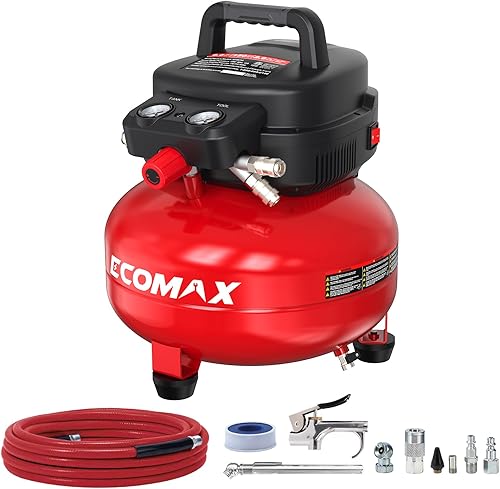
ECOMAX Air Compressor 6 Gallon 150 PSI
Best for an accessory-ready bench - 5
 Check it
California Air Tools 20020 2.0 HP Ultra
Best for quieter shop air - 6
 Best for occasional bench tasksCheck it
- 7
 Check it
RyanTek 15-Gallon Air Compressor
Best for a movable medium shop - 8
 Check it
Stealth 20 Gallon Ultra Quiet Air Compressor
Best for a mobile 20-gallon setup - 9
 Check it
Klutch 20-Gallon Air Compressor
Best for higher-pressure portable work
How we chose the best stationary air compressors
The best stationary air compressor for a workshop should match its tools, power supply and installation space. We compared tank capacity, stated airflow, pressure, noise and portability to separate dedicated stationary equipment from smaller compressors that may suit a bench or movable setup.
The VEVOR 80-gallon unit is the only product here explicitly described as stationary. The other picks are portable models, included because they can suit smaller shops that do not need a large fixed tank.
An airflow figure matters more than horsepower alone when you match a compressor to a tool. Compare the tool's required CFM at its working PSI with compressor delivery at that pressure, then consider how long the tool runs and whether other tools may operate at the same time.
Our score weighs specs, features and buyer feedback against what you're shopping for. For a larger-duty comparison, see our best industrial air compressor guide, and review Best Air Compressor For Professionals for broader shop and jobsite needs.
| Product | Best for | Tank capacity | Air delivery | Power and pressure | Our score |
|---|---|---|---|---|---|
| VEVOR 80 Gallon Air Compressor | a dedicated production shop | 80 gallons | 15.5 SCFM at 90 PSI | 220V single-phase; 145 PSI max | 9.7 |
| VEVOR 13-Gallon Air Compressor | a quiet small shop | 13 gallons | 4.6 SCFM at 90 PSI | 2 HP; 125 PSI max | 9.6 |
| CRAFTSMAN 6 Gallon 150 PSI Oil-Free Pancake | a compact tool corner | 6 gallons | 2.6 SCFM at 90 PSI | 120V; 150 PSI max | 9.5 |
| ECOMAX Air Compressor 6 Gallon 150 PSI | an accessory-ready bench | 6 gallons | 3 cubic inches at 90 PSI, as stated | 1.5 HP; 150 PSI max | 9.3 |
| California Air Tools 20020 2.0 HP Ultra | quieter shop air | 20 gallons | 5.3 CFM at 90 PSI | 2 HP; 125 PSI max | 9.1 |
| CRAFTSMAN Air Compressor | occasional bench tasks | 2 gallons | Not stated | 120V; 125 PSI max | 8.9 |
| RyanTek 15-Gallon Air Compressor | a movable medium shop | 15 gallons | 4.5 CFM at 90 PSI | 2 HP; 125 PSI max | 8.7 |
| Stealth 20 Gallon Ultra Quiet Air Compressor | a mobile 20-gallon setup | 20 gallons | 5 CFM at 90 PSI | 1.8 HP; 150 PSI max | 8.6 |
| Klutch 20-Gallon Air Compressor | higher-pressure portable work | 20 gallons | 4.2 SCFM at 90 PSI | 2 HP; 175 PSI max | 7.9 |
Stationary and portable air compressors compared
The VEVOR 80-gallon model offers the largest stated tank and airflow in this group, while smaller units trade reserve capacity for a compact or movable design. Check the electrical requirement and intended placement before narrowing the options.
VEVOR 80 Gallon Air Compressor: Best for a dedicated production shop
- 80-gallon tank
- 15.5 SCFM at 90 PSI
- 220V/60Hz single-phase power
- 145 PSI maximum pressure
The large tank and stated airflow suit a fixed workshop with sustained air demand. Confirm the shop has compatible 220V single-phase power and room for a 264.6 lb compressor.
Pros
- Largest tank and airflow here
- Oil-free design
- Made for stationary workshop use
Cons
- Requires compatible 220V power
- Heavy and intended for a planned installation
VEVOR's 80-gallon compressor is the clear fit when you want a dedicated shop air source and have compatible electrical service. It provides 15.5 SCFM at 90 PSI, a 145 PSI maximum and an 80-gallon tank, which gives this group the most substantial stated combination of storage and airflow.
The compressor weighs 264.6 lb and measures 22.1 x 22.1 x 62.2 in. Plan its position before delivery, including a clear path into the shop and enough access for routine checks and tank drainage.
VEVOR specifies 220V/60Hz single-phase power. Confirm that supply with an electrician before purchase, and use the compressor's manual to plan installation and operation.
VEVOR describes the model as oil-free and gives an 86 dB noise figure. That is still substantial sound for an occupied workspace, so consider where the unit will sit relative to work areas.
Choose it for a permanent workshop supply where the tank size and electrical service match your needs. If a 60-gallon tank may be enough, compare our best 60 gal air compressor picks.
VEVOR 13-Gallon Air Compressor: Best for a quiet small shop
- 13-gallon tank
- 4.6 SCFM at 90 PSI
- 66 dB
- 125 PSI maximum pressure
This smaller oil-free compressor has a lower stated noise level and a 13-gallon tank. Its wheels make it movable, so it is a flexible shop option rather than a fixed-installation model.
Pros
- 66 dB operation
- 4.6 SCFM at 90 PSI
- Wheels for moving between work areas
Cons
- Much less tank capacity than a full-size stationary unit
- Portable design
The VEVOR 13-gallon model is a compact option for a small shop that needs a quieter portable compressor. Its 4.6 SCFM at 90 PSI supports a range of DIY tasks, while the 66 dB figure is lower than the larger stationary pick's stated noise level.
It has a 2 HP motor and 125 PSI maximum pressure. The oil-free design reduces routine pump maintenance, and the 13-gallon tank stores less air than a full-size shop receiver.
Two 7-inch rubber wheels make it easier to move between work areas. That mobility is useful when a compressor has to serve different benches, though it does not offer a fixed installation's large air reserve.
Consider the electrical and tool requirements before buying, and confirm that the stated airflow meets the demands of the tools you plan to use. It is not a substitute for a high-output fixed system when several air-hungry tools run for long periods.
Choose it for lighter workshop work and movement between tasks, not for a permanent production supply.
CRAFTSMAN 6 Gallon 150 PSI Oil-Free Pancake: Best for a compact tool corner
- 6-gallon tank
- 2.6 SCFM at 90 PSI
- 150 PSI maximum pressure
- 120V
A compact pancake unit can serve a small shop corner for lighter air-tool and inflation work. Its 30.8 lb body and carry handle make it portable rather than a permanent shop supply.
Pros
- Runs on 120V
- Dual quick couplers
- Oil-free pump
Cons
- Small tank for ongoing demand
- Portable pancake format
The CRAFTSMAN pancake compressor suits a small shop corner for inflation and shorter jobs with compatible air tools. It has a 6-gallon tank, 2.6 SCFM at 90 PSI, and a 150 PSI maximum, in a 30.8 lb portable format.
Its 120V, 1 HP motor fits a different installation profile from the 220V VEVOR. Dual quick couplers allow two connections, but the compact tank has less stored air than a shop compressor designed for sustained demand.
The oil-free pump cuts down on oil-related maintenance. CRAFTSMAN also specifies a 1-year limited warranty, so check the warranty terms that apply where you buy.
A portable pancake model can be stored out of the way when the work area is clear. For continuous sanding, painting or other long-running tasks, use tool airflow requirements to decide whether its output and tank are sufficient.
Choose it for occasional bench tasks on a standard 120V supply, rather than as the main source for a busy workshop.
ECOMAX Air Compressor 6 Gallon 150 PSI: Best for an accessory-ready bench
- 6-gallon tank
- 150 PSI maximum pressure
- Oil-free pump
- Includes a 25 ft hose and accessories
The included hose, gauge and inflation fittings make it a ready-to-use choice for a small bench. Check tool airflow needs carefully because its stated delivery figure is not directly comparable to the SCFM ratings of the other picks.
Pros
- 10-piece accessory kit
- Dual quick couplers
- Oil-free pump
Cons
- Small tank
- Air delivery is stated in a different unit
ECOMAX includes a 25 ft hose and a set of air fittings with its 6-gallon pancake compressor. Those accessories can help outfit a small bench for inflation and light tasks without gathering each connection separately.
The compressor has a 1.5 HP motor and reaches 150 PSI. Its air delivery is stated as “3 cubic inches” at 90 PSI, an unusual unit that cannot be compared directly with the SCFM figures on the other picks, so confirm the output with the seller or manufacturer before matching it to a tool.
The oil-free pump, dual gauges and dual quick couplers suit a simple portable setup. The compressor weighs 34.17 lb and has a flip-up handle for carrying and storage.
Its small tank makes it a poor fit for a high-demand fixed air system. Consider the exact tools and their airflow needs first, especially if they run continuously.
Choose it when the included hose and fittings are useful, and verify the airflow figure before relying on it for powered tools.
California Air Tools 20020 2.0 HP Ultra: Best for quieter shop air
- 20-gallon tank
- 5.3 CFM at 90 PSI
- 70 dB
- Oil-free dual-piston pump
The 20-gallon tank and 70 dB noise figure suit a shop where sound matters and moderate airflow is enough. It has wheels, so it can be moved as needed instead of serving as a fixed installation.
Pros
- 70 dB noise figure
- 5.3 CFM at 90 PSI
- Oil-free dual-piston pump
Cons
- Portable wheeled design
- 20-gallon tank is smaller than dedicated stationary options
California Air Tools' 20020 combines a 20-gallon tank with 5.3 CFM at 90 PSI and a 70 dB noise figure. It suits a shop that wants more stored air than a small pancake unit and values lower operating noise.
The oil-free dual-piston pump and 2 HP motor are paired with a 125 PSI maximum. For a similar capacity, compare 20-gallon oil-free air compressors.
It is rated for 110V/60Hz outlets and draws 14 amps, so check the circuit against other equipment that may run at the same time.
This compressor weighs 134 lb and has wheels. It is therefore easier to reposition than a large stationary unit, but it remains a portable design rather than a fixed receiver intended to stay installed.
California Air Tools describes a pump life cycle of over 3,000 hours. Treat that as the brand's stated figure, and follow the manual's operating and maintenance instructions.
Choose it for a quieter, movable 20-gallon setup when its output matches your tools. For a broader look at professional-use machines, see Best Air Compressor For Professionals.
CRAFTSMAN Air Compressor: Best for occasional bench tasks
- 2-gallon tank
- 125 PSI maximum pressure
- Oil-free pump
- 10-piece accessory kit
Its small tank and included fittings suit intermittent inflation and light bench jobs where storage space is tight. The 19 lb compressor is portable and will not provide the stored-air reserve of a stationary tank.
Pros
- Compact 2-gallon tank
- Includes hose and inflation accessories
- Oil-free pump
Cons
- Air delivery is not stated
- Limited stored air for continuous tool use
The CRAFTSMAN 2-gallon compressor is for occasional small jobs where storage space matters more than air reserve. It reaches 125 PSI, uses an oil-free pump and weighs about 24.5 lb based on its stated 11.11 kg weight.
It comes with a hose, tire gauge, blow gun and fittings. For another bundled setup, compare DeWalt air compressor kits.
Those accessories make it useful for inflation and light bench work, but the product details do not state an airflow figure, so there is no basis here to match it to a tool's CFM requirement.
The 120V unit has two quick couplings and a 1/3 HP motor. Its small tank means you should expect limited stored air compared with 15- or 20-gallon compressors.
This is not a practical replacement for a stationary shop compressor when work is continuous or several tools need air. Use the product manual to confirm suitable applications and safe operating steps.
Choose it for occasional inflation and compact storage, not for a workshop's main air supply.
RyanTek 15-Gallon Air Compressor: Best for a movable medium shop
- 15-gallon vertical tank
- 4.5 CFM at 90 PSI
- 66 dB at 4 m
- 125 PSI maximum pressure
The vertical tank saves floor footprint, while its wheels and handle support movement around a workspace. Consider it when a medium tank is enough and a portable layout fits better than fixed piping.
Pros
- Vertical tank design
- 66 dB at 4 m
- Dual air outlets
Cons
- Portable rather than stationary
- 15-gallon tank offers less reserve than larger shop units
RyanTek's 15-gallon vertical compressor offers 4.5 CFM at 90 PSI in a format designed to use less floor width than a horizontal tank. Its wheels and handle make it movable around a garage or work area.
The 2 HP motor reaches a stated 125 PSI maximum. RyanTek gives a 66 dB noise figure at 4 m, so use that measurement distance when comparing it with noise figures from other compressors.
The oil-free twin-cylinder design and dual outlets may suit a workshop handling inflation, nail guns or painting tasks. Match the stated airflow to each tool and allow for the lower capacity compared with an 80-gallon stationary tank.
Because this is a portable model, it works better as a flexible shop compressor than as a permanently installed source for high-volume use. Its 68.3 lb weight also matters if you plan to move it often.
Choose it for a medium shop that needs a vertical footprint and mobility.
Stealth 20 Gallon Ultra Quiet Air Compressor: Best for a mobile 20-gallon setup
- 20-gallon tank
- 5 CFM at 90 PSI
- 68 dB
- 150 PSI maximum pressure
Its 20-gallon tank and 68 dB figure make it a quieter option for a shared garage or shop. The steel tank has wheels, which suits a movable setup more than permanent placement.
Pros
- 68 dB noise figure
- 5 CFM at 90 PSI
- Two quick couplers
Cons
- Portable wheeled design
- Less capacity than a large fixed shop compressor
The Stealth 20-gallon compressor combines 5 CFM at 90 PSI with a 68 dB noise figure. It is a candidate for a garage where a quieter portable unit is more useful than a fixed high-capacity system.
The 1.8 HP motor reaches a 150 PSI maximum. The oil-free design reduces routine pump maintenance, and two quick couplers make it easier to switch between connected tools.
Its steel tank and 8-inch rubber wheels support movement around a shop. At 121.4 lb, it is not a light carry, so plan the route and storage position even though it is wheeled.
The 20-gallon capacity is less than the 80-gallon stationary VEVOR, and the Stealth is built as a portable model. Check tool airflow needs and expected run time before choosing it for sustained work.
Choose it for a movable 20-gallon compressor with a lower stated noise level.
Klutch 20-Gallon Air Compressor: Best for higher-pressure portable work
- 20-gallon tank
- 4.2 SCFM at 90 PSI
- 175 PSI maximum pressure
- Oil-free pump
The 175 PSI maximum is the highest stated pressure among these picks, while 4.2 SCFM at 90 PSI gives a clearer basis for matching tools. Its wheels and handle make it a portable shop compressor.
Pros
- 175 PSI maximum pressure
- Oil-free pump
- Thermal overload protection
Cons
- Portable rather than stationary
- 80 dB noise figure
Klutch's 20-gallon compressor offers a 175 PSI maximum, the highest stated pressure among these picks. Its 4.2 SCFM at 90 PSI is the more useful figure for comparing it with air tools that specify an operating pressure and airflow demand.
The 2 HP motor has thermal overload protection, and the oil-free pump reduces routine maintenance. Klutch also lists rubber foot stabilizers to reduce vibration during operation.
This model weighs 90 lb and has large rubber wheels and a handle. It is portable, so it can serve different parts of a garage, but it does not provide the storage capacity of a large stationary unit.
Its stated noise figure is 80 dB. Consider its placement if the shop shares walls with living areas or if quieter operation is a priority.
Choose it for portable work where the higher pressure rating is useful, while confirming that 4.2 SCFM is enough for your tools.
How do you choose a stationary air compressor?
Choose a stationary compressor by matching airflow and pressure to your tools, then confirm the tank, power supply and installation area. A large tank helps cover short demand peaks, but the pump must still replenish air at a rate that keeps up with the work.
How much airflow does your shop need?
Airflow is the first number to compare with tool requirements. Check each tool's CFM at its working PSI, then account for whether tools may run together or for long periods.
For example, the VEVOR 80-gallon model states 15.5 SCFM at 90 PSI, while the portable picks here range from 2.6 to 5.3 CFM at 90 PSI where figures are given. These numbers help narrow the field, but account for duty cycle and pressure needs before choosing.
What does tank capacity change?
Tank capacity affects how much compressed air is stored and how often the compressor may cycle during bursts of use. A larger receiver can help supply short demand spikes, but it cannot make up for a pump that delivers too little air for ongoing work.
A 6-gallon portable unit may suit intermittent nailing or inflation. A shop using sanders, spray equipment or multiple tools should compare airflow and run time closely, then consider a larger tank and compressor combination.
Does the power supply fit the compressor?
Check voltage, frequency, phase and current before arranging installation. The 80-gallon VEVOR specifies 220V/60Hz single-phase power, while several smaller models use 120V.
Have a qualified electrician confirm the circuit and wiring. Do not rely on an extension cord or a circuit assumption when the compressor's electrical requirements call for a dedicated setup.
Where should a fixed compressor sit?
Plan a dry, ventilated location with enough room for service access and drainage. Account for the compressor's dimensions and weight, sound traveling into nearby rooms, and a safe path for air lines.
Use the manufacturer's installation instructions for clearances, mounting, drainage and any required protection. The tank and piping should be installed in line with applicable local rules.
What air system should you choose for your workshop?
Choose the VEVOR 80-gallon model when you need a fixed supply, have compatible 220V service and can fit its large tank. For a smaller shop where mobility and lower capacity make more sense, compare the 13- to 20-gallon portable units against your tools' CFM needs.
If you're still learning how the equipment fits together, read How An Air Compressor Works? and How Many Types Of Air Compressor? before planning a complete shop air system.
Our top 3 picks at a glance
-
1
Best for a dedicated production shop
VEVOR 80 Gallon Air Compressor
9.7/10 our score
See it on Amazon -
2
-
3
Best for a compact tool corner
CRAFTSMAN 6 Gallon 150 PSI Oil-Free Pancake
9.5/10 our score
See it on Amazon
Frequently asked questions
What makes an air compressor stationary?
A stationary air compressor is designed to stay in one place and supply a workshop or production area. Larger tanks, substantial weight and site-specific power needs can make a fixed installation practical, but check the compressor's dimensions, electrical requirements and service clearances before choosing its location.
How large should a stationary air compressor tank be?
Choose tank size based on tool airflow, how many tools may run at once, and how steadily they draw air. A larger tank stores more compressed air, but it does not replace enough compressor output.
Compare each tool's required CFM at its working pressure with the compressor's delivered airflow.
Does a stationary compressor need special wiring?
It depends on the compressor's voltage and current requirements. The VEVOR 80-gallon model here specifies 220V/60Hz single-phase power, while smaller models may use 120V.
Have a qualified electrician confirm that the circuit, wiring and disconnect suit the unit and local requirements.
Can I use a portable compressor as a stationary shop compressor?
Yes, if its airflow and tank capacity match your tools and work pace. Portable models can serve a bench or small shop, but their smaller tanks may cause more frequent cycling during sustained use.
Keep the unit accessible for draining, inspection and maintenance.
What should I check before installing a stationary air compressor?
Confirm the electrical supply, floor space, weight support, ventilation, noise exposure and access for maintenance. Plan the air line layout and condensate drainage using the manufacturer's instructions and applicable local rules.
A fixed tank should be installed and operated according to its manual.


