How Do I Choose the Right Air Compressor for My Shop?
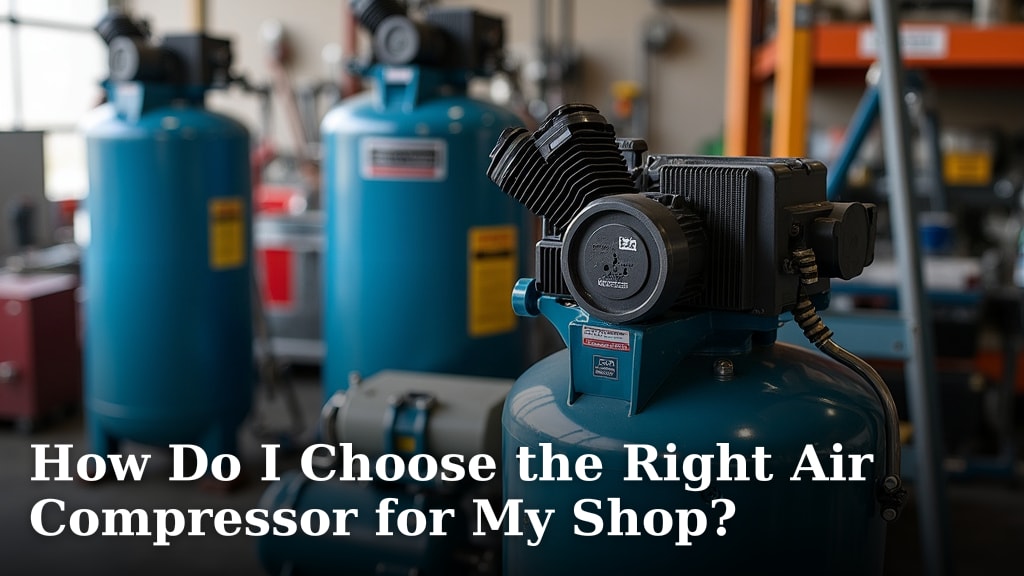
To choose the right air compressor for your shop, you need to match its capabilities to your tools’ needs, focusing on CFM and PSI requirements. We found that sizing your compressor correctly prevents frustrating slowdowns and underperformance.
You’re not just buying a machine; you’re investing in your shop’s efficiency and your own sanity. Think about the types of air tools you use most often and how frequently you’ll use them. A bigger tank isn’t always better if the compressor can’t keep up with air delivery.
- Match CFM and PSI to your highest-demand tools.
- Consider continuous use versus intermittent tasks.
- Look at tank size for air storage and recovery.
- Decide between oil-lubricated and oil-free models.
Let’s walk through the key factors to consider, making sure you pick the perfect air compressor for your unique shop setup.
Picking the Perfect Air Compressor for Your Workshop
Choosing the right air compressor can feel like a big decision. We’ll help you break it down into simple steps. You want a machine that works with your tools, not against them.
Think of your air compressor as the heart of your pneumatic tool system. It needs to pump enough air, at the right pressure, to keep everything running smoothly. Let’s make sure you get the best fit.
Understanding CFM and PSI: Your Air Compressor’s Language
These two terms are the most important numbers you’ll encounter. They tell you what an air compressor can actually do. Don’t let them intimidate you; they’re straightforward.
What is CFM? (Cubic Feet per Minute)
CFM measures how much air your compressor can deliver. It’s like the volume of air flow. Your air tools have specific CFM requirements to operate correctly.
If your compressor’s CFM is too low, your tool will starve for air. It will run weakly or stop working entirely. This can be very frustrating, especially in the middle of a project.
Always check your tools’ CFM ratings. If you have several tools, consider the one with the highest continuous CFM demand. We found that matching this number is critical for performance.
What is PSI? (Pounds per Square Inch)
PSI measures the pressure of the air. Think of it as the force behind the air. Most air tools require a certain minimum PSI to function properly.
A higher PSI means more force. While CFM determines how long a tool can run, PSI dictates how hard it can work. Air nailers, for example, need enough PSI to drive nails effectively.
Your compressor’s maximum PSI should meet or exceed your tools’ requirements. However, you’ll often regulate the PSI down to the tool’s operating level using a pressure regulator.
The CFM and PSI Connection
Most manufacturers list CFM at a specific PSI, like “6 CFM at 90 PSI.” This means the compressor delivers 6 cubic feet of air per minute when operating at 90 pounds per square inch of pressure.
When comparing models, always compare their CFM ratings at the same PSI. We found this is the most accurate way to compare air output.
A good rule of thumb is to take your highest CFM tool requirement and add 20-30%. This gives you a buffer for efficiency losses and ensures your compressor won’t struggle (Popular Mechanics).
Matching Your Tools to Your Compressor
This is where the rubber meets the road. What kind of work do you do? Your tools will dictate the compressor you need. Don’t overbuy, but definitely don’t underbuy.
Intermittent Use Tools (Low CFM)
These tools use short bursts of air. Think about an air nailer or an impact wrench for loosening a few bolts. They build up pressure in the tank and then quickly release it.
- Brad nailers: 0.3-0.5 CFM at 90 PSI
- Staplers: 0.5-1.0 CFM at 90 PSI
- Impact wrenches (small): 2-5 CFM at 90 PSI
- Tire inflators: 1-2 CFM at 90 PSI
For these tools, a smaller, portable compressor with a tank around 2-6 gallons might be enough. It won’t need a huge motor if it’s just filling up small bursts of air.
Continuous Use Tools (High CFM)
These tools demand a constant supply of air. Examples include grinders, sanders, and paint spray guns. They keep running and need the compressor to keep up continuously.
- Orbital sanders: 6-10 CFM at 90 PSI
- Die grinders: 5-8 CFM at 90 PSI
- Paint spray guns (HVLP): 10-15 CFM at 30-40 PSI (often require lower PSI but high CFM)
- Air chisels: 4-6 CFM at 90 PSI
If you use these tools frequently or for extended periods, you’ll need a compressor with a higher CFM rating. A larger tank helps, but the compressor’s motor must generate enough air quickly.
Many experts say that if you’re doing serious automotive work or continuous woodworking, a compressor delivering 10-15 CFM at 90 PSI is a good starting point (Tool Review Site).
Air Compressor Types: What’s Under the Hood?
Not all compressors are created equal. They have different internal mechanisms that affect performance, noise, and maintenance.
Piston-Driven Compressors
These are the most common types for home shops. A piston moves up and down inside a cylinder to compress air. They can be single-stage or two-stage.
- Single-stage: Compresses air once. Good for lighter use.
- Two-stage: Compresses air twice for higher pressure. Essential for heavy-duty tools and professional work.
We found two-stage compressors are more efficient for high-demand applications. They also tend to run cooler because the compression happens in stages.
Oil-Lubricated vs. Oil-Free Compressors
This is a big decision that impacts maintenance and noise.
| Feature | Oil-Lubricated | Oil-Free |
|---|---|---|
| Noise Level | Generally quieter | Significantly louder |
| Longevity | Typically longer lifespan | Shorter lifespan due to friction |
| Maintenance | Requires regular oil changes | No oil changes needed |
| Air Quality | Risk of oil carryover (needs filter) | “Cleaner” air output |
| Cost | Often higher initial cost | Generally lower initial cost |
For a quieter shop and tools that last longer, an oil-lubricated compressor is often preferred. If portability and zero maintenance are your top priorities, oil-free might be for you. Just prepare for more noise.
Tank Size: Storage and Recovery
The air tank stores compressed air. It doesn’t affect the compressor’s CFM output, but it does affect how often the motor runs. A larger tank means the compressor cycles less frequently.
If you’re using tools intermittently, a larger tank can act as a buffer. You get more working time before the motor kicks on. This means less noise and wear on the motor.
For continuous tools, a larger tank helps, but the compressor’s CFM output is still king. A big tank with a small motor will still struggle to keep up with a continuous sander.
Power Source: Electric vs. Gas
Most home shops will use electric compressors. They’re quieter and don’t produce exhaust fumes. Make sure your shop’s electrical circuits can handle the compressor’s demands.
Gas-powered compressors are for outdoor or remote job sites. They’re powerful and portable but generate fumes and a lot more noise. They are not suitable for enclosed workshops.
Portability: Where Will You Use It?
Do you need to move your compressor around the shop, or will it stay in one place? Small “pancake” or “hot dog” compressors are easy to move. Larger stationary units might be on wheels or fixed.
Consider the weight and size if you need to take it to different work areas. This impacts your comfort and efficiency.
Your Air Compressor Checklist
Ready to make a decision? Use this quick checklist to guide your final choice. You’re looking for the best balance for your specific needs.
- Tool Requirements: List all your air tools and their CFM/PSI.
- Highest Demand: Identify the tool with the highest CFM.
- Usage Frequency: Will you use it for continuous tasks or quick jobs?
- Noise Tolerance: How important is quiet operation in your shop?
- Maintenance Preference: Are you okay with occasional oil changes?
- Shop Power: Do you have adequate electrical circuits for the compressor?
By answering these questions, you’ll narrow down your options significantly. Remember, the goal is to buy the right tool once, not to regret your purchase later.
Conclusion
Choosing the right air compressor for your shop doesn’t have to be overwhelming. By focusing on your tools’ CFM and PSI needs, considering usage, and understanding compressor types, you can make a smart decision. We’ve shown that a little research upfront saves you a lot of hassle later.
Your ideal compressor is the one that reliably powers your most demanding tasks without constant cycling. Use our checklist to match your needs to the machine’s capabilities. Invest wisely, and you’ll enjoy years of efficient, frustration-free work in your shop.
Frequently Asked Questions
How much air compressor tank size do I really need?
The tank size primarily affects how often your compressor cycles on and off. For intermittent tools, a larger tank (10-20 gallons) provides a good buffer. For continuous-use tools, focus more on the compressor’s CFM output; a larger tank only helps slightly.
Can I use a small pancake compressor for automotive work?
For light automotive tasks like tire inflation or using a small impact wrench for a few bolts, yes. However, for continuous work like grinding, sanding, or painting, a pancake compressor typically won’t deliver enough sustained CFM to keep up.
Is it worth buying a 2-stage air compressor for a home garage?
If you regularly use high-demand tools like grinders, large impact wrenches, or paint sprayers, a 2-stage compressor is definitely worth it. They offer higher PSI and are more efficient and durable for heavy-duty, continuous use compared to single-stage models.
What’s the best way to reduce air compressor noise in my shop?
Oil-lubricated models are inherently quieter than oil-free ones. You can also place the compressor in a separate enclosure, use sound-dampening mats underneath, or position it further away from your main work area. Some modern compressors are designed with quieter motors.
Do I need any special wiring for a larger air compressor?
Many larger, more powerful air compressors (typically 3 HP and above) require a 240-volt dedicated circuit. Smaller compressors often run on standard 120-volt outlets. Always check the electrical requirements of your chosen model to ensure your shop can safely power it.
