
Can You Use an Air Compressor to Power a Sander?
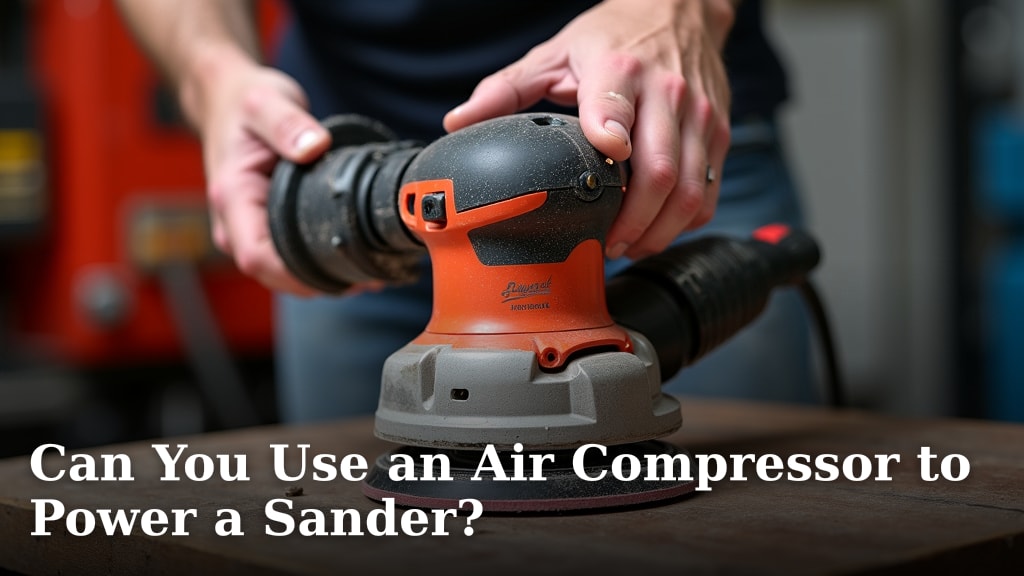
Yes, you absolutely can use an air compressor to power a sander, but with a few important considerations. Your air compressor needs to provide enough air pressure and air volume for the specific sander you plan to use. Not all compressors are created equal, and matching one to your tool is key for optimal performance and tool longevity.
Many DIYers wonder if their existing compressor is up to the task. It’s not just about turning it on; you need to ensure the compressor’s CFM (cubic feet per minute) rating meets or exceeds the sander’s requirements. Failing to do so can lead to a sander that lacks power and an overheated compressor.
- You can power a sander with an air compressor.
- Check the sander’s CFM and PSI requirements.
- Ensure your compressor meets or exceeds these specs.
- Matching compressor and sander prevents tool damage and ensures good results.
- A proper setup leads to smoother sanding and less frustration.
Let’s get into the details of what you need to consider to make sure your air compressor and sander are a perfect match.
Powering Your Sander with an Air Compressor: What You Need to Know
So, you’ve got a sander that runs on air and a trusty air compressor sitting in your garage. The big question is, can they be friends? The short answer is a resounding yes! You can absolutely use your air compressor to power your sander.
However, it’s not quite as simple as just plugging them in and hoping for the best. Think of it like matchmaking for your tools. You need to make sure their compatibility is just right. We’ve found that many DIYers jump into this without checking the specs, and it often leads to disappointment or even damaged equipment.
Understanding Your Sander’s Needs: Pressure and Volume
Your sander, whether it’s an orbital sander, a detail sander, or even a more aggressive belt sander, has specific requirements. These needs boil down to two main things: air pressure and air volume.
PSI: The Pressure Factor
PSI stands for Pounds per Square Inch. This is the measure of how much force the air is exerting. Most air sanders operate efficiently within a certain PSI range. You’ll typically see this listed on the sander itself, in its manual, or on the manufacturer’s website.
We found that most common sanders require between 70 and 90 PSI to run at their intended speed and power. If your compressor can’t deliver this consistent pressure, your sander will likely feel sluggish. It just won’t have the “oomph” to do the sanding job effectively. This can lead to longer sanding times and an uneven finish.
CFM: The Volume of Air
CFM stands for Cubic Feet per Minute. This is arguably the most critical spec to match. CFM tells you how much air your compressor can deliver to your tool over time. Sanders, especially when they’re actively sanding, can consume a large volume of air.
If your compressor’s CFM rating is lower than what your sander needs, the compressor will struggle. It might run constantly, overheat, and eventually shut down or even fail prematurely. It’s like trying to drink a milkshake through a tiny straw; the flow just isn’t enough.
Many experts recommend that your compressor’s CFM rating should be at least 1.5 to 2 times the CFM requirement of your sander. This buffer ensures that the compressor isn’t constantly running at its absolute limit.
Decoding Your Air Compressor’s Capabilities
Now, let’s turn our attention to the compressor. You need to know its capabilities to see if it’s a good fit for your sander. This information is usually found on a label on the compressor tank or in its manual.
Compressor Tank Size Matters (But Not How You Think)
You’ll see compressors advertised with tank sizes like 10 gallons, 20 gallons, 30 gallons, or even larger. While a bigger tank can store more compressed air, it doesn’t directly dictate how much air volume (CFM) your compressor can *produce* continuously. A larger tank is more like a reservoir; it can supply air for a bit longer before the motor needs to kick in to replenish it. But if the motor can’t produce enough CFM, even a huge tank will eventually run dry.
The Compressor’s CFM Rating: The Real Hero
This is the number you absolutely must focus on. Look for the CFM rating, often specified at a particular PSI (e.g., 4 CFM @ 90 PSI). This tells you how much air the compressor can deliver at a usable pressure.
If you’re unsure, a general rule of thumb we’ve found helpful is to ensure your compressor’s rated CFM at 90 PSI is at least 1.5 times the sander’s requirement at 90 PSI. For example, if your sander needs 5 CFM at 90 PSI, you’d ideally want a compressor that provides at least 7.5 CFM at 90 PSI.
Duty Cycle: How Long Can It Run?
Another important, though sometimes overlooked, specification is the compressor’s duty cycle. This tells you how long the compressor motor can run within a given period before needing to cool down. A 50% duty cycle means the motor can run for 5 minutes out of every 10-minute period.
For intermittent use, like a quick touch-up, a lower duty cycle might be okay. But for longer sanding projects, you’ll want a compressor with a higher duty cycle, ideally 75% or even 100% (continuous duty). If your compressor overheats and shuts off mid-project, you’ll know you pushed it too hard or it wasn’t suited for the task.
Matching Compressor to Sander: A Practical Guide
So, how do you put all this information together? It’s about comparing the numbers. Let’s make it easy to understand.
Finding Your Sander’s Specs
Typically, sanders will list their requirements in the manual or on a tag. You’re looking for two numbers: PSI and CFM.
- PSI (Pressure): Usually around 70-100 PSI for most sanders.
- CFM (Volume): This can vary greatly, from 3 CFM for a small detail sander to 10 CFM or more for a powerful belt sander.
Finding Your Compressor’s Specs
Check the label on your compressor. You’re looking for the CFM rating, usually stated at 90 PSI. Also, note the tank size and the motor horsepower (HP), though CFM is the most telling.
The Golden Rule: Compressor CFM ≥ Sander CFM x 1.5
This is a solid guideline for ensuring your compressor can keep up. Let’s break it down with a table.
| Sander Type | Typical PSI Requirement | Typical CFM Requirement (at 90 PSI) | Recommended Compressor CFM (at 90 PSI) |
|---|---|---|---|
| Detail Sander | 90 PSI | 3-4 CFM | 4.5 – 6 CFM |
| Random Orbital Sander (5-inch) | 90 PSI | 7-10 CFM | 10.5 – 15 CFM |
| Belt Sander | 90 PSI | 10-15 CFM | 15 – 22.5 CFM |
As you can see, larger or more aggressive sanders demand significantly more air. Running a sander that requires 10 CFM from a compressor that only provides 4 CFM is a recipe for frustration. You’ll spend more time waiting for the compressor to catch up than actually sanding.
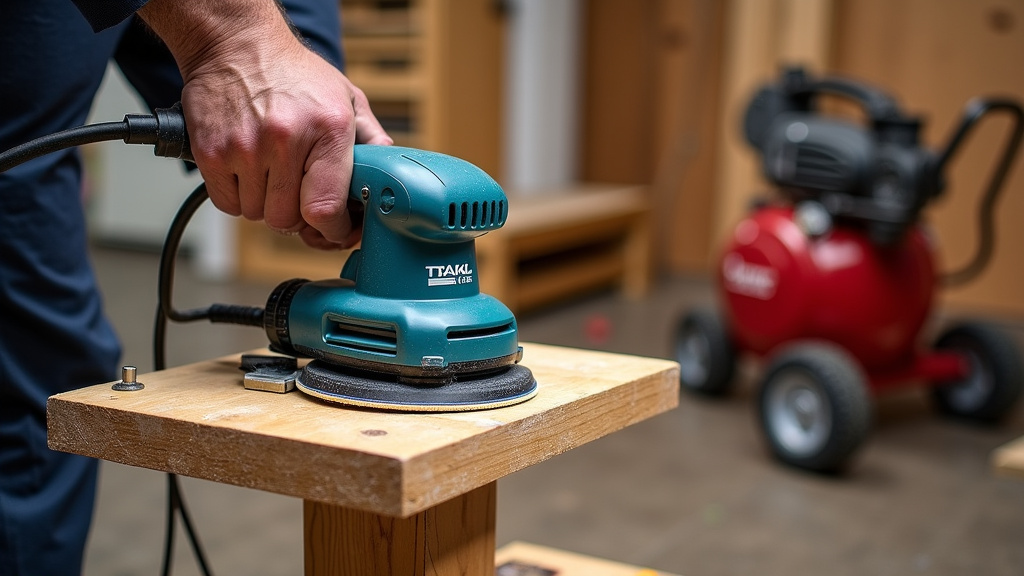
Essential Accessories for a Smooth Setup
Beyond just the compressor and sander, a few other items make the connection work well. These aren’t just nice-to-haves; they’re important for performance and safety.
Air Hose Quality and Size
The air hose connecting your compressor to your sander is a vital link. If it’s too small in diameter (e.g., 1/4-inch for a high-CFM tool), it can restrict airflow. This is like putting a kink in the hose. We found that for most sanders, a 3/8-inch or 1/2-inch diameter hose is ideal to ensure adequate air volume reaches the tool.
Hose length also plays a role. The longer the hose, the more resistance there is. Try to use the shortest hose possible that still gives you good working range. Also, ensure your hose is rated for the pressure your compressor produces. Burst hoses are dangerous!
Regulators and Filters: The Unsung Heroes
Most compressors have a built-in regulator, but it’s wise to ensure it’s working correctly. You need to set the regulator to the sander’s specified PSI. Too much pressure can damage the sander; too little means poor performance.
Air filters are also important. They remove moisture and debris from the air line. Moisture can cause rust in your sander and ruin a finish. Debris can clog small ports and damage moving parts. A good inline filter or a combination filter-regulator-oiler unit is a smart investment for tool longevity.
When Your Compressor Might Be Too Small
Let’s be honest, not every compressor is built for heavy-duty sanding. If you’re noticing any of these signs, your compressor is likely undersized for your sander:
- The compressor motor runs constantly.
- The compressor frequently shuts off due to overheating.
- The sander’s power fluctuates or feels weak.
- The air coming out of the sander feels warm or wet.
If you experience these issues, it’s not a reflection on you; it just means your current compressor isn’t the right match for that particular sander. It might be perfect for inflating tires or using brad nailers, but sanding demands more.
A Quick Checklist for Success
To make sure your compressor and sander are ready for action, run through this quick checklist:
- Check Sander Specs: Note the required PSI and CFM.
- Check Compressor Specs: Find its CFM output at 90 PSI.
- Compare CFM Ratings: Ensure compressor CFM ≥ sander CFM x 1.5.
- Inspect Air Hose: Make sure it’s the right diameter and condition.
- Set the Regulator: Dial in the correct PSI for your sander.
- Test Air Quality: Check for moisture or debris filters.
Getting these details right means you’ll have a sander that performs beautifully and lasts longer, making your projects much more enjoyable.
Conclusion
You absolutely can power your sander with an air compressor. The key to a successful sanding project lies in matching your compressor’s capabilities to your sander’s demands. Always check the PSI and CFM requirements of your sander. Then, ensure your compressor provides at least 1.5 times the required CFM to avoid straining your equipment and ensure optimal performance. By paying attention to these specs and using the right accessories like quality hoses and regulators, you’ll get smoother results and protect your tools. Take a moment to check those numbers before your next project, and you’ll be sanding like a pro.
Frequently Asked Questions
What happens if my air compressor’s CFM is too low for my sander?
If your compressor’s CFM rating is lower than your sander needs, the compressor will struggle to keep up. You’ll likely experience inconsistent sander power, and the compressor motor may run constantly or overheat. This can shorten the lifespan of both your sander and your compressor.
Do I need a special type of air hose for my sander?
Yes, the air hose is important. For most sanders, especially those that use more air, a 3/8-inch or 1/2-inch diameter hose is recommended. A smaller hose can restrict airflow, reducing your sander’s power. Always ensure your hose is rated for the pressure your compressor produces.
Can I use a small pancake compressor for sanding?
Small pancake compressors are great for light tasks like inflating tires or powering brad nailers. However, they typically don’t produce enough CFM for most sanding applications. Sanding is an air-hungry job, and a small compressor will likely struggle and shut off frequently. Small pancake compressors are often not suitable for sanding; learn about their limitations.
How do I know if my compressor’s PSI is set correctly for my sander?
Check the sander’s manual or the manufacturer’s website for its recommended operating PSI, usually between 70 and 100 PSI. Most compressors have a regulator that allows you to dial in the exact pressure. You can use a separate air pressure gauge to confirm the output from the regulator.
Is it okay if my compressor runs continuously while I’m sanding?
It’s generally not ideal. If your compressor runs constantly without stopping, it means it’s struggling to keep up with the demand and may be running at its maximum capacity. This can lead to overheating and premature wear. Ideally, your compressor should cycle on and off.
