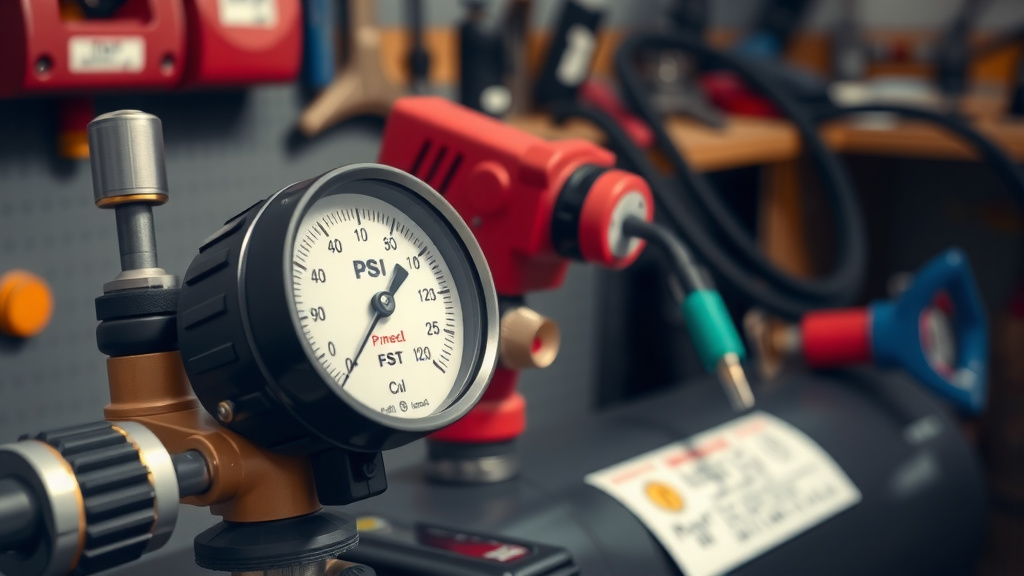
Coleman Powermate Powermax Pressure Adjustment
Adjust the Coleman Powermate Powermax compressor's regulated outlet pressure with the regulator knob while air is flowing, then confirm the reading on the outlet gauge. Set pressure to the tool maker's requirement and never exceed the tool, hose, or compressor limit.
On this page (9 sections)
- How do you adjust Coleman Powermate Powermax pressure?
- What pressure should you set on a Powermax compressor?
- How can you tell which gauge to use?
- Which compressor tool can help with pressure work?
- Why is the Dorman bypass pulley not a compressor accessory?
- Can a portable inflator replace a Powermax compressor?
- What should you check before changing a regulator?
- What if the regulator will not hold the selected pressure?
- What is the safe Coleman Powermate Powermax adjustment method?
Adjusting a Coleman Powermate Powermax compressor means setting the regulated outlet pressure, not changing the tank's automatic start and stop points. Turn the regulator knob in small steps, watch the outlet gauge, and set the pressure your air tool requires.
Before starting, identify the gauge connected to the regulated outlet. Many compressors have more than one pressure reading, so don't confuse tank pressure with the pressure supplied to your hose.
How do you adjust Coleman Powermate Powermax pressure?
Use the regulator knob to raise or lower outlet pressure while watching the regulated gauge. The exact knob direction can vary by model, so confirm which direction raises pressure before making a large adjustment.
- Turn the compressor off if the control layout is unclear.
- Connect the hose and tool only after checking the fittings.
- Pull or open the regulator knob if your model has a locking control.
- Turn the knob slowly in one direction.
- Watch the regulated outlet gauge.
- Stop at the pressure required by the tool.
- Lock the knob again if the regulator has a locking feature.
Some regulators show pressure more clearly while air is flowing. If the gauge rises higher when the tool is idle, reconnect the tool and make a small correction while air passes through the line.
For a broader explanation of regulator settings, see How to Set Air Compressor PSI?. The same basic distinction applies: set the outlet pressure for the tool, not simply the highest pressure shown on the tank gauge.
What pressure should you set on a Powermax compressor?
Set pressure to the tool manufacturer's required range. A nailer, blow gun, inflator, and spray tool may each need a different outlet setting.
Use the lowest pressure that lets the tool work correctly. Excess pressure can make a tool harder to control, damage a workpiece, or exceed the rating of a hose or fitting.
Check the tool label, manual, or instructions for its operating range. If the tool calls for a pressure range, begin near the lower end and increase gradually only when needed.
The compressor's maximum tank pressure is not a recommendation for every connected tool. It only describes the compressor's pressure limit, while the regulator gives you control over the working pressure at the outlet.
Read How to Change PSI On Air Compressor? if you need to compare pressure changes at the regulator with pressure changes at the tank control.
How can you tell which gauge to use?
Use the gauge that shows regulated outlet pressure for the hose connection you are using. The tank gauge shows stored air pressure and may not change in the same way as the outlet gauge.
Trace the hose from the tool back to the compressor. The gauge beside the regulator or outlet is normally the one to watch during adjustment.
If the gauge does not move when you turn the knob, check whether the knob is locked. Some controls need to be pulled upward before adjustment and pushed down to lock.
A gauge that stays at zero can also mean the tank has no air, the outlet valve is closed, or the gauge itself has a problem. Release pressure safely before removing any fitting or gauge.
What should you do if the pressure keeps changing?
Pressure normally falls as the tool consumes air. The motor should restore tank pressure according to its normal operating cycle, while the regulator should continue supplying the selected outlet pressure.
If outlet pressure falls sharply, inspect the hose for kinks and listen for leaks around fittings. A restricted hose, leaking connection, or tool that needs more airflow than the compressor can deliver can also cause the gauge to drop.
Don't keep turning the regulator higher to compensate for a tool that is air-hungry. That may not solve the airflow problem and can push the tool beyond its recommended setting.
For more control tips, read How to Control PSI On Air Compressor?.
Which compressor tool can help with pressure work?
A compressor with a readable regulator and outlet gauge makes pressure adjustment easier. A portable compressor can also help when the job is away from a workshop, but it still needs to match the tool's pressure and airflow needs.
The DEWALT D55154 has a 4-gallon tank, 1.1 HP electric motor, 125 PSI maximum pressure, and 4 CFM airflow capacity. Its panel includes a high-flow regulator, and its 0.5 in compatible hose diameter suits readers comparing a wheeled workshop compressor for regulated tool use.
Its 65 dB noise specification, 44 lb weight, and 24 x 19.75 x 22.6 in dimensions matter when you plan where to use or store it. The electric power source also means you need a suitable outlet and enough room for the unit to move safely.
The D55154 is a compressor option, not a replacement regulator for a Coleman Powermate Powermax. Use it as a comparison point when deciding what a compressor panel, tank size, and airflow rating mean in daily work.
Why is the Dorman bypass pulley not a compressor accessory?
The Dorman 34152 A/C Compressor Bypass Pulley is an automotive part, not an air-compressor pressure control. It is designed to let a standard drive belt remain in use after an inoperable vehicle A/C compressor is bypassed.
Its title identifies it as a Dorman 34152 A/C Compressor Bypass Pulley. The included components are a pulley and bracket, with screw mounting and a 1.4 lb item weight.
Don't connect this part to a Coleman Powermate compressor, air hose, regulator, or pressure switch. It does not adjust outlet PSI and cannot replace a pneumatic regulator.
This product is included here to prevent a common wording mistake. “A/C compressor” refers to an automotive air-conditioning compressor, while the Coleman Powermate is an air compressor that stores and delivers compressed air.
Can a portable inflator replace a Powermax compressor?
A portable tire inflator can serve tire and small inflation jobs, but it is not a direct replacement for a shop compressor. Compare its working pressure, airflow, duty cycle, and intended use before choosing it for a tool.
The VIAIR 400P/40043 is a 12V portable air compressor rated for 150 PSI and designed for truck and SUV tires up to 35 in. It has a 2.3 CFM free-flow capacity, a 33% duty cycle at 100 PSI, and a 25 ft 5-in-1 inflator and deflator hose with an inline 100 PSI gauge.
The kit includes an 8 ft power cord, deluxe dual-compartment carry bag, 3 inflation tips, a needle adapter, and a Presta valve adapter. Its dimensions are 10.87 x 5.83 x 7.48 in, and its weight is 10.4 lb.
The VIAIR uses a 12V power source and has a 30 A maximum current specification. It suits tire inflation and similar portable jobs better than continuous pneumatic-tool work, so don't select it only because its maximum PSI is higher.
If you need to raise pressure for a specific compressor task, How to Increase Air Compressor PSI? explains why the pressure switch, regulator, airflow, and tool demand must be treated as separate issues.
What should you check before changing a regulator?
Check the tool rating, hose condition, fittings, and gauge before adjusting pressure. A correct knob setting cannot make an unsafe hose, damaged fitting, or unsuitable tool safe.
Disconnect power before inspecting the compressor's exterior controls. Let the tank cool and follow the owner's instructions for draining air or water.
Look for damaged hoses, loose couplers, cracked fittings, and leaking connections. Apply approved leak-checking methods around joints, but keep hands away from escaping high-pressure air.
Never remove a regulator, pressure switch, safety valve, or gauge while the system is pressurized. Those parts affect pressure control and should be serviced only with the compressor depressurized and the correct instructions available.
What if the regulator will not hold the selected pressure?
A regulator that will not hold pressure may have a worn adjustment mechanism, contaminated valve, leaking connection, damaged gauge, or an internal fault. First confirm that the pressure change is not simply caused by the tool consuming air.
Turn the compressor off, disconnect the tool, and observe the gauges as pressure settles. If the outlet reading changes without air use, stop relying on that setting until the regulator and gauge are checked.
Don't adjust the pressure switch to fix a regulator problem. The switch controls motor cycling, while the regulator controls the pressure leaving the compressor.
If the safety valve releases air, the gauge behaves abnormally, or the motor cycles in an unusual way, stop using the unit and follow the correct Coleman Powermate service guidance.
What is the safe Coleman Powermate Powermax adjustment method?
The safe method is to identify the outlet gauge, open the regulator, make small changes, and set pressure to the connected tool's requirement. Keep the tank pressure control and safety devices at their factory settings unless the exact service instructions say otherwise.
Choose a workshop compressor such as the DEWALT when you need a wheeled electric unit with a 4-gallon tank and 4 CFM airflow capacity. Choose the VIAIR for portable 12V tire inflation, and do not use the Dorman bypass pulley for pneumatic equipment.
After setting the regulator, test the tool at low demand and watch for pressure drops or leaks. If the reading will not hold, stop adjusting and inspect the regulator, hose, fittings, and tool demand before continuing.
Frequently asked questions
How do you adjust pressure on a Coleman Powermate Powermax compressor?
Turn the regulator knob slowly while watching the regulated outlet gauge. Turn one way to raise pressure and the other way to lower it, then stop at the pressure required by your tool.
Make adjustments with the tool disconnected or lightly flowing, depending on the regulator design.
What is the difference between tank pressure and outlet pressure?
Tank pressure is the air stored in the receiver, while outlet pressure is the regulated pressure sent to your hose or tool. The regulator changes outlet pressure without directly setting the tank's cut-in or cut-out points.
Why does Powermax pressure drop while using a tool?
Pressure can fall when the tool uses air faster than the compressor can deliver it. A small drop may be normal, but a large drop can point to a restricted hose, leak, clogged filter, incorrect regulator setting, or a tool demand above the compressor's available airflow.
Can you adjust the pressure switch on a Coleman Powermate compressor?
Don't adjust the pressure switch unless the exact service instructions authorize it. The switch controls when the motor starts and stops, while the regulator controls outlet pressure.
Changing the switch can create an unsafe tank-pressure condition.