
How Much CFM Do I Need for a Paint Sprayer?
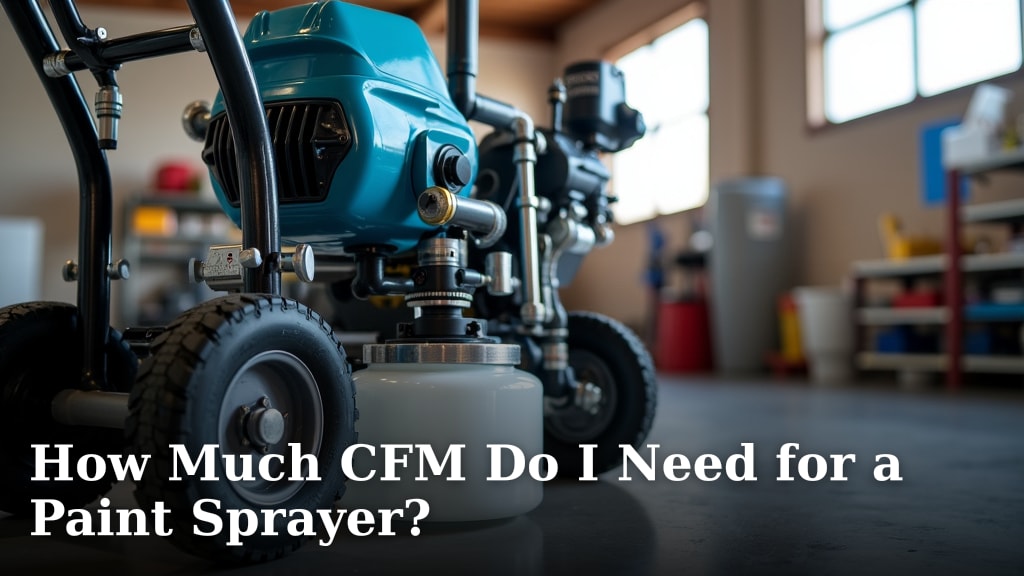
For most home improvement projects, you’ll need a paint sprayer with at least 10-15 CFM (cubic feet per minute) at 40 PSI. This range gives you enough power for common tasks. Matching your sprayer’s CFM to your air compressor’s output is critical for smooth, consistent results. Don’t worry, it’s simpler than it sounds!
Getting the right CFM for your paint sprayer ensures proper atomization. This means your paint sprays in a fine mist, not chunky splatters. We found that too little CFM leads to poor finish and frustration. Air volume is key for a professional-looking coat.
- CFM stands for Cubic Feet per Minute.
- It measures the air volume your compressor provides.
- PSI measures air pressure.
- Match your sprayer’s CFM requirement to your compressor.
- More CFM often means faster, smoother painting.
Let’s break down how to choose the perfect CFM for your next painting adventure. We’ll help you understand the numbers and what they mean for your projects.
Choosing the Right CFM for Your Paint Sprayer
So, you’re ready to tackle a painting project. You’ve got your paint, your sprayer, but what about the air compressor? The right CFM is like having enough gas in your car – you won’t get far without it. We found that understanding CFM ensures your paint comes out smoothly, not as splatters or thick globs.
Your paint sprayer needs a certain volume of air to properly break up the paint into a fine mist. This process is called atomization. If your air compressor doesn’t supply enough air (CFM) for your sprayer, your paint job will suffer. It’s like trying to blow out a candle with a weak puff of air; it just won’t work effectively.
Understanding CFM and PSI: What’s the Difference?
You’ll often hear CFM and PSI mentioned together. They both relate to air, but they measure different things. Think of it like water flowing through a garden hose.
CFM (Cubic Feet per Minute) is the volume of air your compressor can deliver. It’s how much air is actually moving. In our garden hose analogy, this would be the total amount of water coming out over a minute. More CFM means more paint can be sprayed faster and more consistently. The more paint you want to spray, the higher the CFM you’ll need.
PSI (Pounds per Square Inch) is the pressure of the air. This is how hard the air is pushing. In our garden hose example, PSI is the force of the water coming out. High PSI helps push the paint out of the nozzle. Many sprayers require a specific PSI (often around 40 PSI) to function correctly. You need enough pressure, but too much can also cause problems, like overspray.
So, you need both: enough volume (CFM) to keep spraying and enough pressure (PSI) to push the paint out effectively. We often see people confuse these, which leads to painting frustrations.
How to Find Your Paint Sprayer’s CFM Requirements
This is the most important step! Your paint sprayer’s manual or product specifications will clearly state its CFM requirements. It usually looks like “X CFM at Y PSI.” For instance, it might say “6 CFM @ 40 PSI.”
Always check your specific sprayer’s documentation. Don’t guess! We found that ignoring this can lead to buying an undersized compressor, which is a waste of money and a source of headache. If you bought a used sprayer without a manual, a quick online search for the model number usually brings up the specifications.
Why the “at X PSI” Matters
You’ll notice that CFM is always specified “at a certain PSI.” This is because an air compressor’s CFM output changes with pressure. A compressor might deliver a lot of air at low pressure, but less air when it’s pumping up to a higher pressure. Always match the CFM to the required PSI of your sprayer.
For example, if your sprayer needs 6 CFM at 40 PSI, you need a compressor that can reliably deliver at least 6 CFM when operating at 40 PSI. Don’t look at the maximum CFM a compressor can produce if that maximum is at a lower PSI than your sprayer requires. This is a common pitfall we’ve identified.
Matching Your Compressor to Your Sprayer
Once you know your sprayer’s CFM needs, you can choose an air compressor. The general rule is: your compressor’s CFM should be equal to or greater than your sprayer’s CFM requirement.
Many experts say it’s best to aim for a compressor that provides about 1.5 times the CFM your sprayer needs. For example, if your sprayer needs 6 CFM, look for a compressor that offers 9 CFM or more at the required PSI. This gives you a buffer. This extra capacity means your compressor won’t have to run constantly, extending its lifespan and providing more consistent airflow for a better finish.
Think of it like driving a car. You wouldn’t want to drive with the gas pedal floored all the time, right? A compressor with a little extra power runs more comfortably and efficiently, just like a car with a bigger engine can cruise without straining.
CFM Requirements for Different Painting Applications
The type of painting you’re doing heavily influences the CFM you need. A small touch-up job is very different from painting an entire car or a large room.
- Small Projects (e.g., furniture, crafts): For tasks like painting a chair or small cabinets, you might get by with lower CFM. Typically, 5-8 CFM at 40 PSI could be sufficient. These projects don’t require continuous spraying for long periods.
- Medium Projects (e.g., fences, doors, small rooms): For larger items or small interior walls, you’ll want something in the 8-12 CFM at 40 PSI range. This allows for more continuous spraying without the compressor constantly struggling to catch up.
- Large Projects (e.g., vehicle painting, whole house interiors/exteriors): If you’re tackling big jobs, you’ll need significantly more power. Look for compressors that deliver 12-15 CFM or higher at 40 PSI. Car painting, for instance, demands a very fine finish and consistent spray, which requires substantial airflow (National Institute for Occupational Safety and Health).
We’ve created a simple table to give you a quick reference. Remember, these are general guidelines. Always consult your specific sprayer’s manual.
| Project Type | Recommended CFM @ 40 PSI | Example Use |
|---|---|---|
| Small DIY | 5-8 CFM | Small furniture, crafts, touch-ups |
| Medium DIY/Home | 8-12 CFM | Fences, doors, small rooms, cabinets |
| Large DIY/Pro-sumer | 12-15+ CFM | Automotive, entire rooms, exterior house trim |
Choosing the right CFM is like picking the right tool for the job. You wouldn’t use a tiny hammer to build a house, right? The same logic applies to your air compressor and paint sprayer.
Other Factors Affecting Compressor Performance
While CFM is critical, a few other things can impact your painting experience. Don’t overlook these!
Tank Size
The air compressor’s tank size plays a role, especially for intermittent spraying. A larger tank stores more compressed air, meaning the compressor motor doesn’t have to cycle on and off as frequently. This is helpful for short bursts of spraying, allowing you to work longer before the compressor kicks back on. However, tank size does NOT change the CFM output. It just affects how long you can spray continuously before the motor needs to replenish the air.
If you’re doing continuous spraying, a larger tank offers little benefit over a smaller one with the same CFM rating. The CFM is the continuous output, not the stored amount.
Hose Diameter and Length
Believe it or not, your air hose can affect performance. A longer or narrower hose can cause a significant drop in air pressure and volume (CFM) by the time the air reaches your sprayer. We found that using too long or too thin of a hose starves your sprayer of the air it needs.
To prevent this, use the shortest practical hose length. Also, opt for a hose with a larger internal diameter, typically 3/8 inch for most painting applications, if your system can support it. A good rule of thumb is to check the air tool manufacturer’s recommendations for hose size.
Air Dryers and Filters
Compressed air contains moisture and oil vapor, which can ruin a paint job. An air dryer or filter removes these contaminants. While they don’t directly affect CFM output, they are vital for a high-quality finish. Keep your air clean! We often see otherwise perfect setups marred by moisture in the paint.
Some sources, like automotive painting guides, highly recommend using air filters and dryers to ensure a pristine finish, especially for car body work.
Troubleshooting Low CFM Symptoms
How do you know if you don’t have enough CFM? Your paint job will tell you! Here are some common signs:
- Poor Atomization: The paint comes out in thick droplets or a “spitting” pattern instead of a fine mist.
- Inconsistent Spray Pattern: The spray might be heavy in one area and light in another.
- Compressor Runs Constantly: Your compressor motor never shuts off or kicks on immediately after stopping spraying for a moment. It’s struggling to keep up.
- Rough Finish: The final painted surface feels bumpy or textured, not smooth.
- Excessive Overspray (sometimes): While too much pressure can cause this, too little CFM can also lead to it if you’re trying to compensate by getting too close.
If you notice these issues, first check your air compressor settings and your sprayer’s requirements. It’s often a simple matter of matching the numbers. We’ve seen many people get frustrated only to find their compressor was simply too small for the task.
Your CFM Checklist
Here’s a quick checklist to help you choose the right CFM for your paint sprayer:
- Identify your paint sprayer’s exact CFM and PSI requirements (check the manual).
- Determine the type and size of your painting project (small, medium, large).
- Choose an air compressor that meets or exceeds your sprayer’s CFM at the required PSI.
- Consider adding a 1.5x CFM buffer for better performance and compressor longevity.
- Ensure your air hose is the correct diameter and length for minimal air loss.
- Plan to use an air filter/dryer for a clean, professional paint finish.
Getting the CFM right is not just about the numbers; it’s about making your painting project enjoyable and giving you the professional-looking results you want. Don’t let an underpowered compressor hold you back!
Conclusion
Matching your paint sprayer’s CFM requirements with your air compressor is foundational for a successful project. We’ve shown you that understanding CFM and PSI, checking your sprayer’s manual, and choosing a compressor with a little extra power will prevent frustration. Always consider your project size and the type of finish you want.
By following these guidelines, you’ll achieve that smooth, professional finish you’re aiming for. Take the time to make the right choice, and your painting will become much more enjoyable and effective. Now, go confidently choose the right setup for your next project!
Frequently Asked Questions
Can I use a paint sprayer without an air compressor?
Yes, many types of paint sprayers, like HVLP (High Volume Low Pressure) turbines or airless sprayers, do not require an external air compressor. These units have built-in motors that generate the necessary air volume or pressure. Always check your specific sprayer’s design before purchasing.
Does a bigger air compressor tank mean more CFM?
No, a larger tank size does not increase the CFM output of your air compressor. CFM refers to the continuous volume of air your compressor can produce. A bigger tank simply stores more air, allowing the compressor motor to run less frequently for intermittent tasks, but it doesn’t change the sustained airflow.
What happens if my compressor’s CFM is too low for my sprayer?
If your compressor’s CFM is too low, your paint sprayer won’t atomize paint properly. You’ll likely experience sputtering, a rough or inconsistent spray pattern, and a poor finish. Your compressor will also run constantly, straining the motor and shortening its lifespan.
Is it better to have more CFM than my sprayer requires?
Yes, it’s generally better to have a compressor that provides slightly more CFM than your sprayer requires. This buffer, often around 1.5 times the sprayer’s needs, ensures continuous airflow and reduces strain on your compressor. It leads to a more consistent spray and extends the life of your equipment.
How can I quickly check my compressor’s actual CFM output?
While testing CFM accurately can be complex, a simple real-world check is to see if your compressor can keep up during continuous spraying without the pressure dropping significantly. For precise numbers, you’ll need a specialized airflow meter, but your compressor’s specifications sticker or manual is the best place to find its rated CFM at specific PSI levels.
