
What Does An Air Compressor Look Like?
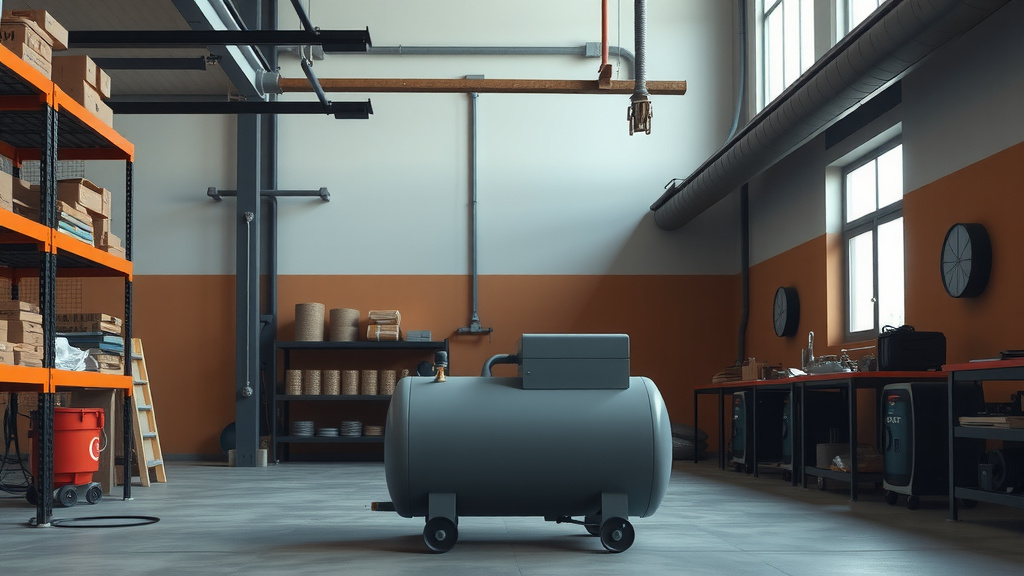
An air compressor typically looks like a sturdy machine featuring a metal tank, an electric motor or gas engine, and a pump mechanism.
These machines come in various shapes and sizes, from small, portable units resembling a hot dog or pancake to large, stationary industrial systems that look like substantial metal cylinders or enclosed cabinets.
- The appearance of an air compressor varies widely, ranging from compact, portable designs to large, stationary industrial units.
- Key visual components often include a storage tank, a pump, and a motor, though their arrangement differs by type.
- Portable models might be small enough to carry, featuring wheels or handles for easy movement.
- Larger, stationary compressors typically have a prominent vertical or horizontal tank designed for fixed installation.
- Understanding these visual cues helps you identify the right compressor for your specific needs, whether for DIY tasks or heavy-duty industrial work.
What Does An Air Compressor Look Like?
An air compressor is designed to take in ambient air, compress it, and store it under pressure. Its visual identity often depends on its size and intended use, but common features remain.
You’ll usually see a core set of components, even as the overall shape changes. Think of it like cars; they all have an engine, wheels, and a body, but a sports car looks very different from a pickup truck.
The Basic Anatomy of an Air Compressor
Imagine a robust, functional piece of equipment. An air compressor usually presents as a collection of mechanical parts working together. It’s built for durability and performance.
You’ll notice its essential components are openly visible on many models. They each play a vital role in its operation.
The Tank: The Air Reservoir
Most air compressors feature a distinct metal tank. This tank stores the compressed air. It’s often the most visually prominent part.
Tanks can be cylindrical and oriented horizontally or vertically. Research often highlights tank size as a key indicator of air capacity (Compressed Air and Gas Institute).
The Pump: The Heart of the Machine
The pump is the mechanism that compresses the air. It often sits on top of or next to the tank.
You might see cylinders, pistons, or rotary elements. It’s the hardworking core, making the air ready for use.
The Motor: Powering the Pump
Attached to the pump, you’ll find the motor. This provides the power needed to compress air.
It can be an electric motor, often enclosed for safety, or a gas engine on larger portable units. The motor is what brings the pump to life.
Control Panel and Gauges
Many compressors include a control panel with various gauges. These show air pressure and sometimes run time.
You’ll also find an on/off switch and pressure regulators here. These are your interface with the machine, allowing you to manage its output.
Different Types, Different Looks
Not all air compressors look alike; their appearance changes with their purpose. Just as you wouldn’t expect a screwdriver to look like a wrench, you shouldn’t expect all compressors to be identical.
Each design is optimized for specific tasks, influencing its overall form factor. You’ll quickly learn to spot the differences.
Portable Air Compressors: Small and Mighty
These units are designed for mobility and convenience. They are often compact and lightweight.
You’ll see models shaped like pancakes, hot dogs, or twin stacks. Many come with handles or wheels for easy transport, perfect for DIY or small job sites.
- Pancake Compressors: Resemble a round, flat pancake, very stable and compact.
- Hot Dog Compressors: Feature a single, elongated horizontal tank, like a hot dog.
- Twin-Stack Compressors: Have two smaller horizontal tanks stacked or side-by-side, offering more air capacity.
- Wheelbarrow Compressors: Larger portable units on wheels, designed to be moved around a site.
- Hand-Carry Compressors: The smallest, often box-shaped or with small tanks, meant for ultimate portability.
Stationary Air Compressors: Big and Built to Stay
For workshops and industrial settings, stationary compressors are much larger. They are built for fixed installation.
You’ll often see tall, vertical tanks or substantial horizontal tanks. These machines are designed for continuous, heavy-duty operation, making them a significant presence in any workspace.
Specialty Compressors: Unique Designs
Beyond the common piston types, you have specialty compressors. These include rotary screw or scroll compressors.
They often look like enclosed cabinets, sometimes resembling a large server unit. The internal components are generally hidden for efficiency and noise reduction, giving them a sleek, industrial look.
Why Do They Look So Different?
The variation in appearance stems directly from their function and intended application. A tiny craft compressor doesn’t need the same robust build as one powering a factory.
Many experts say that design follows demand. The demands of a construction site are very different from those of an auto repair shop (OSHA guidelines often touch on equipment suitability).
| Feature | Portable Compressor (e.g., Pancake) | Stationary Compressor (e.g., Vertical Tank) |
|---|---|---|
| Typical Size | Compact, easy to carry or roll | Large, tall, fixed placement |
| Tank Orientation | Horizontal (often single or twin) | Vertical (most common) or large horizontal |
| Power Source | Electric (120V) or small gas engine | Electric (240V or 3-phase) or large gas/diesel |
| Mobility | High, often with handles/wheels | Low, designed for permanent installation |
| Primary Use | DIY, trim work, small tools | Industrial, auto shops, heavy tools |
| Noise Level | Often louder for piston types | Can be quieter if enclosed (rotary screw) |
Key Visual Cues to Spot an Air Compressor
Even if you’re new to the world of air tools, certain features will quickly tell you what you’re looking at. Keep an eye out for these visual identifiers.
Spotting these elements helps you understand the machine’s basic function. It’s like recognizing a refrigerator by its door and cooling coils, even if the model varies.
- Pressure Tank: Is there a noticeable, often cylindrical, metal tank? This is a strong indicator.
- Air Hoses/Outlets: Do you see ports or fittings where air hoses would connect?
- Motor/Engine: Is there a visible power unit, either electric or gas-powered, attached?
- Pressure Gauges: Can you spot dials showing PSI (pounds per square inch) readings?
- Relief Valve: Is there a small, often brass, safety valve present on the tank or manifold?
Safety Features You Might See
Beyond its core components, you’ll also notice important safety features. These are built into the design to protect you and the equipment.
Many guidelines point to pressure relief valves as a vital safety component (OSHA). You’ll see them, often as a small pull ring or lever, ensuring no over-pressurization.
What an Air Compressor Isn’t (and Why It Matters)
It’s easy to confuse an air compressor with other machinery. For example, it’s not a vacuum pump, which creates suction, nor is it a power generator.
A generator produces electricity, typically with outlets for standard plugs. Research often connects understanding equipment differences with proper tool selection (CAGI). Knowing what you need prevents costly mistakes.
Conclusion
Understanding “what does an air compressor look like” really comes down to recognizing its core components and how they adapt to different needs. From the compact hot dog model perfect for your garage to the large, stationary unit powering an entire factory, the fundamental goal remains the same: to compress and store air.
By observing the tank, pump, motor, and gauges, along with specific design elements for portability or power, you can confidently identify and differentiate these essential machines. Each look serves a purpose, guiding you to select the right air compressor for your specific tasks. It’s about more than just appearance; it’s about knowing what tools are available to help you get your job done right.
How do I tell the difference between a piston and a rotary screw compressor just by looking?
Piston compressors typically have visible cylinders and connecting rods, often open or semi-enclosed, and may have a distinct thumping sound. Rotary screw compressors, on the other hand, usually come in a fully enclosed cabinet, looking more like a large, quiet appliance, with fewer moving parts visible from the outside.
Are tankless air compressors truly tankless, and what do they look like?
Tankless air compressors, sometimes called “direct drive” or “inflators,” do not have a large storage tank. They look like a small, compact box or a handheld device with a motor and pump. They provide air on demand for tasks like inflating tires or blowing dust, without the bulk of a reservoir.
Why do some air compressors have two tanks instead of one?
Compressors with two tanks, often called “twin-stack” designs, offer increased air storage capacity and provide a more stable base. This design is popular for portable units that need more sustained air delivery without increasing the footprint as much as a single, larger tank might.
Can I tell how powerful an air compressor is just by its size?
While larger air compressors generally indicate greater power and air capacity, size alone isn’t a definitive measure. You need to look at specifications like CFM (Cubic Feet per Minute) and PSI (Pounds per Square Inch), which are usually listed on a label. A smaller, well-designed unit might outperform a larger, less efficient one.
What’s the purpose of the fan I see on some compressor pumps?
The fan on a compressor pump is crucial for cooling. Compressing air generates heat, and excessive heat can damage the pump and motor. The fan helps dissipate this heat, ensuring the compressor operates efficiently and prolongs its lifespan. It’s a key component for continuous operation.
