9 Best Quiet Air Compressors for Home Garages (October 2026)
The best quiet garage air compressors include the California Air Tools 2010A 1.0 HP Ultra for quiet small-shop work, the Makita MAC210Q Quiet Series for protected portable use, and the Metabo HPT Quiet Air Compressor for nailer work in tight spaces.
On this page (4 sections)
The California Air Tools 2010A is the best quiet garage air compressor for most short jobs, with a 60 dB stated noise level and 2.20 CFM at 90 PSI. Choose the VEVOR for more airflow and a 13-gallon tank, or the California Air Tools 10020C for larger capacity with a stated 70 dB rating.
Quiet depends on more than the number on a spec label. Match airflow to your tools, consider how often the pump will cycle, and think about where the compressor will sit in relation to people and neighboring rooms.
For a broader overview of quiet models, see our Best Quiet Air Compressor guide. This roundup focuses on garage use, from trim work and inflation to larger air tools.
Our picks at a glance
-
1
 Best for quiet small-shop work
California Air Tools 2010A 1.0 HP Ultra
9.7/10 our score
See it on Amazon -
2
-
3
 Best for nailer work in tight spaces
Metabo HPT Quiet Air Compressor
9.6/10 our score
See it on Amazon
- 4
 Check it
VEVOR 13-Gallon Air Compressor
Best for quieter higher-airflow work - 5
 Check it
Klutch 29-Gallon Air Compressor
Best for longer tool sessions - 6
 Check it
DEWALT Air Compressor for Trim
Best for two trim nailers - 7
 Check it
CRAFTSMAN 6 Gallon 150 PSI Oil-Free Pancake
Best for general garage projects - 8
 Check it
Limodot Quiet Oil-Free Air Compressor
Best for a ready-to-use hose kit - 9
 Check it
California Air Tools 10020C 2.0 HP Ultra
Best for larger quiet shop capacity
How we chose a quiet air compressor for a garage
The best quiet garage air compressor balances stated noise, useful airflow and a tank size that fits your jobs. We compared those published figures alongside portability, couplers and stated uses.
Noise figures are useful for screening, but they do not guarantee the same sound in every garage. The ratings may come from different measurement conditions, and room shape, distance and surfaces affect what you hear.
A compact compressor can be easier to place near a workbench, while a larger tank can support longer tool sessions. For fixed installations, compare stationary air compressors.
Read the tool’s CFM and PSI needs before choosing a compressor based on noise alone.
Our score weighs specs, features and buyer feedback against what you're shopping for. The picks are ordered by score, with a close score broken by how well each model fits a quiet home garage.
| Product | Best for | Tank capacity | Airflow | Noise | Our score |
|---|---|---|---|---|---|
| California Air Tools 2010A 1.0 HP Ultra | quiet small-shop work | 2 gallons | 2.20 CFM at 90 PSI | 60 dB | 9.7 |
| Makita MAC210Q Quiet Series | protected portable use | 2 gallons | 1.6 CFM | 60 dB | 9.7 |
| Metabo HPT Quiet Air Compressor | nailer work in tight spaces | 1 gallon | 59 dB | 9.6 | |
| VEVOR 13-Gallon Air Compressor | quieter higher-airflow work | 13 gallons | 4.6 SCFM at 90 PSI | 66 dB | 9.6 |
| Klutch 29-Gallon Air Compressor | longer tool sessions | 29 gallons | 5.1 SCFM at 90 PSI | 81 dB | 9.5 |
| DEWALT Air Compressor for Trim | two trim nailers | 2.5 gallons | 3.0 SCFM at 90 PSI | 71.5 dBA | 9.5 |
| CRAFTSMAN 6 Gallon 150 PSI Oil-Free Pancake | general garage projects | 6 gallons | 2.6 SCFM at 90 PSI | 82 dB | 9.5 |
| Limodot Quiet Oil-Free Air Compressor | a ready-to-use hose kit | 5 gallons | 2.8 CFM at 90 PSI | 68 dB in title; 70 dB in specs | 9.4 |
| California Air Tools 10020C 2.0 HP Ultra | larger quiet shop capacity | 10 gallons | 5.30 CFM at 90 PSI | 70 dB | 8.8 |
Quiet garage compressors for different jobs
The California Air Tools 2010A leads for small jobs because it combines a 60 dB figure with useful airflow at 90 PSI. Larger or more versatile garage tasks may call for a bigger tank, higher airflow or extra couplers.
For a large fixed garage setup, compare quiet 80 gallon compressors.
California Air Tools 2010A: Best for quiet small-shop work
California Air Tools 2010A 1.0 HP Ultra: Best for quiet small-shop work
- 60 dB noise level
- 2-gallon aluminum tank
- 2.20 CFM at 90 PSI
- Oil-free dual-piston pump
A quiet, portable option for indoor jobs and smaller air tools. Its 2-gallon tank and stated 2.20 CFM at 90 PSI suit intermittent work more than sustained high-demand use.
Pros
- 60 dB stated noise level
- 35 lb weight
- Oil-free pump
Cons
- Small 2-gallon tank
- Less airflow than the larger picks
The California Air Tools 2010A pairs a 60 dB noise level with a 2-gallon aluminum tank. It provides 2.20 CFM at 90 PSI, a useful combination for shorter sessions with compatible tools.
Its oil-free dual-piston pump avoids routine oil changes, and the compressor weighs 35 lb. The maker gives a 120 PSI maximum in its product bullets, while a separate specification field lists 125 PSI, so check the exact unit details before relying on a pressure limit.
The small tank keeps the unit portable but limits stored air compared with larger garage compressors. Choose it for jobs with pauses between tool use, such as trim work, inflation or short bursts of air.
The 2010A is a strong fit when lower noise matters more than sustained airflow. For a wider comparison of quiet models across different uses, see Best Quiet Air Compressor.
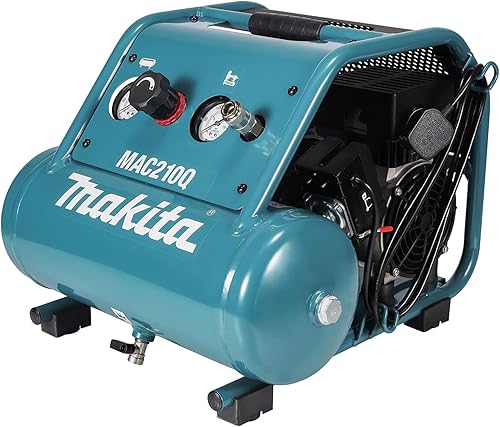
Makita MAC210Q: Best for protected portable use
Makita MAC210Q Quiet Series: Best for protected portable use
- 60 dB noise level
- 2-gallon tank
- Oil-free dual-piston pump
- Roll-cage construction
The MAC210Q pairs quiet operation with a protective roll cage for moving and storage. Its 2-gallon tank and stated airflow point to trim and other intermittent tasks.
Pros
- 60 dB stated noise level
- Roll cage protects pump and motor
- Oil-free pump
Cons
- 2-gallon tank
- Lower stated airflow than the 2010A
The Makita MAC210Q also states a 60 dB noise level, with a 2-gallon tank and oil-free dual-piston pump. Its roll-cage construction helps protect the pump and motor when you transport or store it.
Makita gives a 1.6 CFM airflow figure, so this is best suited to intermittent tasks rather than tools with a high continuous air demand. Its stated 135 PSI maximum provides headroom for tools that use higher pressure, but always follow each tool’s requirements.
At 44 lb, it is heavier than the 2010A and still designed for portability. The lower-RPM motor and oil-free pump reduce routine maintenance needs.
Pick it if a protective frame and easy storage matter alongside quiet operation. If your priority is the smallest footprint, compare it with our best quiet compact air compressor picks.
Metabo HPT Quiet Air Compressor: Best for nailer work in tight spaces
Metabo HPT Quiet Air Compressor: Best for nailer work in tight spaces
- 59 dB noise level
- 1-gallon tank
- Universal quick coupler
- 25.2 lb weight
A compact compressor with a universal quick coupler for switching among nailers. The small tank and light weight suit quick jobs where easy carrying matters.
Pros
- Lowest stated noise level here
- Lightweight at 25.2 lb
- Universal quick coupler
Cons
- Small 1-gallon tank
- Airflow is not stated in the available product details
The Metabo HPT Quiet Air Compressor has the lowest stated noise figure in this group at 59 dB. Its 1-gallon tank and 25.2 lb weight make it a compact choice for moving between a bench and a work area.
A universal quick coupler supports fast changes among framing, siding, finish and roofing nailers. The integrated control panel lets you adjust PSI, and an overload protection circuit cuts power if an overload occurs.
The product details do not provide an airflow figure, so compare the compressor with the nailer’s air demand before buying. Its small tank makes it more suitable for shorter jobs than sustained high-volume use.
Choose it when carrying ease, a low noise rating and quick nailer changes matter most. For a garage compressor with more tank capacity, look at the best large quiet air compressor options.
VEVOR 13-Gallon Air Compressor: Best for quieter higher-airflow work
VEVOR 13-Gallon Air Compressor: Best for quieter higher-airflow work
- 66 dB noise level
- 13-gallon tank
- 4.6 SCFM at 90 PSI
- 2 HP motor
The 13-gallon tank and stated airflow suit a home garage with painting, auto repair or woodworking tasks. Wheels help move its 71 lb frame between work areas.
Pros
- Larger tank than the compact picks
- 4.6 SCFM at 90 PSI
- Wheels for moving
Cons
- 71 lb weight
- Louder than the 59 to 60 dB compact models
The VEVOR 13-gallon compressor offers 4.6 SCFM at 90 PSI and a stated 66 dB noise level. That larger tank and airflow figure make it a more practical match for garage tasks such as auto repair, woodworking and spray painting.
Its oil-free design and 2 HP motor are paired with a maximum pressure of 125 PSI. The maker says air builds in under 3 minutes, but actual fill time can vary with conditions and the starting pressure.
Two 7-inch rubber wheels help move the 71 lb compressor around the garage. See more portable air compressors on wheels.
Plan its parking spot before purchase, since the 13-gallon size takes considerably more room than 1- or 2-gallon portable models.
This is the best middle ground here for buyers who want more working capacity without moving to the loudest large-tank option. Check that the tools you plan to use fit its airflow and pressure range.
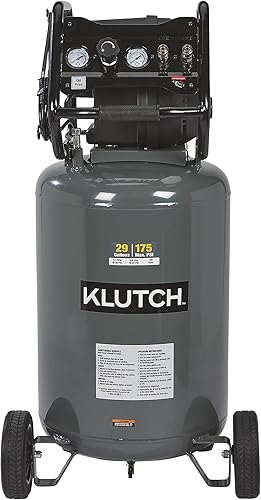
Klutch 29-Gallon Air Compressor: Best for longer tool sessions
Klutch 29-Gallon Air Compressor: Best for longer tool sessions
- 29-gallon tank
- 5.1 SCFM at 90 PSI
- 175 PSI maximum pressure
- Oil-free pump
A large tank and 5.1 SCFM at 90 PSI fit longer air-tool sessions than the compact picks. Its stated 81 dB noise level makes placement and household noise tolerance especially important.
Pros
- Largest tank in this group
- 5.1 SCFM at 90 PSI
- Wheels for mobility
Cons
- 81 dB stated noise level
- 127 lb weight
The Klutch 29-gallon model is the largest tank in this group and supplies 5.1 SCFM at 90 PSI. Compare it with portable air compressors for air tools if you are matching output to pneumatic tools.
It is aimed at intermediate to continuous air tool use, with stated applications including nailing, stapling, painting and blow guns.
The tradeoff for that capacity is noise: its stated level is 81 dB. At 127 lb, it also needs a planned location, though large flat-free tires make it easier to roll around a workspace.
The pump is oil-free, and a brass quick-connect coupler helps with hose changes. The listed maximum pressure is 175 PSI in the product title, while a spec field uses an unclear unit label, so verify the unit’s pressure information before setup.
Choose Klutch when longer tool sessions and airflow matter more than a low noise number. If the compressor will run near shared living space, a smaller quiet model may be a better fit.
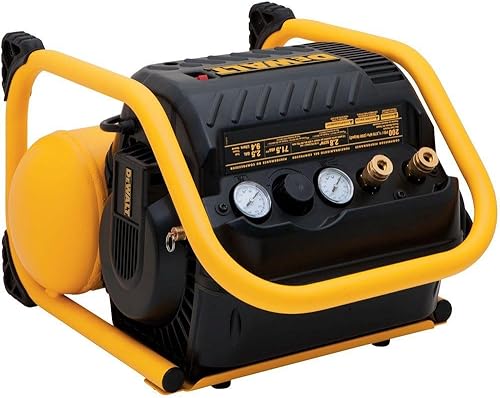
DEWALT Air Compressor for Trim: Best for two trim nailers
DEWALT Air Compressor for Trim: Best for two trim nailers
- 71.5 dBA noise level
- 2.5-gallon tank
- 3.0 SCFM at 90 PSI
- Dual quick couplers
Two quick couplers support two nailers, while 3.0 SCFM at 90 PSI provides more stated airflow than the small quiet models. Its 71.5 dBA rating is higher than the 59 to 60 dB picks.
Pros
- Dual quick couplers
- 3.0 SCFM at 90 PSI
- Can be stored vertically or horizontally
Cons
- 71.5 dBA stated noise level
- 2.5-gallon tank
The DEWALT Air Compressor for Trim gives 3.0 SCFM at 90 PSI from a 2.5-gallon tank, with dual quick couplers for two nailers. Its stated 71.5 dBA level is higher than the compact 59 to 60 dB options, though the airflow and dual connections add flexibility for trim work.
The 200 PSI maximum and oil-free pump make it a capable portable option for compatible pneumatic tools. It weighs 36 lb and can be stored or operated vertically or horizontally, which helps when garage floor space is limited.
A low 12 amp draw is designed for easier startup and fewer breaker trips. As with any compressor, match its output and the tool’s pressure needs before connecting equipment.
This model suits a garage where trim nailers are the main task and the extra coupler is useful. It is not the first choice if the lowest stated noise level is your main goal.
CRAFTSMAN 6 Gallon 150 PSI Oil-Free Pancake: Best for general garage projects
CRAFTSMAN 6 Gallon 150 PSI Oil-Free Pancake: Best for general garage projects
- 6-gallon tank
- 2.6 SCFM at 90 PSI
- 150 PSI maximum pressure
- Dual quick couplers
A 6-gallon tank and dual couplers support a range of home projects, from tire inflation to woodworking and nailing. Its stated 82 dB noise level is the highest in this group.
Pros
- 6-gallon tank
- Dual quick couplers
- 30.8 lb weight
Cons
- 82 dB stated noise level
- Less airflow than the larger high-output picks
The CRAFTSMAN pancake compressor gives you a 6-gallon tank, 2.6 SCFM at 90 PSI and dual quick couplers. Those features cover a broad mix of home projects, including tire inflation, woodworking, roofing, framing and automotive maintenance.
Its maximum pressure is 150 PSI, and the 30.8 lb body has a carry handle for moving around a garage. The oil-free pump and low-voltage start motor reduce routine upkeep and ease startup.
The compromise is noise: the stated level is 82 dB, the highest among these picks. Consider where you will run it and whether you can place it away from shared walls or occupied rooms.
Choose it for general-purpose capacity and tool connections when quiet operation is one factor among several. If noise is the deciding factor, compare its rating with the first three compact picks.
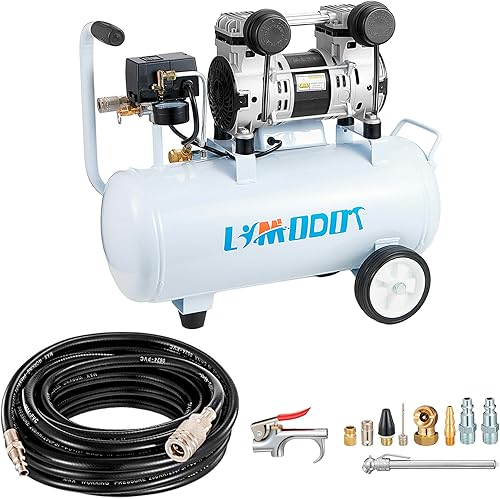
Limodot Quiet Oil-Free Air Compressor: Best for a ready-to-use hose kit
Limodot Quiet Oil-Free Air Compressor: Best for a ready-to-use hose kit
- 5-gallon tank
- 2.8 CFM at 90 PSI
- 25 ft PVC air hose
- 13-piece accessory kit
The 5-gallon tank comes with a 25 ft hose and a 13-piece accessory kit for common garage tasks. Noise figures differ between 68 dB in the title and 70 dB in the specifications, so confirm the exact model details.
Pros
- 5-gallon tank
- 25 ft hose and accessory kit
- 2.8 CFM at 90 PSI
Cons
- Noise figures conflict
- 120 PSI maximum pressure
The Limodot includes a 25 ft PVC hose and a 13-piece accessory kit with its 5-gallon tank. It supplies 2.8 CFM at 90 PSI and is described for tasks such as nailing, airbrushing, inflation and spray-gun use.
Its noise details conflict: the product title states 68 dB, while the specification field lists 70 dB. Treat it as a quieter mid-size option, but confirm the noise figure for the exact model before choosing it based on sound alone.
The compressor has wheels and a 1.2 HP induction motor, with a stated 120 PSI maximum. The hose and fittings can save a separate setup step, though you should check that the included accessories fit your tools.
Pick Limodot when the included hose kit and 5-gallon tank are useful for your garage. For high airflow or a larger tank, compare it with the VEVOR and California Air Tools 10020C.
California Air Tools 10020C: Best for larger quiet shop capacity
California Air Tools 10020C 2.0 HP Ultra: Best for larger quiet shop capacity
- 70 dB noise level
- 10-gallon steel tank
- 5.30 CFM at 90 PSI
- Wheels
A 10-gallon tank and 5.30 CFM at 90 PSI provide substantial capacity for a garage or shop. Its 82.5 lb weight and wheels make it movable, though it takes more floor space than compact models.
Pros
- 5.30 CFM at 90 PSI
- 10-gallon tank with wheels
- 70 dB stated noise level
Cons
- 82.5 lb weight
- Larger footprint than portable 1 to 2-gallon picks
The California Air Tools 10020C combines a 10-gallon steel tank with 5.30 CFM at 90 PSI and a stated noise level of 70 dB. It offers much more airflow than the 2-gallon quiet compressors while keeping its noise figure below the larger Klutch and CRAFTSMAN models.
Its 2 HP motor runs at a stated 1680 RPM, and its oil-free dual-piston pump is described for use across varied temperatures and terrains. The tank has wheels, but at 82.5 lb it is not as easy to lift or carry as the compact picks.
California Air Tools describes the model for garage, shop and jobsite use. A 125 PSI maximum pressure gives a clear limit for matching tools, while its tank and airflow make it a better fit for tasks that need more sustained supply.
Choose it when your garage work benefits from higher airflow and a larger reservoir, with noise still a concern. It is a practical middle ground between compact quiet compressors and the higher-capacity but louder Klutch.
How do you choose a quiet air compressor for a home garage?
Choose a quiet air compressor for your garage by matching its airflow to your tools, then comparing noise rating, tank size and mobility. A model that is quiet but undersized can cycle often and interrupt work.
What noise level suits a quiet garage air compressor?
Lower stated dB figures offer a useful starting point, but ratings may use different test conditions. The compact Metabo HPT lists 59 dB, while the California Air Tools 2010A and Makita MAC210Q each list 60 dB.
Larger choices range from the California Air Tools 10020C at 70 dB to the Klutch at 81 dB and CRAFTSMAN at 82 dB. Keep distance, wall placement and the room’s sound surfaces in mind when deciding where to run a compressor.
How much airflow does a garage air compressor need?
Check the tool’s air demand at its required pressure, then choose a compressor that can meet it. Airflow figures in this roundup range from 1.6 CFM for the Makita to 5.30 CFM at 90 PSI for the California Air Tools 10020C.
For a tool used in short bursts, a small tank may be enough even when its airflow is modest. A tool that runs continuously needs enough compressor output to keep up, so use the tool maker’s requirements as your guide.
Should you choose a larger tank for garage work?
A larger tank stores more air before the pump needs to refill it, which can help during bursts of higher-demand work. It does not replace the need for enough airflow, since the pump must recover the stored air between uses.
The 1- and 2-gallon models are easier to carry and place. The 10-, 13- and 29-gallon choices take more space and weigh more, but they offer more stored capacity for longer sessions.
For a fuller explanation of matching tank and output to your space, read What Is the Best Air Compressor Size for a Home Garage?. Our Best Air Compressor For Home Garage guide also covers broader garage needs beyond low noise.
Which garage tasks fit each compressor size?
Small quiet compressors suit inflation, trim work and other tasks with breaks between uses, provided their airflow meets the tool requirement. A compact unit also makes sense when you need to carry it or store it on a shelf.
A 5- to 13-gallon compressor can suit a wider range of garage work, including painting or auto repair when its airflow matches the equipment. The 29-gallon Klutch provides the highest tank capacity here, but its 81 dB noise figure deserves careful placement planning.
Which quiet garage air compressor should you choose?
Choose the California Air Tools 2010A for a compact garage compressor with a 60 dB rating and 2.20 CFM at 90 PSI. Pick the VEVOR if you need more airflow and a larger tank, or the California Air Tools 10020C for 5.30 CFM at 90 PSI with a 70 dB rating.
For nailer work, the Metabo HPT keeps the noise figure low and makes tool changes simple with its universal quick coupler. If you need longer sessions, match the larger compressors to your tools and accept the extra noise, weight and floor space they bring.
Our top 3 picks at a glance
-
1
Best for quiet small-shop work
California Air Tools 2010A 1.0 HP Ultra
9.7/10 our score
See it on Amazon -
2
-
3
Best for nailer work in tight spaces
Metabo HPT Quiet Air Compressor
9.6/10 our score
See it on Amazon
Frequently asked questions
What is a quiet garage air compressor?
A quiet garage air compressor is one with a lower stated noise level that still supplies enough airflow for your tools. The compact picks here range from 59 to 60 dB, while larger tanks add capacity but can be louder.
Compare noise and airflow together, since a quiet model may not keep up with a demanding tool.
Is 60 dB quiet for an air compressor?
A 60 dB rating is among the lower figures in this roundup, and both the California Air Tools 2010A and Makita MAC210Q state that level. Noise ratings may be measured under different conditions, so treat them as a guide rather than a direct lab comparison.
The compressor's location and nearby walls can also affect how loud it seems in your garage.
How much airflow does a home garage compressor need?
Match airflow at the pressure your tool needs, using the tool's stated CFM requirement as your baseline. This roundup ranges from the compact Metabo HPT, with no airflow figure stated here, to the California Air Tools 10020C at 5.30 CFM at 90 PSI.
Allow for a margin if you plan to run a tool continuously.
Should I choose a larger tank or a quieter compressor?
Choose a larger tank when your tools draw air for longer stretches, and choose a quieter compact model for shorter tasks near people or shared spaces. Tank size stores more compressed air, while the pump still needs enough airflow to keep up over time.
Check both the tool's demand and the compressor's noise rating.
Can a quiet compressor run spray equipment?
Some can, but the compressor must meet the spray tool's airflow and pressure needs. The VEVOR 13-gallon model is described for spray painting and gives 4.6 SCFM at 90 PSI, while smaller tanks may need frequent recovery.
Check the spray equipment's requirements before you choose.