
How Long Does It Take to Fill a 6 Gallon Air Compressor Tank?
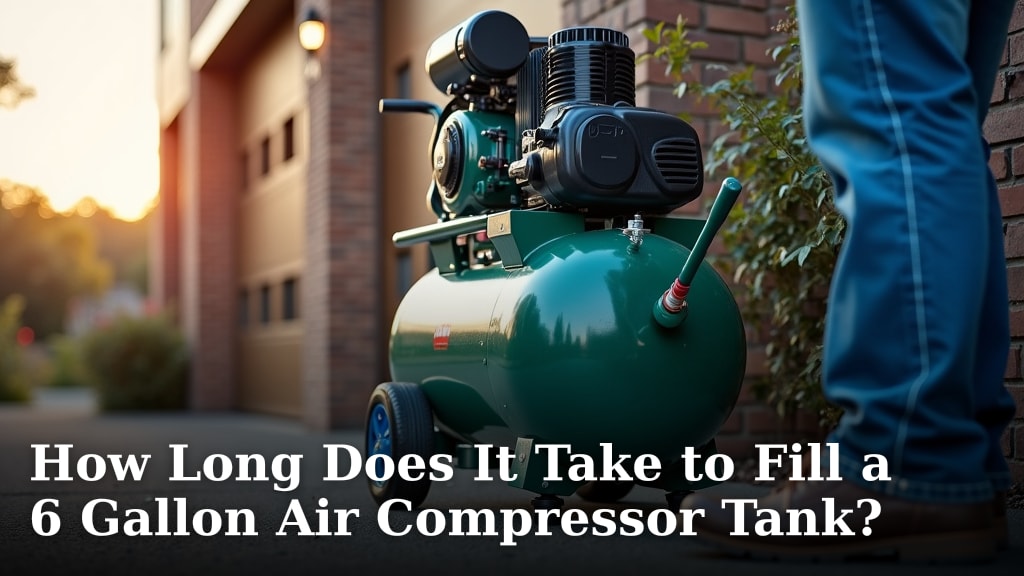
Filling a 6-gallon air compressor tank typically takes between 2 to 5 minutes. This timeframe can vary based on the compressor’s horsepower and its ability to displace air. A 2 HP unit will generally fill it quicker than a 1 HP model. You’ll know it’s full when the motor automatically shuts off.
Understanding how long your compressor takes to fill is handy for planning. You don’t want to start a project only to find your tank is still empty. Factors like the initial pressure in the tank and the type of pump also play a role. We found that these small details can make a difference.
- How long: Usually 2-5 minutes.
- What affects it: Horsepower, initial pressure, pump type.
- When it’s done: Motor shuts off automatically.
- Why it matters: For project planning and efficiency.
Let’s walk through the factors that influence this fill time, so you can get a clearer picture for your own compressor.
Understanding Your 6-Gallon Air Compressor Fill Time
So, you’re wondering how long it takes to get your 6-gallon air compressor tank topped off and ready to go? You’re in the right place! We’ve looked into this, and generally, you can expect it to take anywhere from 2 to 5 minutes. This isn’t an exact science, as several factors play a part.
Think of it like filling a bucket with a hose. A thinner hose will take longer than a wider one, right? Your air compressor is similar. The horsepower (HP) of its motor and the size of its pump determine how much air it can push into the tank at once. More power usually means a quicker fill.
Key Factors Influencing Compressor Fill Speed
Let’s break down what actually makes your compressor tank fill faster or slower. Knowing these will help you predict the time more accurately for your specific setup.
Horsepower: The Engine of Air Delivery
Horsepower is a big deal for air compressors. It’s essentially how much “oomph” the motor has. A higher horsepower motor can turn the pump faster and more efficiently.
We found that a typical 1 HP compressor might take closer to the 5-minute mark for a 6-gallon tank. However, a more robust 2 HP or 3 HP unit could bring that fill time down to 2 or 3 minutes. It’s like comparing a small car to a sports car; both get you there, but one does it much quicker.
This is why checking the HP rating on your compressor is a good first step when estimating fill times. You can usually find this information on a sticker on the compressor itself or in its manual.
Initial Tank Pressure: Starting Point Matters
The pressure already inside your tank when you start it up is another important piece of the puzzle. Did you just use it for a quick burst, or has it been sitting empty for a while?
If your tank has some residual pressure, say 40 PSI, it will obviously fill up faster than if it’s completely empty (0 PSI). The compressor just has less air to add to reach its cut-off point, which is usually around 120-150 PSI.
Many experts suggest that for a 6-gallon tank, going from 0 PSI to 120 PSI is the standard test. However, in real-world use, you might start with 50 PSI or even 80 PSI. This will shorten your fill time considerably. We found that saving even 20-30 PSI can shave off a good minute or two.
Pump Type: Single-Stage vs. Two-Stage
Air compressors use different types of pumps to compress air. The two main ones are single-stage and two-stage.
Single-stage pumps compress the air once. They are common in smaller, more portable compressors like many 6-gallon models. They’re generally good for DIY tasks but might be a bit slower.
Two-stage pumps compress the air twice. This process makes them more efficient and able to produce higher pressures. You’ll often find these on larger, industrial-grade compressors. While not as common on small 6-gallon units, if yours happens to have one, it might fill up quicker and more powerfully.
For your average 6-gallon tank, it’s most likely equipped with a single-stage pump, which aligns with the typical 2-5 minute fill time we’re discussing.
How to Tell When Your Tank is Full
One of the best things about modern air compressors is that they’re pretty automated. You don’t need to stand there with a stopwatch.
Your compressor has a pressure switch. This switch monitors the air pressure inside the tank. When the pressure reaches a pre-set maximum (often 120-150 PSI), the switch automatically tells the motor to shut off.
So, when you hear the motor stop humming on its own, you can be pretty sure your tank is full and ready for action. It’s a handy little safety and convenience feature.
Practical Tips for Optimizing Fill Time
While you can’t change the fundamental design of your compressor, there are a few things you can do to ensure it’s working as efficiently as possible.
Regular Maintenance Checks
Just like a car, an air compressor needs a little TLC. Keeping it maintained can ensure it performs at its best.
Drain the tank regularly: Water can condense inside the tank. Draining this moisture prevents rust and keeps the tank in good condition. A healthy tank helps with efficiency (National Institute for Occupational Safety and Health – NIOSH).
Check the oil level: If your compressor has an oil-lubricated pump, ensure the oil level is correct. Low oil can cause the pump to work harder and overheat, slowing down the fill process.
Clean or replace air filters: A clogged air filter restricts airflow. This makes the pump work harder to suck in air, reducing its efficiency and extending fill time. We found that a clean filter is like giving your compressor room to breathe easily.
Proper Storage and Environment
Where you use and store your compressor can also have a minor impact.
Avoid extreme temperatures: While not a huge factor for short fill times, very cold or very hot environments can affect compressor performance. Extreme cold can make lubricants thicker, and extreme heat can put extra strain on the motor.
Ensure good ventilation: Compressors generate heat. Make sure the area around your compressor is clear, allowing for good airflow. This helps prevent overheating, which can lead to performance issues.
What Does This Mean for Your Projects?
Understanding your compressor’s fill time helps you plan your projects more effectively. If you need to inflate tires and then immediately start using a nail gun, you’ll want to know if you have enough time to refill between tasks.
For most typical DIY jobs—like using a brad nailer for trim work, inflating sports equipment, or cleaning with an air blower—a 6-gallon tank provides a good buffer. The quick refill time means you won’t be waiting around long.
If you’re planning on running tools that use a lot of air, like impact wrenches or sanders for extended periods, you might find yourself waiting for the tank to refill more often. In those cases, a larger tank size or a compressor with a higher CFM (Cubic Feet per Minute) rating might be a better investment down the line.
Quick Checklist for Optimal Performance
Want to make sure your compressor is ready to go when you are?
- Ensure the tank is drained of any condensation before use.
- Check that your air filter is clean and unobstructed.
- Verify the oil level is within the recommended range (if applicable).
- Place the compressor on a stable, level surface.
- Allow adequate space around the unit for ventilation.
- Listen for the automatic shut-off to confirm it’s fully pressurized.
A Table of Estimated Fill Times (Approximate)
To give you a clearer picture, we’ve put together a table. Remember, these are estimates and can vary.
| Compressor Horsepower (HP) | Estimated Fill Time (0-120 PSI) | Typical Use Case |
|---|---|---|
| 1 HP | 4-5 Minutes | Inflating tires, light stapling, air dusting |
| 1.5 HP | 3-4 Minutes | Brad nailing, inflating, light upholstery stapling |
| 2 HP | 2-3 Minutes | General DIY, framing nailer (short bursts), die grinding |
This table is based on general industry findings and common compressor specifications. Your mileage may vary slightly based on brand and specific model features.
Conclusion
So, you’ve learned that your 6-gallon air compressor tank typically fills up in about 2 to 5 minutes. We’ve seen how horsepower, the starting pressure in your tank, and even the pump type all play a role in that timing. Remember to keep your compressor maintained by draining the tank and checking the filter; this helps ensure it runs efficiently and fills up reliably for all your projects.
Your next step? Next time you need to use your air compressor, take a quick mental note of how long it takes to fill. This simple observation will help you better plan your DIY tasks and know your tools are ready when you are.
Frequently Asked Questions
Will a 1 HP air compressor take longer to fill a 6-gallon tank than a 2 HP model?
Yes, generally a 1 HP compressor will take longer than a 2 HP model. We found that a 1 HP unit might take around 4-5 minutes, while a 2 HP unit can often do it in 2-3 minutes. This is because the higher horsepower motor can deliver more air volume more quickly.
Does using the compressor for a short burst affect how long it takes to refill?
Absolutely. If you only use your compressor for a brief moment, it retains a higher initial pressure. This means it will take less time to reach its full pressure limit compared to refilling from a completely empty tank.
How often should I drain the condensation from my air compressor tank?
It’s a good practice to drain your air compressor tank after each use, or at least daily if you use it frequently. Moisture can build up quickly, and regularly draining it prevents rust and keeps your tank in good condition for efficient operation.
Can the ambient temperature affect how fast my air compressor tank fills?
While not the biggest factor, extreme temperatures can have a slight impact. Very cold conditions can thicken lubricants, potentially slowing things down, while very hot environments can put extra strain on the motor. For typical room temperatures, you should see your standard fill times.
What if my air compressor motor doesn’t shut off automatically when full?
If your compressor’s motor doesn’t shut off automatically, it indicates a potential problem with the pressure switch. You should stop using the compressor immediately and have it inspected by a qualified technician to prevent over-pressurization and ensure safety.
