
How to Test Air Compressor CFM Output?

Testing your air compressor’s CFM output is a straightforward process. You can easily check your air compressor’s CFM using a flow meter or by observing how well it powers your tools. This helps ensure you have enough air for your projects.
Understanding your compressor’s CFM, or cubic feet per minute, is key for selecting the right tools. It tells you the volume of air it can deliver. Knowing this prevents frustration when your tools aren’t performing as expected. It’s like knowing how much water your hose can put out – essential!
- CFM measures air volume.
- Test with a flow meter or tool performance.
- Ensures tools get enough air.
- Prevents project delays.
- Proper testing saves frustration.
Let’s walk through how to accurately test your air compressor’s CFM output step by step.
Verifying Your Air Compressor’s Airflow: A Practical Guide
You’ve got your air compressor, and you’re ready to tackle that project. But how do you know if it’s truly delivering the air you need? It’s not enough to just know the manufacturer’s CFM rating. You need to test it. This guide will show you how to confirm your air compressor’s CFM output.
Understanding CFM: More Than Just a Number
CFM stands for cubic feet per minute. It tells you how much air your compressor can supply. Think of it like the gallons per minute rating on a water faucet. A higher CFM means more air volume. This is vital for running tools that need a lot of air. Tools like grinders, sanders, and impact wrenches demand a higher CFM. If your compressor can’t keep up, your tools won’t perform well. You might experience sputtering or a complete lack of power. Ensuring you have adequate CFM output prevents these frustrating slowdowns.
Why CFM Testing Matters for Your Projects
You might be wondering why you even need to test this. Well, manufacturer ratings can sometimes be a bit optimistic. Or, your compressor might have aged and its performance has decreased. Testing confirms the actual airflow. This knowledge helps you avoid buying tools that your compressor can’t handle. It also helps you troubleshoot when a tool isn’t working as expected. Is it the tool, or is it the air supply? Testing your compressor’s CFM provides a clear answer. It’s about making sure your tools get the air they need to do their job effectively.
Methods for Testing Air Compressor CFM Output
There are a couple of common ways to check your compressor’s CFM. You can use specialized equipment for precision. Or, you can get a good estimate by observing tool performance. Both methods have their place. We’ll cover the most practical and widely used techniques.
Using a Digital Air Flow Meter (The Precise Method)
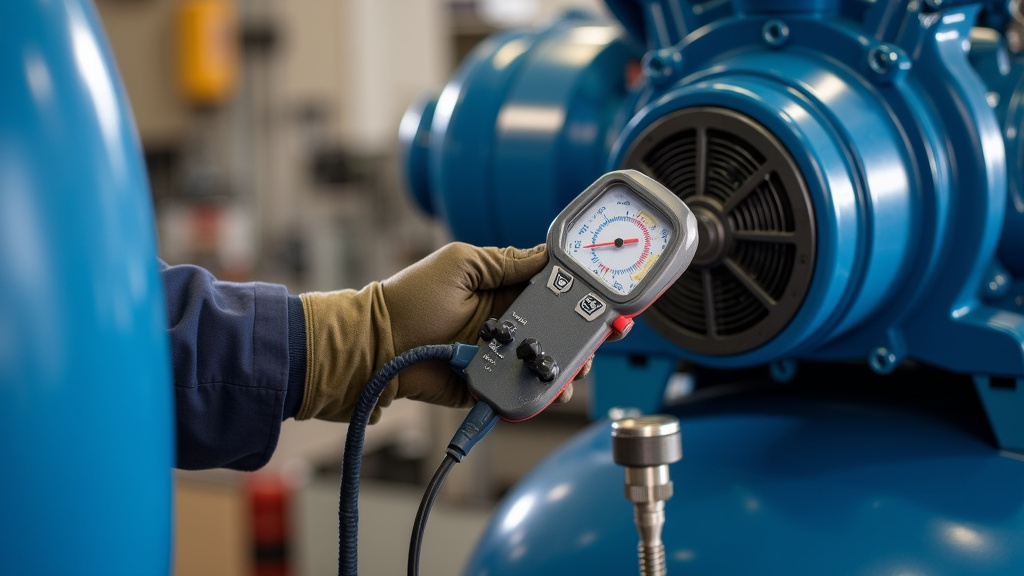
For the most accurate measurement, a digital air flow meter is your best friend. These devices connect directly to your compressor’s outlet. They measure the volume of air passing through them in real-time. This is the gold standard for CFM testing.
What You’ll Need for This Test
You’ll need a few things to get started. First, of course, is your air compressor. You’ll also need a digital air flow meter. Make sure the meter’s fitting matches your compressor’s outlet. You might need an adapter. Finally, have your compressor’s manual handy. It will tell you the expected CFM rating under specific conditions. This helps you compare your test results.
Step-by-Step Flow Meter Test
Here’s how to conduct the test:
- Ensure your compressor is in good working order. Check the oil levels and air filters.
- Connect the digital air flow meter securely to your compressor’s air outlet. Make sure there are no leaks at the connection point.
- Turn on your air compressor and let it build pressure. Allow it to run until it reaches its maximum pressure and the motor shuts off.
- Once the tank is fully pressurized, observe the reading on the digital air flow meter. Note the CFM output.
- You’ll want to check the CFM at different pressure levels. Many meters allow you to monitor this as the tank slowly empties.
- Compare your readings to the manufacturer’s specifications. This tells you if your compressor is performing as expected.
Estimating CFM Through Tool Performance (The Practical Method)
If you don’t have a flow meter, you can still get a reasonable idea of your compressor’s capabilities. This involves using a tool that has a known CFM requirement and seeing how well your compressor supports it. It’s less precise but very useful for understanding if your compressor can handle your typical tasks.
Choosing the Right Test Tool
Select a tool that demands a significant amount of air. A good choice is an impact wrench or an air sander. These tools use air quickly. Check the tool’s manual or packaging for its CFM requirement. You want a tool that requires a CFM rating close to, or slightly above, your compressor’s stated output. This puts your compressor to the test.
Performing the Tool Performance Test
Here’s the process:
- First, ensure your compressor tank is fully pressurized. Let it run and shut off.
- Connect the chosen air tool to your compressor using a suitable hose.
- Turn on the tool. For an impact wrench, engage it briefly. For a sander, turn it on and apply light pressure.
- Observe the tool’s performance. Does it run continuously and powerfully? Or does it bog down quickly?
- Listen to your compressor. Does the motor kick on frequently to maintain pressure? Is it struggling to keep up?
- If the tool runs strongly and the compressor cycles normally, it’s likely meeting its CFM demands. If the tool falters, or the compressor runs constantly without reaching full pressure, you might have a CFM deficit.
Factors Affecting Your Air Compressor’s CFM Output
Several things can influence the actual CFM your compressor delivers. It’s not always just about the motor size. These factors can contribute to a lower-than-expected output.
Horsepower and Tank Size: What They Really Mean
While horsepower and tank size are often advertised, they don’t directly equal CFM. Horsepower is a measure of the motor’s power. Tank size determines how much compressed air you can store. A larger tank means you can run tools for longer before the compressor needs to cycle. However, neither directly dictates the CFM. You need to look at the specific CFM rating for your compressor model. We found that many users confuse these specs. It’s important to remember that CFM is about the rate of air delivery, not storage or raw motor power alone.
Compressor Maintenance: The Unsung Hero of Performance
Regular maintenance is absolutely critical for optimal performance. An air compressor that isn’t well-maintained will likely produce less CFM than it’s capable of. This is a common reason for reduced output. We found that neglecting simple tasks can have a big impact.
Key Maintenance Tasks
What should you be checking?
- Air Filter: A clogged air filter restricts airflow into the compressor. This makes the motor work harder and reduces the air it can compress. Clean or replace it regularly. Many sources, like industrial maintenance guides, stress the importance of a clean air intake.
- Oil Levels: For oil-lubricated compressors, correct oil levels are essential. Low oil can lead to overheating and decreased efficiency.
- Drain Valve: Water in the tank can reduce the effective storage volume and potentially cause corrosion. Drain the tank regularly.
- Belts and Connections: Ensure drive belts are properly tensioned and that all hoses and fittings are secure and free of leaks. Small leaks can add up and significantly reduce your available airflow.
Operating Conditions: Environment Matters
The environment where you operate your compressor can also play a role. Temperature and altitude can affect performance. In hotter conditions, the air is less dense. This means the compressor might work harder to achieve the same CFM. Similarly, at higher altitudes, the air pressure is lower. This can also impact the compressor’s efficiency. While you can’t always control these conditions, it’s good to be aware of them. We found that temperature can affect compressor performance by up to 10% in extreme cases.
Interpreting Your CFM Test Results
So, you’ve run your test. Now what? Understanding the numbers is key to knowing if your compressor is up to the task.
Comparing Test Results to Tool Requirements
The most important comparison is between your compressor’s tested CFM and the CFM requirements of the tools you plan to use. A general rule of thumb is that your compressor should supply at least 1.5 times the CFM your most demanding tool requires. This buffer ensures consistent performance and prevents the compressor from being overworked. For instance, if your favorite impact wrench needs 5 CFM, aim for a compressor that reliably delivers at least 7.5 CFM.
When to Consider an Upgrade or Repair
If your tests show a consistently lower CFM output than expected, it’s time to take action. If your compressor is old and showing signs of wear, a repair might not be cost-effective. In such cases, investing in a new compressor with a higher CFM rating might be the best solution. If the compressor is newer but underperforming, a thorough inspection for leaks or a worn component might be in order. Sometimes, a simple fix like replacing a valve or a faulty regulator can restore lost CFM. We found that compressors that are 10 years or older often show a noticeable decline in output.
Checklist: Ensuring Accurate CFM Testing
Before you start your CFM test, run through this quick checklist:
- Is your compressor clean and well-maintained?
- Is the air filter clear of debris?
- Are all hose connections and fittings tight and leak-free?
- Is the tank fully pressurized before starting your test?
- Do you have the correct adapter for your flow meter, if using one?
- Have you noted the CFM requirement for the tool you’re testing with?
Conclusion
Testing your air compressor’s CFM output is essential for ensuring your tools perform optimally and your projects run smoothly. You’ve learned that whether you use a precise digital flow meter or gauge performance with a demanding tool, understanding your compressor’s real-world airflow is key. Don’t forget that regular maintenance and operating conditions can significantly impact your CFM. If your tests reveal a deficit, it’s time to consider repairs or investing in a compressor that better matches your needs.
Your next step is to gather your equipment, perform the test, and use the results to make informed decisions about your tools and compressor.
Frequently Asked Questions
What’s the difference between horsepower and CFM for an air compressor?
Horsepower measures the motor’s power, while CFM measures the volume of air delivered per minute. Horsepower doesn’t directly translate to CFM, as tank size and compressor design also play a role in airflow. You need to check the specific CFM rating for your model.
How can I tell if my air compressor has a CFM leak?
A CFM leak can often be detected by listening for hissing sounds from fittings or hoses, or by observing that your compressor runs much more often than it should to maintain pressure. You might also notice your tools performing poorly even when the tank is full.
Is it normal for my air compressor’s CFM to be lower than the manufacturer’s rating?
Manufacturer ratings are often based on ideal conditions. Your compressor’s actual CFM can be lower due to age, wear and tear, or if it’s not properly maintained. Operating conditions like heat can also affect output. It’s good practice to test and compare to know your compressor’s real performance.
Can I use a regular tire inflator to test CFM?
No, a tire inflator typically uses very little CFM and won’t accurately stress your compressor enough to test its output. You need a tool with a higher, known CFM requirement, like an impact wrench or air sander, to get a meaningful estimate of your compressor’s capabilities.
How often should I test my air compressor’s CFM?
It’s a good idea to test your compressor’s CFM at least once a year, especially if you notice a decline in tool performance. You should also test it after performing major maintenance or if you’re experiencing issues with air-powered tools not performing as expected.
