How to Choose a Palm Nailer for Roofing Nails
A palm nailer for roofing nails only works if the nose clears the nail head and the nail length matches the material. Check head clearance, depth control and nail gauge before you buy, because many small palm nailers fit finish nails, not large roofing nails.
On this page (11 sections)
- How does nail head clearance decide if a palm nailer fits roofing nails?
- What nail length and gauge should you use for roofing repairs?
- Which palm nailer type fits tight roofing spots best?
- How deep should a palm nailer set roofing nails?
- What about nail compatibility when a palm nailer lists several sizes?
- How do weight and balance matter on a roof?
- Is a palm nailer better than a full-size roofing nailer for repairs?
- What trigger and safety features should you check?
- How do you set up air, power and depth on the first day?
- How do you care for a palm nailer after roofing work?
- What should you buy if you need a palm nailer for roofing nails today?
A palm nailer for roofing nails starts with fit, not power. The tool must clear the nail head, set the nail to the right depth and reach spots where a full-size nailer cannot go.
That last point matters on roofs. Ridge repair, flashing and a few lifted shingles often leave only inches of working room.
A palm nailer fits there because its body sits in your hand, not ahead of a long nose.
Fit is also where many buyers go wrong. Roofing nails have large heads.
Some palm nailers use small noses for finish nails and cannot take that head diameter. Check this first, before you compare brands, weights or trigger types.
We compared the specs below to show the gap. One tool is a true coil roofing nailer.
The other two are finish nailers for different nail sizes. They help you see why nail type decides the tool.
How does nail head clearance decide if a palm nailer fits roofing nails?
Nail head clearance decides fit because the nose must sit flat on the shingle. If the head cannot clear the nose, the tool cannot drive straight.
A crooked start can split material, bend the nail or leave the head proud.
Measure the head diameter of the nails you plan to use. Then check the maker's stated nail range for the palm nailer.
If the maker gives no head range, ask before you order, especially for roofing nails.
Also check the nose shape. A wide, thin nose can slide under a lifted shingle edge.
A short, blunt nose may bridge over the head and stop the drive. That bridge is the sign to stop and choose another tool.
Think about where you will work. Palm nailers help in corners, near ridge caps and under tight flashing.
Those spots also limit how you can angle the tool. A tool that fits on a flat bench may not fit on a steep slope.
Our nail gun guide covers the main nailer types. Read it if you are still deciding between a palm nailer, a roofing nailer and a finish nailer for the job.
Rule: buy only if the stated nail head range matches your roofing nails.
What nail length and gauge should you use for roofing repairs?
Nail length must match the material stack. Use the length the shingle maker calls for, not the longest nail the tool accepts.
Too short can fail to hold. Too long can poke through the deck or split the shingle.
For many roofing repairs, the nail must pass through the shingle and grip the deck below. Underlayment, felt or insulation can change the stack.
Add those layers to your length check, then confirm the depth setting before you fire.
Gauge matters as much as length. Roofing nails are usually thicker than brad or pin nails.
A finish nailer built for thin pins will not drive a thick roofing nail, no matter how you set the depth.
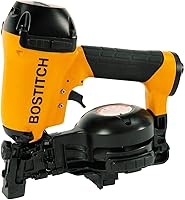
The three tools below show the range. The BOSTITCH coil roofing nailer takes 3/4 in to 1-3/4 in roofing nails.
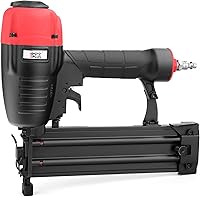
The DEWALT takes 18 gauge brads from 5/8 in to 2-1/8 in. For air-powered trim tools, compare pneumatic 18 gauge brad nailers.
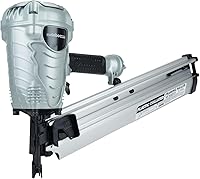
The Metabo HPT takes 23 gauge headless pins from 5/8 in to 1-3/8 in.
Only the first one is built for roofing nails.
That length range suits many shingle repairs, but it does not replace the shingle maker's nail call. Check your shingle guide first, then check the tool range.
Rule: match length and gauge to the shingle maker first, then match the tool.
Which palm nailer type fits tight roofing spots best?
Palm nailers come in pneumatic and cordless forms, and the choice changes your setup. Pneumatic models need a compressor and hose, while cordless models need a battery.
Neither type fixes a wrong nail size.
Pneumatic palm nailers are small and light because the motor that moves air sits elsewhere. That helps on a roof, where every pound counts.
The trade-off is the hose. A hose can snag on ridge lines, vents and bundles of shingles as you move.
Cordless finish nailers cut the hose, but they still have a nose and magazine built for finish nails. The DEWALT DCN680B is battery powered and frees you from a compressor and hose.
It drives 18 gauge brads for molding and trim, not large roofing nails.
The Metabo HPT NP35A is pneumatic and only 2.0 lb. Compare more Metabo HPT nail guns if you are considering that brand.
It drives 23 gauge headless pins for cabinets, paneling and small moldings.
Its light weight shows why palm-style tools feel easy to hold, but its pin size shows why light does not mean right for roofing.
For air supply on larger roofing jobs, see the Best Air Compressor For Roofing Shingles. That guide helps you size a compressor for a full-size roofing nailer, not just a palm nailer.
Rule: pick pneumatic or cordless for your setup, but pick nail fit for your job.
How deep should a palm nailer set roofing nails?
Depth control keeps the nail head flush without crushing the shingle. Set depth on a test piece first, then check each shingle as you go.
A nail set too shallow can lift in wind. A nail set too deep can cut the shingle mat.
Look for tool-free depth adjustment if you will change materials often. It lets you adjust between shingle layers, felt and repair boards without a separate tool.
That speed matters when you move from ridge to field shingles.
The BOSTITCH RN46 has a quick-set adjustable depth guide. It also has a full round driver for more consistent drive quality.
The DEWALT has tool-free depth adjustment for precise countersinking. Precise countersinking suits trim and molding.
On shingles, you want flush seating, not a countersunk hole that can weaken the mat.
The Metabo HPT has depth adjustment for flush drives into a variety of surfaces. On roofing, flush still means the head sits even with the shingle face, not below it.
Start with a test drive on a scrap shingle over a matching deck. Look at the back side too.
If the point shows through, shorten the nail or reduce depth before you work on the roof.
Rule: test depth on scrap material before you drive the first roofing nail.
What about nail compatibility when a palm nailer lists several sizes?
A listed size range is not a promise that every size in the range suits your job. Check the exact gauge, length and head style for your material.
A range can span finish nails that have nothing in common with roofing nails.
This is where buyer patterns help. Many buyers mention they checked the magazine capacity and collation style before they ordered nails.
Collation means how the nails are held together. The wrong collation will not feed, even if the length looks right.
The BOSTITCH RN46 uses a patented single-action side load canister for fast, one-step nail loading. Fast loading helps on large roofs.
On a palm nailer, loading speed matters less than whether the nose clears the head.
The Metabo HPT has a large fastener capacity for fewer reloads. Fewer reloads help in trim work.
They do not help if the pins are headless and far too small for roofing.
Our best palm nailer nails guide breaks down nail types for palm nailers. Use it to match nail style to tool style before you buy a bulk box.
Rule: confirm gauge, length, head style and collation all at once.
How do weight and balance matter on a roof?
Weight matters because you will hold the tool at awkward angles. A palm nailer should feel balanced in one hand, with the nose clear of your fingers.
On a steep slope, a tool that feels fine on the ground can feel heavy fast.
The Metabo HPT weighs 2.0 lb, which makes it easy to hold all day for trim work. It does not make the tool strong enough for roofing nails.
The BOSTITCH RN46 weighs 5.8 lb. That weight reflects a coil magazine and a full roofing build.
On a roof, a heavier tool can tire your wrist, but it also drives roofing nails with the force the job needs.
The DEWALT DCN680B weighs 1.8 kg. Its weight includes the battery build for cordless use.
Balance also affects accuracy. Palm nailers work best when you can press the nose flat with light pressure.
If you must push hard to keep the nose seated, the nail can shift before the drive starts.
Palm nailers for joist hangers face a similar balance test. Our best palm nailer for joist hangers guide shows how fit changes when the fastener head is small and the metal is thin.
Rule: hold the tool at roof angles before you commit to a weight.
Is a palm nailer better than a full-size roofing nailer for repairs?
A palm nailer is better only in tight spots. For open roofing areas, a full-size roofing nailer drives faster and takes the right nails.
For ridge caps and small patches, a palm nailer can reach where a large tool cannot.
The BOSTITCH RN46 shows what a full-size tool offers. It has a lightweight aluminum housing for job site durability.
It also has aggressive wear guards and skid pads to protect the tool on abrasive surfaces.
Its zero nail lockout feature eliminates dry firing and tells you when to reload. That lockout helps you avoid marks on shingles from empty drives.
It also helps you plan reloads before you climb down.
Its nosepiece has carbide inserts for long-life performance. Carbide inserts help the nose last under repeated drives.
On a palm nailer, a worn nose can change head clearance and throw off your depth.
The RN46 also has an adjustable shingle guide for quick shingle spacing. Spacing helps you keep rows even on open sections.
A palm nailer for spot repairs will not give you that guide, so you must mark your spacing by hand.
Rule: use a palm nailer for tight repairs and a roofing nailer for open sections.
What trigger and safety features should you check?
Trigger type changes how the tool fires. Sequential firing needs a full press for each nail, while contact firing can fire as you bounce the tool.
Sequential firing gives you more control near edges and flashing.
For small repairs, sequential control helps you place each nail with care. Contact firing can suit open areas where speed matters, but it can also fire when you do not mean it to.
The DEWALT has a tool-free selectable trigger for sequential or contact actuation modes. That choice lets you switch by task.
It also has a low nail lockout to prevent dry firing and unwanted marks.
The Metabo HPT has a dual trigger for safe and accurate placement. A dual trigger adds a safety step before the drive.
That design suits fine trim work where a stray pin can mark the surface.
The BOSTITCH RN46 description notes two firing methods: contact trip and sequential trip. Contact trip suits large areas, such as roofs, with a bouncing motion.
Sequential trip suits work where you need one nail at a time.
Safety also includes eye protection and a clear work zone. Roof work adds fall risks, so keep your footing secure before you focus on the trigger.
Never point a nailer at your hand, even when the magazine is empty.
Rule: choose sequential control for tight roofing repairs.
How do you set up air, power and depth on the first day?
Setup starts with the right air or battery for the tool you chose. Test air pressure and depth on scrap material before you climb to the roof.
A small change in pressure can change how deep the nail sets.
For pneumatic tools, check the hose for leaks and kinks. A kink can starve the tool of air and cause weak drives.
A leak can waste pressure and make depth uneven from nail to nail.
For cordless tools, check the battery charge and the nail lockout. The DEWALT has a low nail lockout to prevent dry firing.
That lockout helps you avoid marks, but it does not mean the tool fits roofing nails.
Depth setup needs the same care on every tool. The BOSTITCH depth guide sets nails to the depth you want.
The DEWALT and Metabo HPT also offer depth adjustment. Use scrap shingle and deck material that match your repair.
Also check the nose for wear before you start. The BOSTITCH nosepiece uses carbide inserts for long-life performance.
On any tool, a worn or bent nose can change head clearance and cause crooked drives.
If you plan to use a compressor for the first time, read How Do I Choose the Right Air Compressor for My Shop?. That guide helps you match compressor size to your tools.
Rule: set pressure, depth and nose fit on scrap material first.
How do you care for a palm nailer after roofing work?
Care starts with cleaning grit and dust from the nose and magazine. Wipe the nose and check the magazine after each roofing session.
Shingle grit can wear the nose and change head clearance over time.
The BOSTITCH has wear guards and skid pads for abrasive surfaces. Those guards help, but they do not replace cleaning.
Grit in the magazine can cause jams and weak drives on the next job.
The Metabo HPT has a rear exhaust that directs oil and debris away from the work surface. Rear exhaust helps keep trim clean.
On roofing, clean exhaust also keeps dust from coating the shingle face near the drive point.
Store the tool dry and with the magazine clear of loose nails. Moisture can harm metal parts and the driver.
A dry case or a shop shelf with good air flow helps more than a damp truck bed.
Our best joist hanger nailer guide is useful if your repairs include metal connectors near the roof. It shows how a different fastener head changes tool choice, just as roofing nails do.
Rule: clean the nose and magazine after roofing grit touches the tool.
What should you buy if you need a palm nailer for roofing nails today?
Buy based on nail fit, then on reach and control. If the tool cannot take your roofing nail head, it cannot do the job.
No depth setting or trigger type can fix that mismatch.
For open roofing sections, the BOSTITCH coil roofing nailer is the clear fit among the three tools here. It takes 3/4 in to 1-3/4 in roofing nails, has depth control and a shingle guide.
It suits roofing, exterior drywall, insulation board and fiber cement, according to BOSTITCH.
For trim and finish work, the DEWALT and Metabo HPT have their own clear roles. The DEWALT suits 18 gauge brads for molding and casing.
The Metabo HPT suits 23 gauge headless pins for cabinets, paneling and small moldings. Neither one is a substitute for a roofing nail tool.
If your repair is small and tight, look for a palm nailer whose maker states support for roofing nail heads. Then check length, gauge, collation and depth control.
Test the nose fit on a scrap shingle before you buy nails in bulk.
Our pneumatic palm nailer reviews can help you compare palm-style tools by size and nail type. Use that guide to narrow the field after you confirm head clearance.
Final rule: pick the tool by the nail it drives, not by the shape of the handle.
Frequently asked questions
Can a palm nailer drive roofing nails?
Only some can. A palm nailer for roofing nails must accept the nail gauge, length and head diameter your shingles need.
Many palm nailers are made for smaller finish or joist hanger nails, so check the nose and magazine before you assume it fits roofing nails.
What matters most for nail head clearance?
Clearance means the nose can sit flat while the nail head stays clear of the driver and magazine. If the head hits the nose, the nail can sit crooked or fail to drive.
Measure the head diameter and compare it with the maker's stated range.
Do I need a compressor for a palm nailer?
A pneumatic palm nailer needs compressed air, while a cordless finish nailer uses a battery. Your choice depends on whether you already own a compressor and how far you work from it.
Check air use and hose length before you buy.
When should I use a coil roofing nailer instead?
Use a coil roofing nailer for full roofing sections where nail size, depth control and speed matter. A palm nailer suits small, tight repairs where a full-size tool cannot fit.
The BOSTITCH RN46 drives 3/4 in to 1-3/4 in coil roofing nails.